8 minute read · Original practice exercise included
Before you start: Distinguish an uncertain event from an issue that has already happened.
Watch this lesson
Risk, opportunity and issues
Watch on YouTubeOpen the planning and control playlist
YouTube connects when you play a video or follow its links. Playback depends on the video’s availability on YouTube. Its own privacy and storage practices then apply. Voices are AI-generated.
Tools and references for this lesson
Use these resources to practise and extend the topic. Further applications may go beyond the lesson transcript; source pointers lead to the original author or publisher.
Calculators (7)
- Descriptive statistics
Describe a numeric sample before choosing more advanced analysis. · Calculator + guide
- Expected payoff and decision branches
Evaluate one set of mutually exclusive outcomes before comparing decisions. · Calculator + guide
- Weighted option scoring
Make option ratings and criterion weights visible and comparable. · Calculator + guide
- Correlation and simple regression
Describe a linear relationship between paired observations. · Calculator + guide
- Independent risk exposure
Sum expected losses and estimate variation under independent event assumptions. · Calculator + guide
- Survey sample size for a proportion
Plan the number of completed responses for a simple random sample. · Calculator + guide
- Triangular cost simulation
Explore a sum of uncertain cost components with reproducible simulated percentiles. · Calculator + guide
Conceptual models (1)
- Responses to threats and opportunities
Choose an action, an owner and a fallback for an uncertain event. · Guide
Formulas (3)
- Break-even probability
Find the residual probability at which a response breaks even in expected monetary terms. · Guide
- Expected monetary value
Combine an estimated probability and impact while keeping the full downside visible. · Guide
- Net value of a risk response
Compare a paid risk response with accepting the original financial exposure. · Guide
Step-by-step methods (1)
- Compare the cost of a risk response
Make the no-action option explicit, then compare complete expected costs. Keep financial efficiency separate from whether the worst case is tolerable. · Calculator + guide
Further applications (11)
- Conditional probability and independence
Distinguish the chance of an event from its chance after learning that another event occurred. · Guide
- Probability-impact screening
Use explicitly defined probability and consequence categories to prioritise discussion of uncertain events. · Guide
- Sensitivity analysis
Find which uncertain inputs can change a decision or forecast most. · Guide
- Weighted averages and percentage changes
Combine measurements using weights that match the question and keep ratio denominators explicit. · Guide
- Decision trees
Separate choices from uncertain outcomes so conditional costs and payoffs can be compared. · Guide
- Feedback and systems thinking
Examine how feedback, delays and system boundaries shape a problem over time. · Guide
- Normal models and confidence intervals
Quantify sampling uncertainty when a distributional model and sampling design justify it. · Guide
- Project complexity assessment
Examine interactions, uncertainty and constraints that make delivery hard to predict. · Guide
- Analytic hierarchy process
Use structured pairwise judgements to explore the relative priority of alternatives and criteria. · Guide
- Portfolio selection under constraints
Select a feasible combination of initiatives rather than simply ranking projects independently. · Guide
- Risk-adjusted cost and schedule forecasts
Connect uncertainty in activity durations, dependencies and costs rather than applying an unexplained contingency percentage. · Guide
Original framework and research sources (2)
- Cynefin®
Explore how the nature of a situation affects the way decisions are made. · Source pointer
- NIST AI Risk Management Framework
Find an authoritative reference when a project develops or adopts AI. · Source pointer
Check your understanding
An event has a 25% chance of costing 40,000. A response costs 5,000 and reduces the chance to 10%. What is the net expected benefit?
Show answer and reasoning
0.25 × 40,000 − 0.10 × 40,000 − 5,000 = 1,000. That is an expected benefit, not a guarantee. Check response effectiveness and the remaining downside.
Apply the same reasoning to your own example. State one assumption you would need to check.
Chapters
Jump to the corresponding passage in the transcript.
Study materials
Open the original practice sheet · print or save as PDF
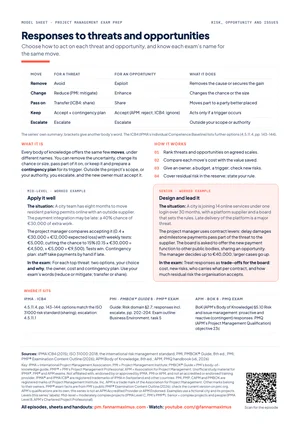
Key terms
The series’ own explanations. Official sources and edition pointers are below.
- Threat and opportunity
- Uncertain events that would harm or help the objectives. PMI® and APM call both ‘risk’; the ICB4 says ‘risk and opportunity’.
- Issue
- For APM, a problem that breaks, or will break, the limits delegated to the project, so the sponsor decides. Others use it for any risk that has happened.
- Reduce or mitigate
- Lowering the chance or the impact of a threat. APM and the ICB4 say reduce; PMI® says mitigate.
- Contingency plan
- A response prepared now and started only by a trigger. PMI®: contingent response strategy; APM: contingent (reactive) response. The ICB4 also lists fallback plans.
- Expected monetary value (EMV)
- Probability times impact in money, added up over the risks. It is an average, not a forecast of one outcome.
- Contingency and management reserve
- Contingency covers identified risks (APM: risk budget). Management reserve covers risks nobody has found (APM adds some very unlikely, very severe ones), held above the project manager.
Try the calculation
A city is moving parking permits online. A gateway-certification delay has a 25% probability and would cost €40,000 in manual payment work. An early certification slot costs €5,000 and is estimated to reduce the probability to 10%. Does the response improve expected cost?
Show the worked answer
After: 0.10 × €40,000 = €4,000
Net benefit: €6,000 − €5,000 = €1,000
The response improves expected cost under these assumptions. You still need an owner, a contingency and enough capacity to handle the remaining exposure.
Break-even probability
0.25 − €5,000 ÷ €40,000 = 12.5%. The response must bring the chance below this threshold to strictly improve expected cost.
A reserve is a separate decision
Expected losses of €4,500, €12,000 and €7,500 sum to €24,000. Subtracting an €8,000 expected opportunity gives €16,000. These are different budgeting assumptions, not a guarantee that either amount will cover the realised cost. Keep uncertain gains distinct from money available to spend.
Where the bodies place it
These are reading pointers, not a claim that the qualifications are equivalent.
IPMA® — Individual competence baseline
ICB4 §4.5.11 addresses identifying, assessing and responding to uncertainty. EMV is included among the supporting techniques.
Read the official sourcePMI® — Guide and exam outline
The eighth-edition guide includes a risk performance domain. The July 2026 exam outline places risk and issue work in Business Environment, tasks 4 and 5.
Read the official sourceAPM — Qualification handbook
The qualification handbook covers risk and issue work in objective 23, including response choices and contingency planning. This is a topic pointer, not an exam weighting.
Read the official sourceGuide context: the official eighth-edition guide overview. Checked 27 September 2026.
About the lesson’s level labels
Levels (this series' labels): Mid-level = moderately complex projects (IPMA Level C, PMI's PMP®); Senior = complex projects and people (IPMA Level B, APM's Chartered Project Professional).
These are the series’ teaching labels, not a declaration that the certifications are equivalent.
Read the transcript
Timed from the episode captions. The published correction is included beside the affected passage.
Open episode transcript
Sara: Welcome to Project Management Exam Prep.
This episode is about risk, opportunity and issues.
Every project management exam tests it.
Leo: You will learn how the three bodies frame it, which responses you can choose,
how to put a number on a risk, and what to do when a risk has already happened.
We finish with a drill, so keep a pen ready.
Sara: Let us start with the three lenses. What does IPMA® say?
Leo: IPMA®, the International Project Management Association, sets out its standard in
the Individual Competence Baseline, the ICB4.
Its element on risk and opportunity asks you to identify, assess,
respond to and control both sides of uncertainty.
Issues sit in its element on plan and control.
Sara: And PMI®?
Leo: PMI®, the Project Management Institute, publishes the PMBOK® Guide,
its guide to the project management body of knowledge.
The eighth edition has a risk performance domain.
The outline of PMI®'s Project Management Professional exam, the PMP®,
tests how you plan and manage risk and how you manage issues.
It asks you to recognize when a risk becomes an issue.
Sara: And APM?
Leo: APM, the Association for Project Management, publishes the APM Body of Knowledge.
It has a section called risk and issue management.
The syllabus of APM's Project Management Qualification, the PMQ,
has an objective with the same name, and asks you to know proactive and reactive
responses.
Sara: Where do the words differ?
Leo: In four places. First, the word risk. PMI® and APM use it for both directions.
The ICB4 says risk and opportunity, and uses risk for the downside.
In this series, threat means the downside, and risk means both.
Sara: Second?
Leo: Lowering a threat. APM and the ICB4 say reduce.
PMI® says mitigate.
Sara: Third?
Leo: Passing part of a threat to someone else.
PMI® and APM say transfer. The ICB4, whose list matches the international risk standard
ISO 31000, says sharing.
Sara: And fourth?
Leo: The word issue. For APM, an issue is a problem that breaks, or will break,
the limits delegated to the project, so the sponsor must decide.
The project manager solves smaller problems.
Others use issue for any risk that has happened.
Sara: What is the core, whichever exam you take?
Leo: Three ideas. One: a risk is an uncertain event that would change your objectives
if it happened. It can hurt, or it can help.
So you look for threats and opportunities at the same time.
Sara: Two?
Leo: Risk work is a cycle, not a one-time list.
You agree how you will manage risk. You identify risks with the team and the stakeholders,
and write them in the risk register, the list of risks with their owners.
You analyse them, first on simple scales, and the big ones with numbers.
You choose responses and carry them out.
You monitor them, escalate what is beyond your authority, and close risks that can
no longer happen.
Sara: Does that change in agile work?
Leo: The steps stay, but the rhythm changes.
In a linear project, you identify risks at the start and at each gate.
In iterative work, you revisit them every iteration.
Risky items move up the backlog, and the team raises new risks in its reviews.
Sara: And three?
Leo: An issue is not uncertain any more. It has happened, or it is happening now.
So you log it, judge its impact, decide who acts, and escalate it if it breaks your
limits. Then you look for the root cause, so that it does not come back.
Sara: Now the responses. The one-page model sheet, free in the description,
has the full table.
Leo: For a threat, you can avoid it, which removes the cause.
You can reduce it, which lowers the chance or the damage.
You can transfer it, for example by contract or insurance.
Or you can accept it and watch it.
Sara: And for an opportunity?
Leo: The mirror images. Exploit it, to make it certain.
Enhance it, to make it more likely or larger.
Share it with a partner who can capture it.
Or take no action. PMI® calls that accept, APM reject, and the ICB4 ignore.
They are close cousins: PMI®'s accept still takes the gain if it comes.
Sara: Is there one more option?
Leo: Escalate. You escalate when the risk is outside the project's scope,
or when the response is beyond your authority.
The new owner must accept it.
Sara: And if a risk happens anyway?
Leo: Then you use a contingency plan, prepared now and started by a trigger.
APM calls it a reactive response. The responses you take now are proactive.
Sara: And the money?
Leo: Expected monetary value. Multiply the probability by the impact.
A fifty percent chance of fifteen thousand euros of overtime has an expected value
of seven thousand five hundred. Add up the expected values of your threats,
and you have a first estimate of the contingency reserve for known risks.
Sara: And for the risks nobody has found?
Leo: A management reserve, held above the project manager.
Some teams subtract expected opportunities from the reserve.
APM advises keeping opportunities you have not captured out of the budget.
Whichever rule you use, say which one, and why.
Sara: How does this change between Mid-level and Senior?
Leo: First, the two levels. They are this series' own labels.
Mid-level means leading moderately complex projects, the level of IPMA® Level C and
PMI®'s PMP® exam. Senior means leading complex projects and people,
the level of IPMA® Level B and of APM's chartered status, Chartered Project Professional.
At Mid-level, you run the process well.
Take Parking Permits Online, a city project that moves resident parking permits
online in eight months. The project manager, Anna, keeps the register with the team,
picks responses, and holds a small reserve under a rule agreed with the steering
group.
Sara: And at Senior level?
Leo: You design the process for others. Take One City Account, a thirty-month city project
that brings fourteen online services under one login, led by Anna some years later.
There, Anna agrees with the board how much risk the city will accept,
and who decides at which amount. She holds a contingency of one point two million
euros. The city manager holds a management reserve of eight hundred thousand.
Sara: So the Senior answer is about the system, not only the list.
Sara: Now the drill. A city is moving resident parking permits online,
and most residents renew in January. There is a twenty-five percent chance that
the payment gateway certification slips.
If it does, staff must take payments by hand in January, which costs forty thousand
euros. An early certification slot costs five thousand euros and cuts the chance
to ten percent. Should the project manager book it, and what else?
Leo: Pause and write your answer. You have forty-five seconds.
Sara: First, the numbers.
Leo: Before the response, the expected loss is ten thousand euros:
twenty-five percent of forty thousand. After it, the loss is four thousand,
plus the slot's five thousand, which makes nine thousand.
So the slot saves one thousand.
Sara: Only just.
Leo: Yes. A shortcut helps. The slot costs five thousand, which is twelve and a half
percent of the forty thousand at stake.
So it pays off only if it cuts the chance by more than twelve and a half points.
It cuts the chance from twenty-five to ten, which is fifteen points,
so it passes. Then prepare a contingency plan: staff trained to take payments by
hand, so renewals never stop. Name an owner and a trigger date,
and cover the residual risk, what is left, in the reserve.
Sara: What lifts that to Senior?
Leo: The numbers are close, so a Senior answer asks what the city can tolerate.
A failure in January means queues and bad press, so you would book the slot even
at equal numbers, and say why. You also check for new risks, and feed the lesson
into the city's risk rules.
Sara: How do the exams ask this?
Leo: IPMA®'s written exam asks for open answers; at Level B it may be oral.
IPMA®'s certification also includes an interview, where assessors ask about your
own projects, so note one threat from your work.
The PMP® exam uses scenarios. PMI®'s outline adds questions built on a case study
or a chart: practise the calculation. APM's PMQ asks for short written answers,
for example: proactive responses act now; reactive ones are prepared now and used
only if the risk occurs.
Sara: Let us recap.
Leo: One. Risk covers threats and opportunities.
An issue has already happened, or breaks your limits.
Sara: Two. Risk work is a cycle: plan, identify, analyse, respond, monitor,
escalate and close. In iterative work, it runs every iteration.
Leo: Three. For a threat, avoid, reduce, transfer or accept.
For an opportunity, exploit, enhance, share or take no action.
Escalate what is outside your scope or authority.
Sara: Four. Expected value is probability times impact.
It sizes the contingency reserve. The management reserve covers what nobody has
found.
Leo: And five. The names differ between IPMA®, PMI® and APM, but the moves are the same.
Learn the moves, then the words your exam uses.
Sara: The model sheet and the study handout are linked in the description.
See you in the next episode.
Sources & further reading
Consult the original publications and authoritative references below. For certification requirements, use the current official documents. Edition-specific page references are included only when verified.
- IPMA® (2015). Individual Competence Baseline for Project, Programme and Portfolio Management, Version 4.0 (ICB4). Zurich: International Project Management Association. ISBN 978-94-92338-00-6 (print), 978-94-92338-01-3 (pdf). Free PDF from IPMA®: https://ipma.world/ipma-standards-development-programme/icb4/
- Project Management Institute (2025). A Guide to the Project Management Body of Knowledge (PMBOK® Guide), Eighth Edition, and The Standard for Project Management. Newtown Square, PA: PMI®. ISBN 9781628258295.
- Project Management Institute (2026). Project Management Professional (PMP®)® Examination Content Outline – 2026 (July 2026 exam update). Newtown Square, PA: PMI®. PDF on pmi.org, accessed 26 September 2026.
- Association for Project Management (2025). APM Body of Knowledge, 8th edition. Princes Risborough: APM. ISBN 9781913305390.
- Association for Project Management (2024, version 6 of April 2026). APM Project Management Qualification: Handbook. https://www.apm.org.uk/media/3r4jbodr/apm-project-management-qualification-handbook.pdf, and the PMQ page https://www.apm.org.uk/qualifications-and-training/project-management-qualification/, accessed 26 September 2026.
- ISO 31000:2018. Risk management — Guidelines. Geneva: International Organization for Standardization.
- IPMA® (2025). IPMA® International Certification Regulations (Public), Version 4.4, for the Assessment of Individuals in Project, Program & Portfolio Management. Zurich: International Project Management Association. https://ipma.world/app/uploads/2025/11/IPMA®-ICR-2025_v_4.4_digital.pdf, via https://ipma.world/ipma-certification/ipma-international-certification-regulations/, accessed 26 September 2026.
Original and technical references for the related tools
- GAO: Cost Estimating and Assessment Guide
Standard estimating practice; the cited guide documents use rather than claiming invention.
- NIST/SEMATECH: statistical methods
Standard mathematical statistics; the handbook is an authoritative technical reference, not a claim of sole origin.
- GAO: Schedule Assessment Guide
Common scheduling practice. The critical-path method is associated with James E. Kelley Jr. and Morgan R. Walker; their 1959 paper is the historical reference.
- Saaty & Kułakowski: Axioms of the Analytic Hierarchy Process
Thomas L. Saaty developed the Analytic Hierarchy Process. This later paper by Saaty and Konrad Kułakowski explains its foundations; it is not its first publication.
- MIT: annotated system dynamics literature
System dynamics traces to Jay W. Forrester, including Industrial Dynamics (1961). Systems thinking is a wider field with multiple origins.