8 minute read · Original practice exercise included
Before you start: Be clear about the intended outcome and the no-change option.
Watch this lesson
Business case, benefits and value
Watch on YouTubeOpen the foundations playlist
YouTube connects when you play a video or follow its links. Playback depends on the video’s availability on YouTube. Its own privacy and storage practices then apply. Voices are AI-generated.
Tools and references for this lesson
Use these resources to practise and extend the topic. Further applications may go beyond the lesson transcript; source pointers lead to the original author or publisher.
Calculators (12)
- Benefit improvement tracking
Compare an observed reduction with a target and an illustrative value per unit. · Calculator + guide
- Benefit-cost ratio and net return
Compare present-value benefits and costs on one consistent boundary. · Calculator + guide
- Break-even volume
Find how much output is needed to cover fixed cost. · Calculator + guide
- Cash-flow funding gap
Find the worst cumulative shortfall in a time-phased cash plan. · Calculator + guide
- Present and future value
Put a single cash amount on a common time basis. · Calculator + guide
- Weighted option scoring
Make option ratings and criterion weights visible and comparable. · Calculator + guide
- Internal rate of return
Find the break-even discount rate for a conventional investment cash-flow sequence. · Calculator + guide
- Level-payment annuity
Value an equal payment at the end of each period. · Calculator + guide
- Nominal to real rate
Align a nominal rate with cash flows measured at constant prices. · Calculator + guide
- Simple and discounted payback
Estimate when positive receipts recover the initial outlay. · Calculator + guide
- Straight-line depreciation
Separate a simple accounting charge from cash spending. · Calculator + guide
- Weighted average cost of capital
Combine equity and after-tax debt costs using financing weights. · Calculator + guide
Conceptual models (2)
- Benefits map
A benefits map makes the proposed links between outputs, changed behaviour and useful outcomes explicit. Treat each link as a hypothesis to test. · Guide
- The living business case
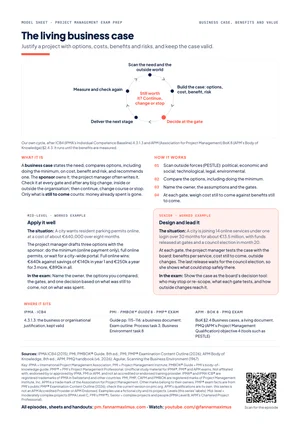
A business case compares feasible options against a need, including doing less or doing nothing. Its purpose is to support an investment decision that can be revisited. · Guide
Formulas (1)
- Net present value
Compare cash flows at different times on a common present-value basis. · Guide
Step-by-step methods (1)
- Compare timed cash flows
Discount each future cash flow to a common date using a consistent period and price basis. Then test the assumptions that drive the result. · Calculator + guide
Further applications (10)
- KPI definition and baselines
Specify a measurable signal with an owner, denominator, collection method and decision purpose. · Guide
- Life-cycle cost and total cost of ownership
Compare the cost of acquiring, operating, maintaining and eventually replacing or retiring an option. · Guide
- Theory of change and logic models
Explain how an intervention is expected to produce an outcome and what assumptions connect the steps. · Guide
- Currency exposure
Identify how cash flows in different currencies change a project’s funding needs. · Guide
- Decision trees
Separate choices from uncertain outcomes so conditional costs and payoffs can be compared. · Guide
- Evaluation and causal inference
Choose evidence that can distinguish an intervention’s contribution from other changes. · Guide
- Feedback and systems thinking
Examine how feedback, delays and system boundaries shape a problem over time. · Guide
- Project complexity assessment
Examine interactions, uncertainty and constraints that make delivery hard to predict. · Guide
- Analytic hierarchy process
Use structured pairwise judgements to explore the relative priority of alternatives and criteria. · Guide
- Portfolio selection under constraints
Select a feasible combination of initiatives rather than simply ranking projects independently. · Guide
Original framework and research sources (5)
- Balanced Scorecard
Find the originating publication. · Source pointer
- Business Model Canvas
Explore an established way to discuss how an organisation creates and captures value. · Source pointer
- Cynefin®
Explore how the nature of a situation affects the way decisions are made. · Source pointer
- McKinsey 7-S framework
Explore organisational alignment when planning a change. · Source pointer
- Porter’s Five Forces
Investigate the competitive setting behind a proposed investment. · Source pointer
Check your understanding
A system is delivered on time, but nobody uses it. Has its expected benefit necessarily been achieved?
Show answer and reasoning
No. An output must contribute to an observed outcome. Define adoption, an outcome measure, a benefit owner and alternative explanations before claiming value.
Apply the same reasoning to your own example. State one assumption you would need to check.
Chapters
Jump to the corresponding passage in the transcript.
Study materials
Open the original practice sheet · print or save as PDF
Anki package not yet available.
Key terms
The series’ own explanations. Official sources and edition pointers are below.
- Business case
- The justification for a project: the need, the options, their costs, benefits and risks, and a recommendation. The sponsor owns it. The ICB4 says business or organisational justification.
- Output, outcome and benefit
- Output: what the project delivers. Outcome: what changes when people use it. Benefit: the measurable gain from that change. PMI® often says deliverable for output.
- Benefit owner and benefit profile
- The benefit owner, in the business, makes a benefit happen and measures it after handover. APM's benefit profile records its measure, baseline, target and owner.
- Value
- What the benefits are worth, set against the costs and any disbenefits (harm the change causes). PMI®: value worth the effort and expense. APM: value for money.
- Sunk cost
- Money already spent. It is gone whatever you decide, so a decision to continue, change or stop weighs only the costs and benefits still to come.
- PESTLE
- A checklist of forces outside the organisation: political, economic, social, technological, legal, environmental. Usually traced to Francis Aguilar's 1967 study of environmental scanning.
About the lesson’s level labels
Levels (this series' labels): Mid-level = moderately complex projects (IPMA Level C, PMI's PMP®); Senior = complex projects and people (IPMA Level B, APM's Chartered Project Professional).
These are the series’ teaching labels, not a declaration that the certifications are equivalent.
Read the transcript
Timed from the episode captions.
Open episode transcript
Sara: Welcome to Project Management Exam Prep.
This episode is about the business case, benefits and value: why a project exists,
and how you know it was worth it. Every project management exam tests it.
Leo: You will learn how the three bodies frame it, how to keep a business case alive,
how outputs become benefits, and how to watch the world outside.
We finish with a drill, so keep a pen ready.
Sara: Let us start with the three lenses. What does IPMA® say?
Leo: IPMA®, the International Project Management Association, sets out its standard in
the Individual Competence Baseline, the ICB4.
Its element on strategy asks you to link the project to the organisation's strategy,
and to write, defend and keep checking its justification, even if that ends the
project. A second element, results orientation, keeps the focus on outcomes.
Sara: And PMI®?
Leo: PMI®, the Project Management Institute, publishes the PMBOK® Guide,
its guide to the project management body of knowledge.
The eighth edition makes focus on value a principle: judge the project by the value
it delivers, not only by its outputs. The outline of PMI®'s Project Management Professional
exam, the PMP®, asks you to help ensure value-based delivery, and to watch the business
environment outside the project for changes.
Sara: And APM?
Leo: APM, the Association for Project Management, publishes the APM Body of Knowledge.
It has sections on business cases and on benefits management.
The syllabus of APM's Project Management Qualification, the PMQ,
has an objective for each, and names tools that find the forces acting on a business
case.
Sara: Where do the words differ?
Leo: In three places. First, the document. PMI® and APM say business case.
The ICB4 says business or organisational justification.
PMI® treats it as a business document, outside the project management plan.
Sara: Second?
Leo: The record for each benefit. APM calls it a benefit profile, and PMI® puts the same
facts in its benefits management plan. The ICB4 tracks benefits with success factors
and key performance indicators.
Sara: And third?
Leo: The world outside. PMI® calls these forces external enterprise environmental factors.
APM's syllabus names checklists such as PESTLE.
The ICB4 speaks of the organisational environment.
Sara: What is the core, whichever exam you take?
Leo: Three ideas. One: every project serves a strategy.
The organisation's mission and vision become strategic objectives,
and each project must bring benefits that serve one of them.
Sara: Two?
Leo: The business case justifies the investment.
It states the need, weighs the options, including doing the minimum,
by cost, benefit and risk, and recommends one.
The sponsor owns it. The project manager often writes it and keeps it current.
And it stays alive: you check it at every gate, and whenever something big changes.
Stopping a project that no longer pays is good governance, not a failure.
Sara: And three?
Leo: Benefits come after outputs. An output is what the project delivers.
An outcome is what changes when people use it.
A benefit is the measurable gain from that change.
Most benefits arrive after handover, so each one needs an owner in the business,
a measure, a baseline, a target and a date.
Value is what the benefits are worth, against the costs and any disbenefits,
the harm a change can do.
Sara: Does that change in agile work?
Leo: The rhythm does. An iterative project delivers value in slices,
ordering its backlog by value and user feedback.
Its business case is often lighter at the start, and sharpened as the team learns.
Sara: How does a business case stay alive?
Leo: The first model sheet, free in the description, draws it as a cycle.
Scan the need and the world outside. Build the case: options,
costs, benefits and risks. Decide at the gate.
Deliver the next stage. Then measure, and check again.
At the centre is one question: is it still worth it?
Continue, change course, or stop.
Sara: What counts in that check?
Leo: Only what is still to come: the cost still to spend, against the benefits still
to come. Money already spent is gone, whatever you decide.
Net present value, internal rate of return and payback, which compare money across
the years, have their own episode.
Sara: And the world outside?
Leo: Scan it with a checklist such as PESTLE: political, economic and social forces,
and technological, legal and environmental ones.
Its roots are usually traced to Francis Aguilar's nineteen sixty-seven book on scanning
the business environment. Then judge each change's effect on the case,
and keep reviewing.
Sara: How do you show which output leads to which benefit?
Leo: With a benefits map, the second model sheet.
Our version reads from left to right: outputs, outcomes, benefits,
and the organisation's aim. Build it backwards, from the aim,
so that every output needs a reason. Take a city that moves resident parking permits
online. The outputs are the online service, a handheld check for wardens,
and a trained service desk. The outcomes: residents renew online,
and wardens check permits by licence plate.
The benefits: fewer counter visits, and no paper permits.
Both serve the city's aim of routine services online.
Mark a disbenefit too: residents who are not online could be left behind.
Sara: And the numbers?
Leo: Say the city issues about twenty-six thousand resident permits a year,
and the target is seventy percent online.
That is about eighteen thousand two hundred permits without a counter visit.
The head of parking services owns it, and keeps measuring after the project closes.
Sara: How does this change between Mid-level and Senior?
Leo: First, the two levels. They are this series' own labels.
Mid-level means leading moderately complex projects, the level of IPMA® Level C and
PMI®'s PMP® exam. Senior means leading complex projects and people,
the level of IPMA® Level B and of APM's chartered status, Chartered Project Professional.
At Mid-level, you keep one business case valid.
Take Parking Permits Online, a city project that moves resident parking permits
online in eight months. The project manager, Anna, drafts the case with the sponsor,
the head of parking services. She checks it at every gate, and tests each change
request against the benefits.
Sara: And at Senior level?
Leo: You make the case a tool for the board.
Take One City Account, a thirty-month city project that brings fourteen online services
under one login, led by Anna some years later.
Each service names a benefit owner. The steering board releases funds at each phase
gate, after Anna tests the case again. She also takes the board a new option:
other public bodies could reuse the payment function.
Sara: Now the drill. A city is moving resident parking permits online in eight months,
on a budget of six hundred and forty thousand euros.
Its business case expects savings of eight hundred and ninety thousand euros over
four years. In month five, four hundred thousand is spent.
Then a new national accessibility law adds sixty thousand euros of work.
The finance controller says the total is now seven hundred thousand,
over budget, so stop. What do you recommend?
Leo: Pause and write your answer. You have forty-five seconds.
Sara: First, the numbers.
Leo: Leave out the four hundred thousand already spent.
To finish, you need the two hundred and forty thousand left in the plan,
plus sixty for the law. That is three hundred thousand still to come,
against eight hundred and ninety thousand of savings.
Continuing pays while the savings still to come exceed that cost.
Three hundred is about a third of eight hundred and ninety.
So the case holds while at least a third of the savings arrive.
Even discounted, the margin stays wide.
Sara: And the actions?
Leo: Treat the law as a change. Update the business case, and ask the benefit owner to
confirm the savings. Give the steering group the options, the numbers and your recommendation:
continue, and meet the law.
Sara: What lifts that to Senior?
Leo: Tolerance and the system. Agree with the sponsor how far the savings may fall before
you would stop. Check whether the law hits the city's other online services,
and propose one shared solution. Make a scan of outside changes a standing item
at every gate. And explain the decision to the team and the supplier.
Sara: How do the exams ask this?
Leo: IPMA®'s written exam asks for open answers; at Level B it may be oral.
IPMA®'s certification also includes an interview, where assessors ask about your
own projects, so note one business case you kept valid.
The PMP® exam uses scenarios, and questions built on a case study or a chart.
APM's PMQ asks for short written answers, such as why benefits must align with strategic
objectives.
Sara: Let us recap.
Leo: One. Every project serves a strategy: trace each benefit to an objective.
Sara: Two. The business case compares options and recommends one.
The sponsor owns it; check it at every gate.
Leo: Three. Outputs lead to outcomes, and outcomes to benefits.
Give each benefit an owner and a measure after handover.
Sara: Four. Decide on what is still to come. Money already spent does not count.
Leo: And five. Scan the world outside, and feed it into the case.
Sara: The model sheets and the study handout are linked in the description.
Next time: governance, roles and assurance.
Sources & further reading
Consult the original publications and authoritative references below. For certification requirements, use the current official documents. Edition-specific page references are included only when verified.
- IPMA® (2015). Individual Competence Baseline for Project, Programme and Portfolio Management, Version 4.0 (ICB4). Zurich: International Project Management Association. ISBN 978-94-92338-00-6 (print), 978-94-92338-01-3 (pdf). Free PDF from IPMA®: https://ipma.world/ipma-standards-development-programme/icb4/
- Project Management Institute (2025). A Guide to the Project Management Body of Knowledge (PMBOK® Guide), Eighth Edition, and The Standard for Project Management. Newtown Square, PA: PMI®. ISBN 9781628258295.
- Project Management Institute (2026). Project Management Professional (PMP®)® Examination Content Outline – 2026 (July 2026 exam update). Newtown Square, PA: PMI®. PDF on pmi.org, accessed 26 September 2026.
- Association for Project Management (2025). APM Body of Knowledge, 8th edition. Princes Risborough: APM. ISBN 9781913305390.
- Association for Project Management (2024, version 6 of April 2026). APM Project Management Qualification: Handbook. https://www.apm.org.uk/media/3r4jbodr/apm-project-management-qualification-handbook.pdf, and the PMQ page https://www.apm.org.uk/qualifications-and-training/project-management-qualification/, accessed 26 September 2026.
- Aguilar, F. J. (1967). Scanning the Business Environment. New York: Macmillan. OCLC 166317.
- Buttrick, R. (2020). The Programme and Portfolio Workout: Directing Business-Led Programmes and Portfolios. Abingdon: Routledge. ISBN 9781138721210 (paperback); 9780367502508 (hardback).
- IPMA® (2025). IPMA® International Certification Regulations (Public), Version 4.4, for the Assessment of Individuals in Project, Program & Portfolio Management. Zurich: International Project Management Association. https://ipma.world/app/uploads/2025/11/IPMA®-ICR-2025_v_4.4_digital.pdf, via https://ipma.world/ipma-certification/ipma-international-certification-regulations/, accessed 26 September 2026.
Original and technical references for the related tools
- OpenStax: Principles of Finance, capital budgeting
Standard financial mathematics; no single inventor is asserted.
- OpenStax: calculating WACC
Standard corporate-finance calculation; no single inventor is asserted.
- GAO: Cost Estimating and Assessment Guide
Standard estimating practice; the cited guide documents use rather than claiming invention.
- Saaty & Kułakowski: Axioms of the Analytic Hierarchy Process
Thomas L. Saaty developed the Analytic Hierarchy Process. This later paper by Saaty and Konrad Kułakowski explains its foundations; it is not its first publication.
- GAO: Schedule Assessment Guide
Common scheduling practice. The critical-path method is associated with James E. Kelley Jr. and Morgan R. Walker; their 1959 paper is the historical reference.
- HM Treasury: The Magenta Book
Evaluation practice has multiple research traditions. This is an authoritative later guide, not a claim of sole invention.
- MIT: annotated system dynamics literature
System dynamics traces to Jay W. Forrester, including Industrial Dynamics (1961). Systems thinking is a wider field with multiple origins.