9 minute read · Original practice exercise included
Before you start: Identify the sponsor and the delivery team.
Watch this lesson
Governance, roles and assurance
Watch on YouTubeOpen the foundations playlist
YouTube connects when you play a video or follow its links. Playback depends on the video’s availability on YouTube. Its own privacy and storage practices then apply. Voices are AI-generated.
Tools and references for this lesson
Use these resources to practise and extend the topic. Further applications may go beyond the lesson transcript; source pointers lead to the original author or publisher.
Calculators (1)
- Weighted option scoring
Make option ratings and criterion weights visible and comparable. · Calculator + guide
Conceptual models (4)
- Compliance map
A compliance map links applicable obligations to owners, delivery requirements and evidence. It helps distinguish a confirmed obligation from an assumption that needs expert review. · Guide
- Ethical decision steps
A structured ethical discussion makes competing obligations and affected people visible before a decision is justified solely by convenience or schedule. · Guide
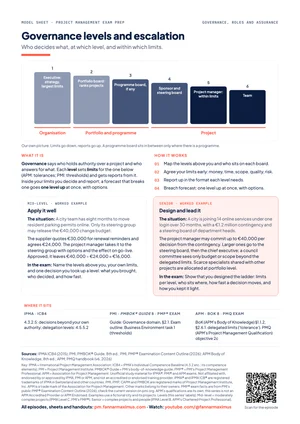
- Governance levels and escalation
Governance makes decision rights explicit: who can approve what, which constraints apply and who must decide when a forecast crosses them. · Guide
- RACI matrix
A responsibility matrix connects deliverables and decisions to the people doing the work, approving it, advising on it and receiving updates. · Guide
Further applications (6)
- Responsibility and accountability checks
Check that important deliverables and decisions have clear ownership. · Guide
- Decision trees
Separate choices from uncertain outcomes so conditional costs and payoffs can be compared. · Guide
- Feedback and systems thinking
Examine how feedback, delays and system boundaries shape a problem over time. · Guide
- Project complexity assessment
Examine interactions, uncertainty and constraints that make delivery hard to predict. · Guide
- Analytic hierarchy process
Use structured pairwise judgements to explore the relative priority of alternatives and criteria. · Guide
- Portfolio selection under constraints
Select a feasible combination of initiatives rather than simply ranking projects independently. · Guide
Original framework and research sources (3)
- Cynefin®
Explore how the nature of a situation affects the way decisions are made. · Source pointer
- PM² project management methodology
Find a publicly available project methodology and its official resources. · Source pointer
- CMMI®
Explore a published approach to organisational capability improvement. · Source pointer
Check your understanding
Two managers both believe they can approve a scope change. What needs clarification?
Show answer and reasoning
Agree the decision owner, delegated limits, consultation and escalation route. A responsibility matrix helps expose the ambiguity; it cannot create authority by itself.
Apply the same reasoning to your own example. State one assumption you would need to check.
Chapters
Jump to the corresponding passage in the transcript.
Study materials
Open the original practice sheet · print or save as PDF
Anki package not yet available.
Key terms
The series’ own explanations. Official sources and edition pointers are below.
- Governance
- Who holds authority over a project and who answers for what: who may decide, within which limits, how reports flow up, and who checks.
- Sponsor
- The senior person accountable for the business case and the benefits. Secures the funding, often chairs the board, and is the project manager's first point of escalation.
- Steering board
- Senior people who direct the project and take decisions beyond the project manager's limits. The ICB4 and PMI®: steering committee; APM: governance board or project board.
- Tolerance and threshold
- A preset limit within which the project manager may decide. APM: tolerance. PMI®: threshold (PMI® keeps ‘tolerance’ for the allowed variation of a quality requirement).
- Assurance
- Checks by people independent of the team, which give the sponsor and board confidence that the project will meet its objectives. Wider than quality assurance.
- RACI
- A common coding for a responsibility chart. Responsible: the people doing the work. Accountable: the one owner, who approves the result. Consulted: asked before. Informed: told after.
About the lesson’s level labels
Levels (this series' labels): Mid-level = moderately complex projects (IPMA Level C, PMI's PMP®); Senior = complex projects and people (IPMA Level B, APM's Chartered Project Professional).
These are the series’ teaching labels, not a declaration that the certifications are equivalent.
Read the transcript
Timed from the episode captions.
Open episode transcript
Sara: Welcome to Project Management Exam Prep.
This episode is about governance, roles and assurance: who decides what on a project,
within which limits, and who checks. Every project management exam tests it.
Leo: You will learn how the three bodies frame it, who does what, how escalation works,
and who checks. We finish with a drill, so keep a pen ready.
Sara: Let us start with the three lenses. What does IPMA® say?
Leo: IPMA®, the International Project Management Association, sets out its standard in
the Individual Competence Baseline, the ICB4.
Its element on governance, structures and processes asks you to work within the
organisation's decision and reporting lines and its support functions,
such as finance, and to tell what is compulsory from what is optional.
Sara: And PMI®?
Leo: PMI®, the Project Management Institute, publishes the PMBOK® Guide,
its guide to the project management body of knowledge.
The eighth edition makes governance a performance domain.
It contrasts structured governance, with a sponsor and a board,
with self-governance by the team. The outline of PMI®'s Project Management Professional
exam, the PMP®, has a task to establish governance, with escalation paths and thresholds.
Sara: And APM?
Leo: APM, the Association for Project Management, publishes the APM Body of Knowledge.
As it puts it, "Governance is about who is allowed to decide what." The syllabus
of APM's Project Management Qualification, the PMQ, has three objectives here:
governance arrangements, reviews and assurance.
Sara: Where do the words differ?
Leo: In three places. First, the board. The ICB4 and PMI® say steering committee.
APM says governance board, or project board.
In this series, we say steering board.
Sara: Second?
Leo: Your limits. APM calls them tolerances: the room you are given to vary from the
plan. PMI® speaks of thresholds, and keeps the word tolerance for quality.
The ICB4 speaks of decisions beyond your authority.
Sara: And third?
Leo: Assurance. For APM, it means independent checks that give the board confidence.
PMI®'s closest term is quality assurance: checking that processes and standards are
followed, with audits. The ICB4 asks you to fit the organisation's own forms of
assurance.
Sara: What is the core, whichever exam you take?
Leo: Three ideas. One: governance answers three questions.
Who decides what? Within which limits? And who checks?
Fit it to the project: too much slows the work, and too little loses control.
Sara: Two?
Leo: Clear roles. The sponsor is accountable for the business case and its benefits,
secures the funding, and is your first point of escalation.
The steering board, often chaired by the sponsor, speaks for the business,
the users and the suppliers, and decides beyond your limits.
You, the project manager, run the work within them.
A project management office, the PMO, sets standards, collects reports and offers
help. Users say what they need and accept the result, and suppliers deliver under
contract.
Sara: And where do team members come from?
Leo: In a functional organisation, their department directs them, and you coordinate.
In a project organisation, they report to you.
In a matrix, they have two bosses, so agree their time with their line manager,
in writing.
Sara: And three?
Leo: Independent checks. At each gate, a review looks back at what was delivered,
and forward at the business case. Assurance goes further: people outside the team
check that the project can meet its objectives, and report to the sponsor and the
board.
Sara: Does that change in agile work?
Leo: Governance gets lighter and more frequent.
The board sets goals, a budget and limits.
Within them, a product owner orders the work for the users, and the team steers
itself. Results are reviewed every iteration, and funding goes on only while the
value holds.
Sara: Now the models. Both model sheets are free in the description.
Leo: The first is our own picture of governance levels.
The organisation's executive sets the strategy and the largest limits.
A portfolio board ranks the projects and shares out scarce people and money.
A programme board comes next, if there is one.
Then the sponsor and the steering board, then you and your team.
Limits go down, and reports go up. Inside your limits, you decide and report.
A forecast that will break a limit goes one level up at once,
with options and a recommendation. That is management by exception.
Sara: Can we have numbers?
Leo: Say you may approve a change up to ten thousand euros, or one week of delay.
The steering board may approve up to one hundred thousand, or one month.
A change costs twenty-five thousand euros and three days.
The days are within your limit, but the money is not, so the steering board decides.
The rule: a decision goes to the lowest level whose limits cover all of it.
Sara: And the second model?
Leo: A responsibility chart, coded RACI: a common convention that the PMBOK® Guide and
the APM Body of Knowledge both use. Rows are deliverables or decisions,
and columns are roles. Responsible: the people who do the work.
Accountable: the one person who owns the result and signs it off.
Consulted: asked before, both ways. Informed: told after, one way.
Sara: What are the rules?
Leo: Exactly one A in each row, and at least one R.
Few Cs, or decisions slow down. In each column, many Rs mean overload,
and an empty column asks why that role is there.
Add the governance decisions too, such as who decides to go live.
Sara: How does this change between Mid-level and Senior?
Leo: First, the two levels. They are this series' own labels.
Mid-level means leading moderately complex projects, the level of IPMA® Level C and
PMI®'s PMP® exam. Senior means leading complex projects and people,
the level of IPMA® Level B and of APM's chartered status, Chartered Project Professional.
At Mid-level, you work well inside the governance you are given.
Take Parking Permits Online, a city project that moves resident parking permits
online in eight months. The project manager, Anna, reports to a steering group that
includes the sponsor, the head of parking services.
Only the steering group may release the money set aside for changes,
so each change goes to them with options.
Sara: And at Senior level?
Leo: You design the governance for others. Take One City Account, a thirty-month city
project that brings fourteen online services under one login,
led by Anna some years later. Anna may commit up to forty thousand euros of reserve
per decision. Larger ones go to the steering board, then the city's chief executive.
She plans assurance in three lines: the team's own checks, an independent review
before each phase gate that reports to the board, and the city's internal audit.
APM calls this the three lines of defence.
Sara: So the Senior answer designs the system.
Sara: Now the drill. A city is moving resident parking permits online,
and most residents renew in January. The steering group gave the project manager
a schedule tolerance of two weeks: any bigger slip goes back to the group.
Six weeks before go-live, the supplier says the payment work will be three weeks
late. The sponsor, who chairs the steering group, says: just agree the new date
with the supplier. Who decides, and what do you do?
Leo: Pause and write your answer. You have forty-five seconds.
Sara: First, the numbers.
Leo: The slip is three weeks. Your tolerance is two, so the slip is outside your authority
by one week. And a three-week slip moves go-live into the January renewals.
Sara: So who decides?
Leo: The steering group, not you and not the sponsor alone.
The sponsor chairs the group, but the group set the tolerance,
so the group decides. Raise an exception report now.
Give the facts, the cause and the options: accept the new date;
pay for extra supplier staff to win back a week and stay inside tolerance;
or go live with card payments at the service desk until online payment is ready.
Recommend one, with its cost and risk, and record the decision.
Sara: What lifts that to Senior?
Leo: Governance and people. Ask why the slip surfaced so late, and add an early warning.
Check what the contract says about delay before anyone agrees a new date.
Give the sponsor a clear role: to champion the decision in the group,
not to bypass it. And set tolerances for time, cost and scope,
and who may approve each, at the start.
Sara: How do the exams ask this?
Leo: IPMA®'s exams ask for open answers. IPMA®'s certification also includes an interview,
where assessors ask about your own projects, so note one decision you escalated,
and who took it. The PMP® exam uses scenarios, and PMI®'s outline adds questions built
on a case study or a chart: practise reading a RACI chart.
APM's PMQ asks for short written answers, for example how the sponsor's duties differ
from the project manager's.
Sara: Let us recap.
Leo: One. Governance says who decides what, within which limits, and who checks.
Sara: Two. The sponsor answers for the business case; the steering board decides beyond
your limits.
Leo: Three. Limits go down and reports go up.
Beyond a limit, escalate at once, with options.
Sara: Four. Gate reviews and independent assurance give the board confidence.
In a RACI chart, each row has one A.
Leo: And five. Steering committee or governance board, threshold or tolerance:
learn the moves, then your exam's words.
Sara: The model sheets and the study handout are linked in the description.
Next time: ethics, compliance and sustainability.
Sources & further reading
Consult the original publications and authoritative references below. For certification requirements, use the current official documents. Edition-specific page references are included only when verified.
- IPMA® (2015). Individual Competence Baseline for Project, Programme and Portfolio Management, Version 4.0 (ICB4). Zurich: International Project Management Association. ISBN 978-94-92338-00-6 (print), 978-94-92338-01-3 (pdf). Free PDF from IPMA®: https://ipma.world/ipma-standards-development-programme/icb4/
- Project Management Institute (2025). A Guide to the Project Management Body of Knowledge (PMBOK® Guide), Eighth Edition, and The Standard for Project Management. Newtown Square, PA: PMI®. ISBN 9781628258295.
- Project Management Institute (2026). Project Management Professional (PMP®)® Examination Content Outline – 2026 (July 2026 exam update). Newtown Square, PA: PMI®. PDF on pmi.org, accessed 26 September 2026.
- Association for Project Management (2025). APM Body of Knowledge, 8th edition. Princes Risborough: APM. ISBN 9781913305390.
- Association for Project Management (2024, version 6 of April 2026). APM Project Management Qualification: Handbook. https://www.apm.org.uk/media/3r4jbodr/apm-project-management-qualification-handbook.pdf, and the PMQ page https://www.apm.org.uk/qualifications-and-training/project-management-qualification/, accessed 26 September 2026.
- IPMA® (2025). IPMA® International Certification Regulations (Public), Version 4.4, for the Assessment of Individuals in Project, Program & Portfolio Management. Zurich: International Project Management Association. https://ipma.world/app/uploads/2025/11/IPMA®-ICR-2025_v_4.4_digital.pdf, via https://ipma.world/ipma-certification/ipma-international-certification-regulations/, accessed 26 September 2026.
Original and technical references for the related tools
- GAO: Cost Estimating and Assessment Guide
Standard estimating practice; the cited guide documents use rather than claiming invention.
- Saaty & Kułakowski: Axioms of the Analytic Hierarchy Process
Thomas L. Saaty developed the Analytic Hierarchy Process. This later paper by Saaty and Konrad Kułakowski explains its foundations; it is not its first publication.
- GAO: Schedule Assessment Guide
Common scheduling practice. The critical-path method is associated with James E. Kelley Jr. and Morgan R. Walker; their 1959 paper is the historical reference.
- MIT: annotated system dynamics literature
System dynamics traces to Jay W. Forrester, including Industrial Dynamics (1961). Systems thinking is a wider field with multiple origins.