8 minute read · Original practice exercise included
Before you start: Read the governance lesson first.
Read the lesson Explore tools and references
Next: Leadership and vision
Watch this lesson
Ethics, compliance and sustainability
Watch on YouTubeOpen the foundations playlist
YouTube connects when you play a video or follow its links. Playback depends on the video’s availability on YouTube. Its own privacy and storage practices then apply. Voices are AI-generated.
Tools and references for this lesson
Use these resources to practise and extend the topic. Further applications may go beyond the lesson transcript; source pointers lead to the original author or publisher.
Calculators (3)
- Pareto counts and cumulative share
Rank recorded problem categories to focus investigation. · Calculator + guide
- Defect density and removal efficiency
Track observed defects on a consistent measurement boundary. · Calculator + guide
- Process capability: Cp and Cpk
Compare a stable process’s spread and centring with specification limits. · Calculator + guide
Conceptual models (4)
- Compliance map
A compliance map links applicable obligations to owners, delivery requirements and evidence. It helps distinguish a confirmed obligation from an assumption that needs expert review. · Guide
- Ethical decision steps
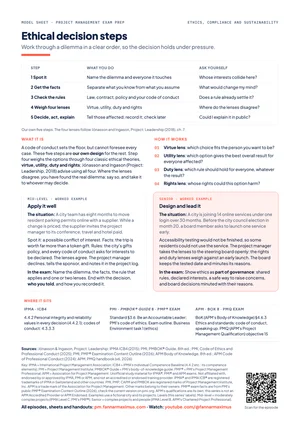
A structured ethical discussion makes competing obligations and affected people visible before a decision is justified solely by convenience or schedule. · Guide
- Governance levels and escalation
Governance makes decision rights explicit: who can approve what, which constraints apply and who must decide when a forecast crosses them. · Guide
- RACI matrix
A responsibility matrix connects deliverables and decisions to the people doing the work, approving it, advising on it and receiving updates. · Guide
Further applications (3)
- Responsibility and accountability checks
Check that important deliverables and decisions have clear ownership. · Guide
- Cost of quality
Compare the cost of preventing and detecting errors with the consequences of failures. · Guide
- Statistical process control
Distinguish routine process variation from signals that merit investigation. · Guide
Original framework and research sources (5)
- Plan–Do–Study–Act
Connect a small test with evidence and a deliberate learning decision. · Source pointer
- PM² project management methodology
Find a publicly available project methodology and its official resources. · Source pointer
- CMMI®
Explore a published approach to organisational capability improvement. · Source pointer
- EFQM Model
Find an organisational assessment approach for improvement work. · Source pointer
- GPM® P5™ Standard
Find project-specific guidance on sustainability impacts. · Source pointer
Check your understanding
A cheaper option meets the schedule but breaches an applicable obligation. Can its financial score justify choosing it?
Show answer and reasoning
No. Binding constraints must be checked before ranking feasible options. Identify the obligation, accountable owner and evidence of compliance; escalate uncertainty to the appropriate specialist.
Apply the same reasoning to your own example. State one assumption you would need to check.
Chapters
Jump to the corresponding passage in the transcript.
Study materials
Open the original practice sheet · print or save as PDF
Anki package not yet available.
Key terms
The series’ own explanations. Official sources and edition pointers are below.
- Code of conduct
- A body's written rules for ethical practice. IPMA® and PMI® call theirs a code of ethics and professional conduct; APM's is a code of professional conduct.
- Integrity and reliability
- Integrity: acting on your own values. Reliability: others can count on you to do what you agreed, or to warn early when you cannot.
- Conflict of interest
- A personal stake that could bias, or seem to bias, a decision you take for the project. All three codes ask you to declare it.
- Compliance
- Keeping the project within the rules that apply to it, from binding law to voluntary standards, and being able to show the evidence.
- Sustainability
- Weighing a project's long-term social, environmental and economic effects (people, planet, profit). APM's PMQ syllabus adds administrative ones.
- CPD and PDUs
- Continuing professional development: planned learning after you certify. IPMA® and APM say CPD; PMI® counts professional development units (PDUs).
About the lesson’s level labels
Levels (this series' labels): Mid-level = moderately complex projects (IPMA Level C, PMI's PMP®); Senior = complex projects and people (IPMA Level B, APM's Chartered Project Professional).
These are the series’ teaching labels, not a declaration that the certifications are equivalent.
Read the transcript
Timed from the episode captions.
Open episode transcript
Sara: Welcome to Project Management Exam Prep.
This episode is about ethics, compliance and sustainability: doing the right thing,
keeping within the rules, and thinking beyond the deadline.
Every project management exam tests it.
Leo: You will learn how the three bodies frame it, what their codes of conduct share,
how to work through a dilemma, and how to keep a project compliant.
We finish with a drill, so keep a pen ready.
Sara: Let us start with the three lenses. What does IPMA® say?
Leo: IPMA®, the International Project Management Association, sets out its standard in
the Individual Competence Baseline, the ICB4.
Two elements cover this topic. Compliance, standards and regulations asks you to
find the rules that apply, keep the project inside them, and make its results sustainable.
Personal integrity and reliability asks you to act on your values and keep your
word.
Sara: And PMI®?
Leo: PMI®, the Project Management Institute, publishes the PMBOK® Guide,
its guide to the project management body of knowledge.
In the eighth edition, compliance with laws is part of the governance performance
domain. Two principles apply: be an accountable leader, and build sustainability
into every part of the project. The outline of PMI®'s Project Management Professional
exam, the PMP®, has a task to plan and manage project compliance.
Sara: And APM?
Leo: APM, the Association for Project Management, publishes the APM Body of Knowledge.
It has a section on ethics, compliance and professionalism, and one on sustainability.
The syllabus of APM's Project Management Qualification, the PMQ,
has objectives with the same names.
Sara: Where do the words differ?
Leo: In three places. First, how the topic is cut.
The ICB4 splits it: compliance belongs to the context, integrity to the person.
PMI® spreads it across governance and two principles.
APM joins ethics, compliance and professionalism in one section.
Sara: Second?
Leo: The sides of sustainability. The ICB4 and PMI® name three: social,
environmental and economic. The ICB4 says people, planet and profit.
The PMQ syllabus adds a fourth, administrative.
Sara: And third?
Leo: Learning after you certify. IPMA® and APM call it continuing professional development,
or CPD. PMI® counts it in professional development units.
Sara: What is the core, whichever exam you take?
Leo: Three ideas. One: a code of conduct sets the floor.
IPMA®, PMI® and APM each publish one. In our own summary, the three codes share a
core. Report truthfully. Declare any conflict of interest.
Refuse bribes. Obey the law, and keep people safe.
Take responsibility for your decisions, and keep your competence up to date.
Sara: Two?
Leo: Compliance is planned work. Rules come from laws, contracts, standards and the organisation's
policies. Find the ones that apply, ask experts where you cannot judge,
and treat each rule as a possible threat or opportunity.
Sara: Does that change in agile work?
Leo: The rhythm does. In a linear project, compliance is checked at the gates.
In iterative work, each rule joins the definition of done, the checklist every piece
of work must pass.
Sara: And three?
Leo: Sustainability looks beyond the deadline.
A project ends, but its results last for years.
So weigh their effects on people, the environment and money.
Set targets, and report them like any other measure.
The PMBOK® Guide's principle asks you to meet today's needs without leaving the next
generations worse off.
Sara: But a code cannot cover every case. What then?
Leo: Use five steps, our own design. One: spot it.
Name the dilemma, and everyone it touches.
Two: get the facts, not assumptions. Three: check the rules: the law,
the contract, the organisation's policies and your code.
If a rule settles it, follow it.
Sara: And if no rule settles it?
Leo: Four: weigh the options through four lenses.
Jónasson and Ingason, in their book Project: Leadership, use four classic ethical
theories, and advise using all of them.
Virtue: which choice fits the person you want to be?
Utility: which gives the best result for everyone affected?
Duty: which rule should hold for everyone?
Rights: whose rights could it harm?
Sara: And five?
Leo: Decide, act and explain. Tell those affected what you decided and why,
and record it. Where the lenses disagree, you have found the real dilemma.
Say so openly, and take it to whoever may decide.
Sara: And the second model?
Leo: A compliance map, also our own. It sorts every rule by how binding it is,
in four bands. Must: laws and regulations, such as data protection.
Agreed: contracts, and any standard a contract makes binding.
Expected: codes of conduct and the organisation's own promises,
such as climate targets. Chosen: voluntary standards, which APM calls discretionary.
Sara: How do I use it?
Leo: Three moves. Identify: scan the sources, keep what applies here,
and ask experts. Plan: give each rule an owner, and turn it into a requirement,
a task, a contract clause or a test. Check: keep the evidence,
and watch for rules that change, as the APM Body of Knowledge stresses.
Sara: And the regulator?
Leo: A regulator is a stakeholder. Inform it and engage it, usually through your own
expert, such as the data protection officer, who oversees how the organisation handles
personal data. Never escalate to it.
Sara: How does this change between Mid-level and Senior?
Leo: First, the two levels. They are this series' own labels.
Mid-level means leading moderately complex projects, the level of IPMA® Level C and
PMI®'s PMP® exam. Senior means leading complex projects and people,
the level of IPMA® Level B and of APM's chartered status, Chartered Project Professional.
At Mid-level, you keep one project within the rules.
Take Parking Permits Online, a city project that moves resident parking permits
online in eight months. The project manager, Anna, fills in the compliance map in
month one with the data protection officer.
Addresses and licence plates are personal data, and the payment gateway must be
certified before go-live. Each rule gets an owner and a test.
Sara: And at Senior level?
Leo: You build it into the system for others.
Take One City Account, a thirty-month city project that brings fourteen online services
under one login, led by Anna some years later.
Anna sets one compliance map that every service owner fills in.
Shared security and accessibility standards go into every supplier contract.
The steering board reviews sustainability targets at each gate.
Sara: Now the drill. A city is moving resident parking permits online,
and go-live is near. The team has moved twenty-six thousand permits from the old
database. A final test shows that three in every hundred carry the wrong licence
plate or zone. Fixing and retesting takes two weeks.
The sponsor asks you to report the project as green, on track,
at tomorrow's steering group, and to fix the data quietly after go-live.
What do you do?
Leo: Pause and write your answer. You have forty-five seconds.
Sara: First, the size of it.
Leo: Twenty-six thousand divided by a hundred is two hundred and sixty.
Times three, that is seven hundred and eighty permits.
Each one could get a resident fined wrongly.
Sara: And then?
Leo: Walk the five steps. The dilemma: loyalty to the sponsor against a truthful report.
The facts: which records are wrong, and why.
The rules: all three codes ask for truthful reports, and data protection rules usually
require accurate personal data, so involve the data protection officer.
Reporting green fails the rights and duty lenses.
So speak to the sponsor today, in private.
Report amber, at risk, with options: delay two weeks, or go live with the clean
records and move the rest later. The steering group decides, and you record it.
Sara: What lifts that to Senior?
Leo: Read the pressure as a signal about governance.
If amber is punished, people stop reporting it.
So agree status rules that everyone uses, and make bad news safe to bring.
Agree who may accept known data errors at go-live, and up to what rate.
Ask what the sponsor fears, and meet that need honestly.
Sara: How do the exams ask this?
Leo: IPMA®'s written exam asks for open answers; at Level B it may be oral.
IPMA®'s certification also includes an interview, where assessors ask about your
own projects, so note one decision that tested your values.
The PMP® exam uses scenarios, and PMI®'s outline adds questions built on a case study
or a chart. APM's PMQ asks for short written answers, for example why continuing
professional development matters.
Sara: Let us recap.
Leo: One. A code of conduct sets the floor: truthful reports, declared interests,
no bribes, and current competence.
Sara: Two. For a dilemma: spot it, get the facts, check the rules, weigh four lenses,
then decide, act and explain.
Leo: Three. Compliance is planned work: identify, plan and check.
In iterative work, check every increment.
Sara: Four. Sustainability looks beyond the deadline, with targets you report.
Leo: And five. At Senior level, build it into the system, and make it safe to speak up.
Sara: The two model sheets and the study handout are linked in the description.
Next time: leadership and vision.
Sources & further reading
Consult the original publications and authoritative references below. For certification requirements, use the current official documents. Edition-specific page references are included only when verified.
- IPMA® (2015). Individual Competence Baseline for Project, Programme and Portfolio Management, Version 4.0 (ICB4). Zurich: International Project Management Association. ISBN 978-94-92338-00-6 (print), 978-94-92338-01-3 (pdf). Free PDF from IPMA®: https://ipma.world/ipma-standards-development-programme/icb4/
- IPMA® (2025). The IPMA® Code of Ethics and Professional Conduct (revised edition; first published 2015). Zurich: International Project Management Association. https://ipma.world/app/uploads/2025/10/V7.-IPMA®-Code-of-Ethics_2025.pdf, via https://ipma.world/about-us/code-of-ethics/, accessed 26 September 2026.
- IPMA® (2025). IPMA® International Certification Regulations (Public), Version 4.4, for the Assessment of Individuals in Project, Program & Portfolio Management. Zurich: International Project Management Association. https://ipma.world/app/uploads/2025/11/IPMA®-ICR-2025_v_4.4_digital.pdf, via https://ipma.world/ipma-certification/ipma-international-certification-regulations/, accessed 26 September 2026.
- Project Management Institute (2025). A Guide to the Project Management Body of Knowledge (PMBOK® Guide), Eighth Edition, and The Standard for Project Management. Newtown Square, PA: PMI®. ISBN 9781628258295.
- Project Management Institute (2025). PMI® Code of Ethics and Professional Conduct. Newtown Square, PA: PMI®. https://www.pmi.org/-/media/pmi/documents/public/pdf/ethics/pmi-code-of-ethics.pdf, accessed 26 September 2026.
- Project Management Institute (2026). Project Management Professional (PMP®)® Examination Content Outline – 2026 (July 2026 exam update). Newtown Square, PA: PMI®. PDF on pmi.org, accessed 26 September 2026.
- Association for Project Management (2025). APM Body of Knowledge, 8th edition. Princes Risborough: APM. ISBN 9781913305390.
- Association for Project Management (2024). APM Code of Professional Conduct. Approved by the APM Board, 18 November 2024. https://www.apm.org.uk/media/ivjcpn0f/apm-code-of-professional-conduct.pdf, accessed 26 September 2026.
- Association for Project Management (2024, version 6 of April 2026). APM Project Management Qualification: Handbook. https://www.apm.org.uk/media/3r4jbodr/apm-project-management-qualification-handbook.pdf, and the PMQ page https://www.apm.org.uk/qualifications-and-training/project-management-qualification/, accessed 26 September 2026.
- Jónasson, H. I. & Ingason, H. Þ. (2018). Project: Leadership. London: Routledge. ISBN 9780429441547.
Original and technical references for the related tools
- NIST: process capability
Standard process-capability indices. This implementation uses the published mathematical definitions without copying diagrams.
- NIST/SEMATECH: statistical methods
Standard mathematical statistics; the handbook is an authoritative technical reference, not a claim of sole origin.
- GAO: Cost Estimating and Assessment Guide
Standard estimating practice; the cited guide documents use rather than claiming invention.
- NIST: control charts
Walter A. Shewhart developed statistical control charts. NIST is a later technical reference, not their inventor.