8 minute read · Original practice exercise included
Before you start: Understand the team’s task and your authority.
Watch this lesson
Leadership and vision
Watch on YouTubeOpen the people playlist
YouTube connects when you play a video or follow its links. Playback depends on the video’s availability on YouTube. Its own privacy and storage practices then apply. Voices are AI-generated.
Tools and references for this lesson
Use these resources to practise and extend the topic. Further applications may go beyond the lesson transcript; source pointers lead to the original author or publisher.
Conceptual models (6)
- Choosing a response to conflict
Conflict-handling modes provide different ways to balance your own concern with another person’s concern. The useful question is which response fits the stakes, relationship and time available. · Guide
- Leadership that fits the situation
Adjust the amount of direction and support to a particular task and the person’s current familiarity with it. Agree the arrangement rather than assigning a permanent label to the person. · Guide
- Psychological safety
Psychological safety concerns whether people can raise a question, concern or mistake without expecting interpersonal humiliation. It supports learning alongside clear standards of work. · Guide
- Reading a developing conflict
Look at how a disagreement is changing: can people still examine the problem together, or are threats and personal attacks making a constructive exchange harder? · Guide
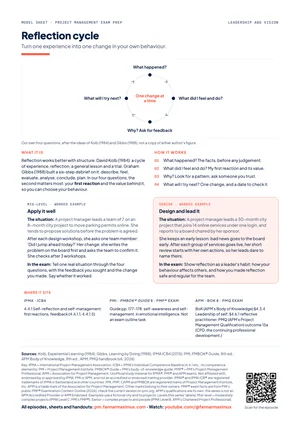
- Reflection cycle
A reflection cycle turns an experience into a specific change you can try, instead of stopping at whether the event felt successful. · Guide
- Team development stages
Team-development stages offer a vocabulary for discussing how a group establishes working relationships and ways of delivering together. They describe a possible pattern, not a required timetable. · Guide
Original framework and research sources (3)
- GROW coaching model
Find a structured approach to a coaching conversation. · Source pointer
- Self-determination theory
Explore research on motivation and the social conditions that support it. · Source pointer
- WOOP
Explore research on turning a personal intention into action. · Source pointer
Check your understanding
A capable colleague is struggling with an unfamiliar task. What evidence would help you decide how to support them?
Show answer and reasoning
Ask about task-specific experience, clarity, constraints and confidence. Agree support and review its effect. Avoid assuming that general seniority determines the help needed for every task.
Apply the same reasoning to your own example. State one assumption you would need to check.
Chapters
Jump to the corresponding passage in the transcript.
- OpeningWatch on YouTube
- One topic, three lensesWatch on YouTube
- The core in plain wordsWatch on YouTube
- Models and methods: leadership that fits the situationWatch on YouTube
- Models and methods: leading yourselfWatch on YouTube
- Mid-level and SeniorWatch on YouTube
- Exam drillWatch on YouTube
- RecapWatch on YouTube
Study materials
Open the original practice sheet · print or save as PDF
Anki package not yet available.
Key terms
The series’ own explanations. Official sources and edition pointers are below.
- Leadership and management
- Management runs the means: plans, budgets, staffing, control. Leadership sets direction, aligns people and inspires them (after Kotter). A project manager needs both.
- Shared vision
- A short, plain picture of the future the project creates and why it matters, agreed with key stakeholders, repeated often and kept current. PMI®'s outline says common vision.
- Situational leadership
- Fitting direction and support to how able and how willing a person is on one task (after Hersey and Blanchard, 1969). PMI® and APM use the term; the ICB4 names no model.
- Servant leadership
- Leading by serving the team first: meeting its needs, removing blocks and helping people grow (after Greenleaf). PMI® defines it; APM links it to self-managing teams.
- Emotional intelligence
- Knowing and managing your own emotions, and reading and handling other people's. The PMBOK® Guide groups it in four areas; two of them are about yourself.
- Leading yourself
- Knowing your values, first reactions and limits, and managing your time, stress and learning. ICB4: self-reflection and self-management. APM: leadership of self.
About the lesson’s level labels
Levels (this series' labels): Mid-level = moderately complex projects (IPMA Level C, PMI's PMP®); Senior = complex projects and people (IPMA Level B, APM's Chartered Project Professional).
These are the series’ teaching labels, not a declaration that the certifications are equivalent.
Read the transcript
Timed from the episode captions.
Open episode transcript
Sara: Welcome to Project Management Exam Prep.
This episode is about leadership and vision.
Every project management exam tests it, because a plan does nothing until people
follow it.
Leo: You will learn how the three bodies frame it, how leadership differs from management,
how to share a vision, how to fit your style to the person, and how to lead yourself.
We finish with a drill, so keep a pen ready.
Sara: Let us start with the three lenses. What does IPMA® say?
Leo: IPMA®, the International Project Management Association, sets out its standard in
the Individual Competence Baseline, the ICB4.
Its element on leadership asks you to give direction, coach, use influence well,
and choose a style that fits the situation.
Senior managers, not only your team, should see you as the leader.
Sara: And PMI®?
Leo: PMI®, the Project Management Institute, publishes the PMBOK® Guide,
its guide to the project management body of knowledge.
The eighth edition makes accountable leadership one of its principles.
The outline of PMI®'s Project Management Professional exam, the PMP®,
has two tasks here: develop a common vision, and lead the project team,
which includes choosing a fitting style.
Sara: And APM?
Leo: APM, the Association for Project Management, publishes the APM Body of Knowledge.
Its section on leadership covers creating a vision, leadership of self,
and situational leadership. The syllabus of APM's Project Management Qualification,
the PMQ, asks how leadership affects motivation, why styles change,
and why coaching and emotional intelligence matter.
It also covers your own professional development.
Sara: Where do the words differ?
Leo: In three places. First, leading yourself.
The ICB4 says self-reflection and self-management.
APM says leadership of self. PMI® puts self-awareness and self-management inside
emotional intelligence.
Sara: Second?
Leo: Adapting your style. PMI® and APM call it situational leadership.
The ICB4 names no model.
Sara: And third?
Leo: Servant leadership. PMI® defines it, and ties it to its leadership principle.
APM uses it for teams that manage themselves.
The ICB4 does not use the term.
Sara: What is the core, whichever exam you take?
Leo: Three ideas. One: leadership is not management.
John Kotter, a scholar of leadership, draws the line.
Management keeps a complex system running, with plans, budgets and control.
Leadership sets the direction, brings people behind it, and inspires them to get
there. A project manager needs both. Leadership is not authority either,
and you also lead upwards and outwards.
Sara: Two?
Leo: A shared vision: a short, plain picture of the future the project creates,
and why it matters. Set it with the sponsor and key stakeholders,
and let people question it. Promote it: repeat it, and link big decisions back to
it. Keep it current. When two people read it differently, find out why.
Sara: Does that change in agile work?
Leo: A product vision guides the backlog, and each review asks whether the result moves
towards it. The team decides how to work, so the leader serves more and directs
less.
Sara: And three?
Leo: Servant leadership, which Robert Greenleaf described, means serving the team first.
You meet its needs, remove blocks, and help people grow, while still giving direction.
And Daniel Goleman made emotional intelligence widely known.
The PMBOK® Guide groups it in four areas: self-awareness, self-management,
social awareness and social skills. The first two are about you.
Sara: How do I choose a style? Both model sheets are free in the description.
Leo: Start with two things you give people. Direction means saying what to do,
how and by when, then checking. Support means listening, encouraging,
and giving the person a say. Paul Hersey and Ken Blanchard described the idea in
nineteen sixty-nine. The labels on screen are our own.
Sara: And then?
Leo: Read the person on this task. How able are they, and how sure and willing?
New to the task, but keen: give clear steps, and check often.
We call that show how. Learning, and less sure: add reasons and encouragement.
Explain why. Able, but still unsure: ask for their plan, and back it.
That is where coaching does most. Able and confident: agree the result,
then give room. Hand over.
Sara: So each person gets one style?
Leo: No. The style belongs to the task. Your best tester may need close support the first
time she presents to senior managers. After a setback, step back in.
Aim to hand over, because it grows people and frees your time.
The ICB4 adds: sometimes hold back your answer, so the team finds its own.
Sara: And leading yourself?
Leo: Our second model is a reflection cycle.
David Kolb described learning as a cycle, from experience to a lesson you try out.
Graham Gibbs built a guided debrief on it that also asks about feelings.
Ours has four questions. What happened?
What did I feel and do: my first reaction, and the value behind it?
Why, and what does it tell me? Ask someone you trust.
And what will I try next time? One small change, with a date to check it.
Sara: Why does the first reaction matter?
Leo: Once you know it, you can choose your behaviour.
A leader who hears bad news as an attack teaches the team to hide problems.
Sara: And time and stress?
Leo: Sort work by importance, not noise. Protect time for important work that is not
yet urgent, such as coaching. Say no to the request, not the person,
and offer an option. APM notes that stress grows when people lack control over time,
ability or resources. Watch for the signs in yourself and your team,
and plan rest. And own your development: find your gaps, and close them.
Sara: How does this change between Mid-level and Senior?
Leo: First, the two levels. They are this series' own labels.
Mid-level means leading moderately complex projects, the level of IPMA® Level C and
PMI®'s PMP® exam. Senior means leading complex projects and people,
the level of IPMA® Level B and of APM's chartered status, Chartered Project Professional.
At Mid-level, you lead your own team well.
Take Parking Permits Online, a city project that moves resident parking permits
online in eight months. The project manager, Anna, leads seven city staff and fits
her style to each person and task. The supplier's team of five does not report to
her, so she leads it through its own lead.
Sara: And at Senior level?
Leo: You lead leaders, across organisations.
Take One City Account, a thirty-month city project that brings fourteen online services
under one login, led by Anna some years later.
Anna leads team leads, an integration partner and nine owners of old systems.
She keeps one vision in front of all of them: one account for every resident.
She coaches the leads instead of solving their problems.
And she paces herself for thirty months, and brings bad news to the steering board
early.
Sara: Now the drill. A city team is moving resident parking permits online,
and go-live in eight weeks cannot move.
The analyst who owns the data migration knows the old database well,
but has never led a migration. She is a week behind and has gone quiet.
The supplier's lead developer offers to take it over.
And two team members ask why paper permits must end at all.
How do you lead here?
Leo: Pause and write your answer. You have forty-five seconds.
Sara: Where do you start?
Leo: With the person. Talk to her alone. She knows the data, but the task is new and
her confidence has dropped. So she needs more direction and more support:
explain why. Do not hand the task over; that takes away her ownership.
Pair her with the developer twice a week, and check in daily.
Set a trigger: if the trial migration fails by next Friday, the developer leads.
Sara: And the question about paper?
Leo: The vision is slipping, so find out why.
Restate it plainly: residents renew from home, and counter staff help those who
need it. Then link each person's task to it.
Sara: What lifts that to Senior?
Leo: The system. Why did nobody see it earlier?
Ask every task owner for confidence, not only progress.
Agree the developer's time with the supplier's lead, under the contract.
Tell the steering group early, with the trade-off: a little risk now,
against a city that can run its own data later.
Sara: How do the exams ask this?
Leo: IPMA®'s written exam asks for open answers; at Level B it may be oral.
IPMA®'s certification also includes an interview, where assessors ask about your
own projects, so note one person whose style you changed.
The PMP® exam uses scenarios, and questions built on a case study or a chart.
APM's PMQ asks for short written answers, such as why a leader may need to change
style.
Sara: Let us recap.
Leo: One. Management runs the means; leadership sets the direction and brings people
with it.
Sara: Two. Set a shared vision with key stakeholders, promote it, and keep it current.
Leo: Three. Fit direction and support to the person and the task: show how,
explain why, back them, hand over.
Sara: Four. Serve the team, and know your own reactions.
Leo: And five. Lead yourself: reflect, protect your time, watch for stress,
and keep learning.
Sara: The two model sheets and the study handout are linked in the description.
Next time: teams, diversity and inclusion.
Sources & further reading
Consult the original publications and authoritative references below. For certification requirements, use the current official documents. Edition-specific page references are included only when verified.
- IPMA® (2015). Individual Competence Baseline for Project, Programme and Portfolio Management, Version 4.0 (ICB4). Zurich: International Project Management Association. ISBN 978-94-92338-00-6 (print), 978-94-92338-01-3 (pdf). Free PDF from IPMA®: https://ipma.world/ipma-standards-development-programme/icb4/
- Project Management Institute (2025). A Guide to the Project Management Body of Knowledge (PMBOK® Guide), Eighth Edition, and The Standard for Project Management. Newtown Square, PA: PMI®. ISBN 9781628258295.
- Project Management Institute (2026). Project Management Professional (PMP®)® Examination Content Outline – 2026 (July 2026 exam update). Newtown Square, PA: PMI®. PDF on pmi.org, accessed 26 September 2026.
- Association for Project Management (2025). APM Body of Knowledge, 8th edition. Princes Risborough: APM. ISBN 9781913305390.
- Association for Project Management (2024, version 6 of April 2026). APM Project Management Qualification: Handbook. https://www.apm.org.uk/media/3r4jbodr/apm-project-management-qualification-handbook.pdf, and the PMQ page https://www.apm.org.uk/qualifications-and-training/project-management-qualification/, accessed 26 September 2026.
- Kotter, J. P. (1996). Leading Change. Boston: Harvard Business School Press. ISBN 9780875847474.
- Greenleaf, R. K. (1977). Servant Leadership: A Journey into the Nature of Legitimate Power and Greatness. New York: Paulist Press. ISBN 9780809102204.
- Goleman, D. (1995). Emotional Intelligence. New York: Bantam Books. ISBN 9780553095036.
- Hersey, P. & Blanchard, K. H. (1969). Life cycle theory of leadership. Training and Development Journal, 23(5), 26–34. Situational Leadership® is a registered trademark of Leadership Studies, Inc. dba The Center for Leadership Studies (situational.com); SLII® is a registered trademark of The Ken Blanchard Companies. This series is not affiliated with either, and does not reproduce or teach their models or programmes.
- Kolb, D. A. (1984). Experiential Learning: Experience as the Source of Learning and Development. Englewood Cliffs, NJ: Prentice-Hall. ISBN 9780132952613.
- Gibbs, G. (1988). Learning by Doing: A Guide to Teaching and Learning Methods. Oxford: Further Education Unit, Oxford Polytechnic. ISBN 9781853380716. Free e-book reissue: Oxford Brookes University, 2013.
- Maslow, A. H. (1943). A theory of human motivation. Psychological Review, 50(4), 370–396. https://doi.org/10.1037/h0054346
- Herzberg, F., Mausner, B. & Snyderman, B. B. (1959). The Motivation to Work, 2nd ed. New York: John Wiley & Sons.
- McGregor, D. (1960). The Human Side of Enterprise. New York: McGraw-Hill.
- IPMA® (2025). IPMA® International Certification Regulations (Public), Version 4.4, for the Assessment of Individuals in Project, Program & Portfolio Management. Zurich: International Project Management Association. https://ipma.world/app/uploads/2025/11/IPMA®-ICR-2025_v_4.4_digital.pdf, via https://ipma.world/ipma-certification/ipma-international-certification-regulations/, accessed 26 September 2026.