8 minute read · Original practice exercise included
Before you start: Read leadership and consider a team you know.
Watch this lesson
Teams, diversity and inclusion
Watch on YouTubeOpen the people playlist
YouTube connects when you play a video or follow its links. Playback depends on the video’s availability on YouTube. Its own privacy and storage practices then apply. Voices are AI-generated.
Tools and references for this lesson
Use these resources to practise and extend the topic. Further applications may go beyond the lesson transcript; source pointers lead to the original author or publisher.
Conceptual models (6)
- Choosing a response to conflict
Conflict-handling modes provide different ways to balance your own concern with another person’s concern. The useful question is which response fits the stakes, relationship and time available. · Guide
- Leadership that fits the situation
Adjust the amount of direction and support to a particular task and the person’s current familiarity with it. Agree the arrangement rather than assigning a permanent label to the person. · Guide
- Psychological safety
Psychological safety concerns whether people can raise a question, concern or mistake without expecting interpersonal humiliation. It supports learning alongside clear standards of work. · Guide
- Reading a developing conflict
Look at how a disagreement is changing: can people still examine the problem together, or are threats and personal attacks making a constructive exchange harder? · Guide
- Reflection cycle
A reflection cycle turns an experience into a specific change you can try, instead of stopping at whether the event felt successful. · Guide
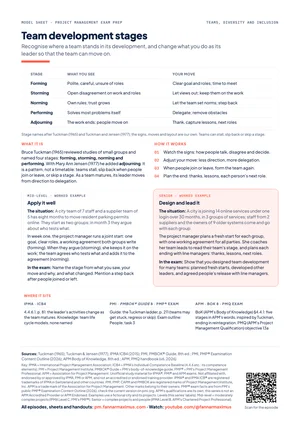
- Team development stages
Team-development stages offer a vocabulary for discussing how a group establishes working relationships and ways of delivering together. They describe a possible pattern, not a required timetable. · Guide
Original framework and research sources (5)
- Psychological safety research
Explore the evidence connecting team conditions with speaking up and learning. · Source pointer
- Belbin® Team Roles
Consider a specific published approach to team contributions. · Source pointer
- Tuckman’s team development research
Read the research behind a frequently simplified team-development model. · Source pointer
- Gersick’s punctuated equilibrium research
Explore an alternative account of how teams change their working approach over time. · Source pointer
- Hofstede’s cultural dimensions
Examine a widely cited account of differences between cultural contexts. · Source pointer
Check your understanding
A team agrees quickly but repeatedly discovers unspoken concerns late. What might you change?
Show answer and reasoning
Create a reliable way to raise concerns early, invite contrary evidence and follow up without blame. Fast agreement is not evidence of shared understanding or psychological safety.
Apply the same reasoning to your own example. State one assumption you would need to check.
Chapters
Jump to the corresponding passage in the transcript.
Study materials
Open the original practice sheet · print or save as PDF
Anki package not yet available.
Key terms
The series’ own explanations. Official sources and edition pointers are below.
- Working agreement
- The rules a team writes for how it works: meetings, decisions, conflicts, what done means. PMI®: team charter. APM: project charter. ICB4: team norms and rules.
- Stages of team development
- Forming, storming, norming, performing and adjourning (after Tuckman, 1965, and Tuckman and Jensen, 1977). A pattern, not a timetable: teams stall, slip back or skip.
- Psychological safety
- A shared belief in a team that people can ask, disagree or admit a mistake without being embarrassed or punished (after Edmondson). It does not lower standards.
- Diversity and inclusion
- Diversity: the range of different people in a team. Inclusion: a setting where each of them is welcome, heard and able to contribute. Diversity pays only with inclusion.
- Distributed team
- A team whose members work in different places or time zones. PMI® and the ICB4: virtual team. APM: dispersed team (also virtual or remote). The PMQ adds hybrid teams.
- Diverge, then converge
- A pattern for team decisions: first collect options and views, often from each person alone; then narrow them to one choice, made by whoever holds the authority.
About the lesson’s level labels
Levels (this series' labels): Mid-level = moderately complex projects (IPMA Level C, PMI's PMP®); Senior = complex projects and people (IPMA Level B, APM's Chartered Project Professional).
These are the series’ teaching labels, not a declaration that the certifications are equivalent.
Read the transcript
Timed from the episode captions.
Open episode transcript
Sara: Welcome to Project Management Exam Prep.
This episode is about teams, diversity and inclusion.
Every project management exam tests it, because projects are delivered by temporary
teams.
Leo: You will learn how the three bodies frame it, how to build an inclusive team,
how teams decide and work apart, how they grow, and why people speak up.
We finish with a drill, so keep a pen ready.
Sara: Let us start with the three lenses. What does IPMA® say?
Leo: IPMA®, the International Project Management Association, sets out its standard in
the Individual Competence Baseline, the ICB4.
Its element on teamwork follows a team's whole life, from choosing members to the
end of the work, with more delegation as the team matures.
Sara: And PMI®?
Leo: PMI®, the Project Management Institute, publishes the PMBOK® Guide,
its guide to the project management body of knowledge.
The eighth edition describes what high-performing teams share,
such as open and safe communication. The outline of PMI®'s Project Management Professional
exam, the PMP®, asks you to lead the project team: clear roles,
an empowered team, and respect for its different skills and views.
Sara: And APM?
Leo: APM, the Association for Project Management, publishes the APM Body of Knowledge,
with sections on team management and on diversity and inclusion.
The syllabus of APM's Project Management Qualification, the PMQ,
has objectives with the same names. They cover team models, virtual and hybrid teams,
bias, and fair treatment.
Sara: Where do the words differ?
Leo: In three places. First, the team's own rules.
PMI® calls them a team charter. APM's glossary says project charter,
which for PMI® authorises the project. The ICB4 says team norms and rules.
We say working agreement.
Sara: Second?
Leo: Teams in different places. PMI® and the ICB4 say virtual.
APM says dispersed, and the PMQ adds hybrid.
We say distributed.
Sara: And third?
Leo: The stages a team goes through. PMI® names the Tuckman ladder.
APM gives five stages in its own words, ending with reintegration into new roles.
The ICB4 names no model.
Sara: What is the core, whichever exam you take?
Leo: Four ideas. One: build the team on purpose.
Choose people for skills, motivation and how well they work together,
and agree their time with their line managers.
Make roles clear, and let the team write its working agreement:
how it meets, decides and handles conflict, and what done means.
Sara: Two?
Leo: Diversity pays only with inclusion. A team with different backgrounds and ways of
thinking solves problems better, and understands the people the project serves,
but only if everyone is heard. So recruit on the skills a role needs.
Run meetings where every voice counts, and credit each idea to the person who had
it. Watch for bias, your own too. And fairness is not the same treatment for all:
it is adapting to what each person needs.
Sara: Three?
Leo: Decide in two steps. Open up: collect views, often from each person alone,
so the senior voice does not steer the rest.
Then narrow down. Say beforehand who decides.
Group decisions take longer, but people commit to them.
Sara: And four?
Leo: A distributed team needs design, not only tools.
If one person joins remotely, everyone joins on their own screen.
Meet when the time zones overlap, and build trust on purpose.
Sara: And in agile work?
Leo: Agile teams are small and stable, and choose how they work.
In each retrospective, a review of how it works, the team updates its agreement.
In linear work, teams often change between phases, so they must form again.
Sara: How does a group become a team? Both model sheets are free in the description.
Leo: The best-known model is Bruce Tuckman's.
In nineteen sixty-five, he reviewed studies of small groups and named four stages.
In nineteen seventy-seven, with Mary Ann Jensen, he added a fifth.
Forming: people are polite and unsure of their roles, so give a clear goal and clear
roles. Storming: they disagree openly, so let the views out and keep them on the
work. Norming: the team sets its own rules and trust grows, so step back.
Performing: the team solves most problems itself, so delegate and remove obstacles.
Adjourning: the work ends, so thank people, capture the lessons,
and help each person into a next role.
Sara: Always in that order?
Leo: No. Tuckman's sources were mostly therapy and training groups,
not projects. A team can stall, slip back when people join or leave,
or skip a stage. So plan to form it again after each big change.
Sara: And what makes people report problems?
Leo: Amy Edmondson, a professor who studies teams, calls it psychological safety.
In our words: a shared belief in a team that you can ask, disagree or admit a mistake
without being embarrassed or punished. It belongs to the group,
unlike trust between two people.
Sara: So it means being nice?
Leo: No. A strong team needs safety and high standards.
Safety alone is merely comfortable. Standards alone create fear,
and problems stay hidden.
Sara: How do I build it?
Leo: Edmondson names three kinds of leader action.
In our words: set the stage, by saying you need every view.
Invite input, the quiet people first. And respond well: thank,
look forward, and help. Our own loop is on screen.
Someone speaks up. You respond. The team learns.
And everyone watching sees whether it was safe.
The ICB4 agrees: tolerate honest errors, and fix the cause in the process.
Deliberate breaches of the rules, Edmondson adds, still get a firm response.
Sara: How does this change between Mid-level and Senior?
Leo: First, the two levels. They are this series' own labels.
Mid-level means leading moderately complex projects, the level of IPMA® Level C and
PMI®'s PMP® exam. Senior means leading complex projects and people,
the level of IPMA® Level B and of APM's chartered status, Chartered Project Professional.
At Mid-level, you build and lead one team.
Take Parking Permits Online, a city project that moves resident parking permits
online in eight months. The project manager, Anna, runs a joint start for seven
city staff and a supplier team of five: one goal, clear roles,
and a working agreement they write together.
Sara: And at Senior level?
Leo: You design how many teams form, work together and end.
Take One City Account, a thirty-month city project that brings fourteen online services
under one login, led by Anna some years later.
People from the city, two suppliers and the owners of nine older systems join as
each group of services starts. Anna plans a fresh start for each,
with one agreement across all organisations.
Groups that speak for disabled residents review the design.
She coaches her team leads to build safety.
Sara: Now the drill. A city is moving resident parking permits online.
Three of the supplier's developers work from another country and join design reviews
by video. Everyone else sits in the city's meeting room.
The most senior city officer speaks first, and the room decides.
For a month, the remote developers have raised no concerns, yet two defects they
had noticed reached testing. What is happening, and what do you do?
Leo: Pause and write your answer. You have forty-five seconds.
Sara: What is happening?
Leo: One project, but two teams. The remote developers are outside the room,
so outside the decisions, and the senior voice goes first, so others hold back.
Safety is low, and the project pays in defects.
Sara: So what do you do?
Leo: Fix the two defects, and review them without blame, as a gap in the process.
Thank the developers for what they saw.
Then treat the whole team as distributed: everyone on their own screen,
in the overlap hours. Change how reviews decide: concerns in writing first,
the senior officer last, then the named owner decides and records why.
Let the team update its working agreement.
Then check: do the remote developers speak up in the next two reviews?
Sara: What lifts that to Senior?
Leo: The system. Agree with the supplier's lead, under the contract,
that concerns travel in both directions.
Weigh a joint workshop in person: travel costs money, but trust saves rework.
Give the steering group one signal: defects found late, by organisation.
And coach the senior officer, because the fix depends on that behaviour.
Sara: How do the exams ask this?
Leo: IPMA®'s written exam asks for open answers; at Level B it may be oral.
IPMA®'s certification also includes an interview, where assessors ask about your
own projects, so note one team you built.
The PMP® exam uses scenarios, and questions built on a case study or a chart.
APM's PMQ asks for short written answers, such as why diversity needs inclusion.
Sara: Let us recap.
Leo: One. Build the team on purpose: the right people, clear roles,
and its own working agreement.
Sara: Two. Diversity pays only with inclusion: every voice heard, and fairness adapted
to each person.
Leo: Three. Decide in two steps, and give remote members the same access.
Sara: Four. Teams form, storm, norm, perform and adjourn, and slip back when they change.
Leo: And five. People speak up when your response makes it safe, while standards stay
high.
Sara: The two model sheets and the study handout are linked in the description.
Next time: communication and knowledge transfer.
Sources & further reading
Consult the original publications and authoritative references below. For certification requirements, use the current official documents. Edition-specific page references are included only when verified.
- IPMA® (2015). Individual Competence Baseline for Project, Programme and Portfolio Management, Version 4.0 (ICB4). Zurich: International Project Management Association. ISBN 978-94-92338-00-6 (print), 978-94-92338-01-3 (pdf). Free PDF from IPMA®: https://ipma.world/ipma-standards-development-programme/icb4/
- Project Management Institute (2025). A Guide to the Project Management Body of Knowledge (PMBOK® Guide), Eighth Edition, and The Standard for Project Management. Newtown Square, PA: PMI®. ISBN 9781628258295.
- Project Management Institute (2026). Project Management Professional (PMP®)® Examination Content Outline – 2026 (July 2026 exam update). Newtown Square, PA: PMI®. PDF on pmi.org, accessed 26 September 2026.
- Association for Project Management (2025). APM Body of Knowledge, 8th edition. Princes Risborough: APM. ISBN 9781913305390.
- Association for Project Management (2024, version 6 of April 2026). APM Project Management Qualification: Handbook. https://www.apm.org.uk/media/3r4jbodr/apm-project-management-qualification-handbook.pdf, and the PMQ page https://www.apm.org.uk/qualifications-and-training/project-management-qualification/, accessed 26 September 2026.
- Tuckman, B. W. (1965). Developmental sequence in small groups. Psychological Bulletin, 63(6), 384–399.
- Tuckman, B. W. & Jensen, M. A. C. (1977). Stages of small-group development revisited. Group & Organization Studies, 2(4), 419–427.
- Edmondson, A. C. (2018). The Fearless Organization. Hoboken, NJ: Wiley. ISBN 9781119477228.
- Hackman, J. R. (2002). Leading Teams: Setting the Stage for Great Performances. Boston: Harvard Business School Press. ISBN 9781578513338.
- IPMA® (2025). IPMA® International Certification Regulations (Public), Version 4.4, for the Assessment of Individuals in Project, Program & Portfolio Management. Zurich: International Project Management Association. https://ipma.world/app/uploads/2025/11/IPMA®-ICR-2025_v_4.4_digital.pdf, via https://ipma.world/ipma-certification/ipma-international-certification-regulations/, accessed 26 September 2026.