8 minute read · Original practice exercise included
Before you start: Identify a decision that requires communication.
Watch this lesson
Communication and knowledge transfer
Watch on YouTubeOpen the people playlist
YouTube connects when you play a video or follow its links. Playback depends on the video’s availability on YouTube. Its own privacy and storage practices then apply. Voices are AI-generated.
Tools and references for this lesson
Use these resources to practise and extend the topic. Further applications may go beyond the lesson transcript; source pointers lead to the original author or publisher.
Conceptual models (2)
- Communication plan
A communication plan connects an information need to its audience, purpose, owner, timing and feedback route. · Guide
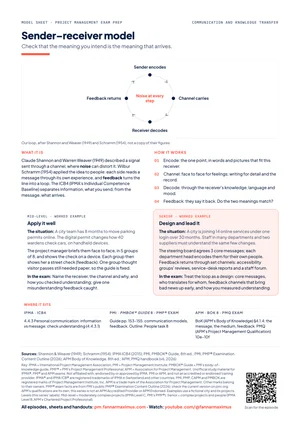
- Sender–receiver model
A message passes through a channel and is interpreted by someone with their own context. Feedback tests whether the meaning received matches the meaning intended. · Guide
Formulas (1)
- Potential communication channels
Count possible undirected pairwise connections in a group. · Guide
Check your understanding
How many possible pairwise communication channels are there among eight people, and what does this number not tell you?
Show answer and reasoning
8 × 7 ÷ 2 = 28 possible pairs. This does not predict message volume, meeting time or the communication routes actually needed.
Apply the same reasoning to your own example. State one assumption you would need to check.
Chapters
Jump to the corresponding passage in the transcript.
- OpeningWatch on YouTube
- One topic, three lensesWatch on YouTube
- The core in plain wordsWatch on YouTube
- Models and methods: the sender and receiver loopWatch on YouTube
- Models and methods: the communication planWatch on YouTube
- Mid-level and SeniorWatch on YouTube
- Exam drillWatch on YouTube
- RecapWatch on YouTube
Study materials
Open the original practice sheet · print or save as PDF
Anki package not yet available.
Key terms
The series’ own explanations. Official sources and edition pointers are below.
- Information and message
- Information is what the sender sends; the message is what the receiver takes from it. The ICB4 separates the two. Communication works when they match.
- Push, pull and interactive
- The PMBOK® Guide's three methods. Push: sent to people, like a report. Pull: fetched from a shared place, like a project site. Interactive: a live exchange, like a meeting.
- Communication plan
- What goes to whom and why, when, how, and who owns it. ICB4: information plan. PMBOK® Guide: communications management plan. APM: communication plan.
- Active listening
- Full attention to the facts and the feeling behind them, saying back what you heard, and asking before you answer (after Rogers and Farson, 1957).
- Tacit and explicit knowledge
- Explicit knowledge can be written down and shared. Tacit knowledge lives in people as skill and judgement, and moves mainly by working together (after Polanyi, 1966).
- Lessons learned
- Knowledge gained on a project that should change how this project or the next one works. Collect lessons throughout, not only at the end, and act on them.
About the lesson’s level labels
Levels (this series' labels): Mid-level = moderately complex projects (IPMA Level C, PMI's PMP®); Senior = complex projects and people (IPMA Level B, APM's Chartered Project Professional).
These are the series’ teaching labels, not a declaration that the certifications are equivalent.
Read the transcript
Timed from the episode captions.
Open episode transcript
Sara: Welcome to Project Management Exam Prep.
This episode is about communication and knowledge transfer.
Every project management exam tests it, because many problems start with a message
that never arrived.
Leo: You will learn how the three bodies frame it, how a message travels,
how to plan who gets what, and how to pass on knowledge.
We finish with a drill, so keep a pen ready.
Sara: Let us start with the three lenses. What does IPMA® say?
Leo: IPMA®, the International Project Management Association, sets out its standard in
the Individual Competence Baseline, the ICB4.
Two elements meet here. Personal communication is the skill: clear messages,
listening, and checking understanding. Organisation and information is the system:
roles, documents, reports and information flows inside the project.
Sara: And PMI®?
Leo: PMI®, the Project Management Institute, publishes the PMBOK® Guide,
its guide to the project management body of knowledge.
The eighth edition places communications in its stakeholders performance domain,
and project knowledge in its governance domain.
The outline of PMI®'s Project Management Professional exam, the PMP®,
has two tasks here: plan and manage communication, and help ensure knowledge transfer.
Sara: And APM?
Leo: APM, the Association for Project Management, publishes the APM Body of Knowledge.
Its communication section covers the message, the medium and the plan.
The syllabus of APM's Project Management Qualification, the PMQ,
puts communication inside its objective on stakeholder engagement.
It also asks why knowledge transfer matters at handover.
Sara: Where do the words differ?
Leo: In three places. First, the plan. The ICB4 calls it an information plan.
PMI® calls it a communications management plan.
APM calls it a communication plan.
Sara: Second?
Leo: What it means to arrive. The ICB4 separates information, what you send,
from the message, what the receiver takes from it.
PMI® separates acknowledging a message from understanding it.
APM separates the message from its medium.
Sara: And third?
Leo: Learning. PMI® manages project knowledge in a lessons learned register.
APM speaks of knowledge management. The ICB4 asks you to exchange lessons with other
projects.
Sara: What is the core, whichever exam you take?
Leo: Three ideas. One: communication is complete only when the meaning arrives.
So you fit the message to the receiver, and you check what they understood.
When you receive, listen actively, as Carl Rogers and Richard Farson described it
in nineteen fifty-seven. Hear the facts and the feeling, say back what you heard,
and ask open questions. That shows you understood, not that you agree.
Sara: Two?
Leo: Information is a system you design. Each role gets what it needs to decide or act,
and no more. Keep one master copy of each document, with versions and access rights.
Log key decisions. And plan the flows: up to the sponsor, down to the teams,
and across to suppliers.
Sara: Does that change in agile work?
Leo: The rhythm and the medium do. A linear project relies more on plans and reports,
on set dates. In iterative work, the team talks daily and shows working results
at every review. A visible board shows the status to anyone.
The PMBOK® Guide calls such a board an information radiator.
Sara: And three?
Leo: Knowledge. Explicit knowledge can be written down, like a checklist.
Tacit knowledge lives in people, as skill and judgement.
The philosopher Michael Polanyi wrote: "we can know more than we can tell." So tacit
knowledge moves by working side by side: pairing, shadowing and mentoring.
And collect lessons learned throughout the project, not only at the end.
Sara: Is there a model behind this? Both model sheets are free in the description.
Leo: The classic one is the sender and receiver model.
Claude Shannon and Warren Weaver described it in nineteen forty-nine:
a signal travels through a channel, and noise can distort it.
In nineteen fifty-four, Wilbur Schramm applied it to people.
He added feedback, and showed that each side reads a message through its own experience.
Sara: How does our loop run?
Leo: The sender has a meaning in mind. She encodes it: words, tone and pictures that
fit this receiver. It travels through a channel: a meeting, a call or a report.
The receiver decodes it, through their own knowledge, language and mood.
Now the receiver has a meaning, and it may not be the sender's.
So feedback closes the loop: the receiver says back what they understood.
Sara: And the noise?
Leo: It enters at every step: jargon, stress, a bad line, a second language.
So after anything important, ask a question that shows understanding.
‘What will you tell your team?’ works better than ‘Is that clear?’
Sara: And the second model?
Leo: The communication plan. Each line answers five questions: what information,
for whom and why, when, how, and who owns it.
Build it from the stakeholder analysis and the project organisation.
Sara: How do I choose the how?
Leo: The PMBOK® Guide names three methods. Push: you send it, like a report.
It arrives, but it may not be read. Pull: people fetch it from a shared site when
they need it, which suits reference material.
Interactive: a live exchange, like a meeting, for decisions, conflict and bad news.
APM calls real face-to-face contact the richest medium.
Sara: Why write a plan at all?
Leo: Because the lines multiply. Any two people share one line of communication.
Each of n people can talk to n minus one others.
That counts every line twice. So multiply n by n minus one, and halve the result.
Five people have ten lines. Ten people have forty-five.
So a plan cannot control every line. It fixes the few routes that must work.
Sara: How does this change between Mid-level and Senior?
Leo: First, the two levels. They are this series' own labels.
Mid-level means leading moderately complex projects, the level of IPMA® Level C and
PMI®'s PMP® exam. Senior means leading complex projects and people,
the level of IPMA® Level B and of APM's chartered status, Chartered Project Professional.
At Mid-level, you make information flow on your project.
Take Parking Permits Online, a city project that moves resident parking permits
online in eight months. The project manager, Anna, keeps a one-page plan.
She takes bad news to the steering group in person, and the details follow in writing.
Sara: And at Senior level?
Leo: You design information and learning across organisations.
Take One City Account, a thirty-month city project that brings fourteen online services
under one login, led by Anna some years later.
Anna sets up one document system, with access rights advised by the data protection
officer. Reports roll up from each team to the steering board.
Each new group of services starts with the lessons of the last.
Sara: Now the drill. A city team of seven is moving parking permits online.
In month three, a supplier team of five joins.
Soon the supplier builds a screen from old permit rules: they changed in a meeting,
and nobody wrote it down. And the only parking officer who knows the unusual permit
cases leaves in six weeks. How many lines of communication are there,
and what do you do?
Leo: Pause and write your answer. You have forty-five seconds.
Sara: First, the numbers.
Leo: For seven people, multiply by six: forty-two.
Half of that is twenty-one lines. For twelve, multiply by eleven:
one hundred and thirty-two. Half of that is sixty-six.
A shortcut: each newcomer adds one line to each person already there.
The eighth adds seven. The ninth adds eight, and so on.
So the five newcomers add forty-five lines.
Twenty-one plus forty-five gives sixty-six again.
Sara: And then?
Leo: Fix the route, not the people. Keep the rules in one versioned master file that
the supplier can open. Log each decision the same day, and open the weekly call
with the new ones. For the officer, start now.
She walks the business analyst through real cases, and the analyst writes them as
rules and test cases. She checks the result, so tacit knowledge becomes explicit.
Sara: What lifts that to Senior?
Leo: A Senior answer treats it as risk and governance.
The only expert leaving is a risk, so it gets an owner.
Rank her knowledge: the cases that could stop renewals come first.
Agree her time with her new manager. Agree with the supplier which channel counts
as an instruction. And pass both lessons to the city's next projects.
Sara: How do the exams ask this?
Leo: IPMA®'s written exam asks for open answers; at Level B it may be oral.
IPMA®'s certification also includes an interview, where assessors ask about your
own projects, so note one message that did not arrive.
The PMP® exam uses scenarios, and questions built on a case study or a chart.
APM's PMQ asks for short written answers, such as the benefits of a communication
plan.
Sara: Let us recap.
Leo: One. Communication is complete only when the meaning arrives.
Check it by listening and asking.
Sara: Two. The loop: encode, channel, decode, feedback, and noise at every step.
Leo: Three. The plan: what, for whom and why, when, how, and who owns it.
Push, pull or interactive.
Sara: Four. Lines grow faster than people: multiply n by n minus one,
then halve it.
Leo: And five. Tacit knowledge moves by working side by side.
Collect lessons as you go, and use them.
Sara: The two model sheets and the study handout are linked in the description.
Next time: stakeholders and engagement.
Sources & further reading
Consult the original publications and authoritative references below. For certification requirements, use the current official documents. Edition-specific page references are included only when verified.
- IPMA® (2015). Individual Competence Baseline for Project, Programme and Portfolio Management, Version 4.0 (ICB4). Zurich: International Project Management Association. ISBN 978-94-92338-00-6 (print), 978-94-92338-01-3 (pdf). Free PDF from IPMA®: https://ipma.world/ipma-standards-development-programme/icb4/
- Project Management Institute (2025). A Guide to the Project Management Body of Knowledge (PMBOK® Guide), Eighth Edition, and The Standard for Project Management. Newtown Square, PA: PMI®. ISBN 9781628258295.
- Project Management Institute (2026). Project Management Professional (PMP®)® Examination Content Outline – 2026 (July 2026 exam update). Newtown Square, PA: PMI®. PDF on pmi.org, accessed 26 September 2026.
- Association for Project Management (2025). APM Body of Knowledge, 8th edition. Princes Risborough: APM. ISBN 9781913305390.
- Association for Project Management (2024, version 6 of April 2026). APM Project Management Qualification: Handbook. https://www.apm.org.uk/media/3r4jbodr/apm-project-management-qualification-handbook.pdf, and the PMQ page https://www.apm.org.uk/qualifications-and-training/project-management-qualification/, accessed 26 September 2026.
- Shannon, C. E. & Weaver, W. (1949). The Mathematical Theory of Communication. Urbana: University of Illinois Press. LCCN 49011922.
- Schramm, W. (1954). How communication works. In W. Schramm (ed.), The Process and Effects of Mass Communication (pp. 3–26). Urbana: University of Illinois Press.
- Rogers, C. R. & Farson, R. E. (1957). Active Listening. Chicago: Industrial Relations Center, the University of Chicago. OCLC 7022047.
- Polanyi, M. (1966). The Tacit Dimension. Garden City, NY: Doubleday. LCCN 66021015.
- Nonaka, I. & Takeuchi, H. (1995). The Knowledge-Creating Company: How Japanese Companies Create the Dynamics of Innovation. New York: Oxford University Press. ISBN 9780195092691.
- Kerzner, H. (2013). Project Management: A Systems Approach to Planning, Scheduling, and Controlling, 11th ed. Hoboken, NJ: Wiley. ISBN 9781118022276.
- IPMA® (2025). IPMA® International Certification Regulations (Public), Version 4.4, for the Assessment of Individuals in Project, Program & Portfolio Management. Zurich: International Project Management Association. https://ipma.world/app/uploads/2025/11/IPMA®-ICR-2025_v_4.4_digital.pdf, via https://ipma.world/ipma-certification/ipma-international-certification-regulations/, accessed 26 September 2026.