8 minute read · Original practice exercise included
Before you start: Know the intended outcome and who may be affected.
Read the lesson Explore tools and references
Next: Conflict and crisis
Watch this lesson
Stakeholders and engagement
Watch on YouTubeOpen the people playlist
YouTube connects when you play a video or follow its links. Playback depends on the video’s availability on YouTube. Its own privacy and storage practices then apply. Voices are AI-generated.
Tools and references for this lesson
Use these resources to practise and extend the topic. Further applications may go beyond the lesson transcript; source pointers lead to the original author or publisher.
Calculators (1)
- Adoption rate and change
Separate delivery of a change from actual use by its intended population. · Calculator + guide
Conceptual models (2)
- Engagement gaps
An engagement-gap assessment compares current behaviour with the participation needed for a particular project decision or outcome. · Guide
- Power–interest grid
A power–interest grid helps discuss who can affect the project and who is affected by its outcome. It is a starting point for engagement, not a judgement of a person’s worth. · Guide
Further applications (1)
- Stakeholder salience
Examine why particular stakeholder claims receive attention and whose claims may be overlooked. · Guide
Original framework and research sources (5)
- Stakeholder theory
Investigate the relationships and responsibilities surrounding an organisation’s decisions. · Source pointer
- ADKAR®
Explore individual adoption alongside delivery of an organisational change. · Source pointer
- Bridges Transition Model
Explore the personal experience of transition when circumstances change. · Source pointer
- Kotter’s change approach
Consider the leadership and organisational work needed for a substantial change. · Source pointer
- Lewin’s group dynamics and change
Investigate the social forces and conditions that sustain or change behaviour. · Source pointer
Check your understanding
A group has little formal authority but will live with the outcome. Should a low influence score exclude them?
Show answer and reasoning
No. Consider impacts, rights, knowledge and participation needs alongside influence. A grid is a discussion aid, not permission to ignore affected people.
Apply the same reasoning to your own example. State one assumption you would need to check.
Chapters
Jump to the corresponding passage in the transcript.
Study materials
Open the original practice sheet · print or save as PDF
Anki package not yet available.
Key terms
The series’ own explanations. Official sources and edition pointers are below.
- Stakeholder
- Anyone who takes part in a project, is affected by it, can affect it, or cares how it turns out, inside or outside the organisation.
- Stakeholder engagement
- Identifying, analysing, planning and acting to win and keep people's support. APM prefers it to ‘stakeholder management’; the ICB4 and PMI® use both.
- Power and authority
- Authority is the formal right to decide. Power is wider: expertise, respect and relations count too. In PMI®'s grids, power means authority and influence is a separate axis.
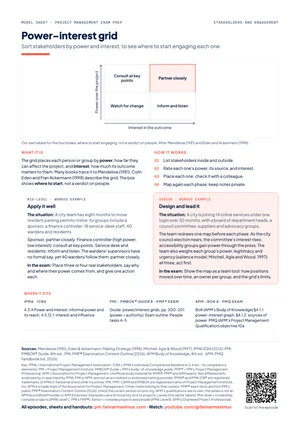
- Power–interest grid
- Places each stakeholder by power over the project and interest in its outcome, to choose where to start. Traced to Mendelow (1981); described by Eden and Ackermann (1998).
- Engagement levels
- Unaware, resistant, neutral, supportive, leading (the PMBOK® Guide's names). Mark each group now and needed; APM's analysis uses support, opposition or undecided.
- Expectation management
- Steering what stakeholders expect, so they expect what the project will really deliver, and when. The ICB4 builds it on the communication plan.
About the lesson’s level labels
Levels (this series' labels): Mid-level = moderately complex projects (IPMA Level C, PMI's PMP®); Senior = complex projects and people (IPMA Level B, APM's Chartered Project Professional).
These are the series’ teaching labels, not a declaration that the certifications are equivalent.
Read the transcript
Timed from the episode captions.
Open episode transcript
Sara: Welcome to Project Management Exam Prep.
This episode is about stakeholders and engagement.
Every project management exam tests it, and some weight it heavily.
Leo: You will learn how the three bodies frame it, how to analyse stakeholders by power
and interest, how to plan engagement, and how to manage expectations.
We finish with a drill, so keep a pen ready.
Sara: Let us start with the three lenses. What does IPMA® say?
Leo: IPMA®, the International Project Management Association, sets out its standard in
the Individual Competence Baseline, the ICB4.
Its element on stakeholders asks you to analyse them, set a strategy,
and engage them throughout, with the sponsor as an ambassador.
Two more elements feed it: relations and engagement, the personal side,
and power and interest, the informal side.
Sara: And PMI®?
Leo: PMI®, the Project Management Institute, publishes the PMBOK® Guide,
its guide to the project management body of knowledge.
The eighth edition has a stakeholders performance domain: identify stakeholders;
plan, manage and monitor their engagement.
The outline of PMI®'s Project Management Professional exam, the PMP®,
gives the topic three tasks: engage stakeholders, align their expectations,
and manage those expectations.
Sara: And APM?
Leo: APM, the Association for Project Management, publishes the APM Body of Knowledge.
Its section on stakeholder engagement names five steps, from identify to review.
The syllabus of APM's Project Management Qualification, the PMQ,
has an objective on stakeholder engagement and communication.
Sara: Where do the words differ?
Leo: In three places. First, APM has moved away from the term stakeholder management,
and speaks of engagement. The ICB4 and PMI® still speak of managing expectations.
Sara: Second?
Leo: Power. In PMI®'s grids, power means formal authority, and influence is a separate
axis. For the ICB4, power is any ability to influence others,
formal or not. APM plots influence, and looks behind it at the sources of power.
Sara: And third?
Leo: The plan. The ICB4 often puts the engagement strategy in a communication plan.
PMI® and APM keep a stakeholder engagement plan beside a communications plan.
Sara: What is the core, whichever exam you take?
Leo: Three ideas. One: a stakeholder is anyone who takes part in the project,
is affected by it, can affect it, or cares how it turns out.
In the end, they judge whether you succeeded.
So look wide, inside and outside, and include those who oppose you.
Sara: Two?
Leo: Engagement is a cycle. Identify stakeholders.
Analyse their interest, influence and attitude, and ask why.
Plan how to engage each group. Act on the plan.
Then review it, because people and settings change.
Sara: Does that change in agile work?
Leo: The rhythm does. In a linear project, engagement peaks at the start,
at each gate and at handover. In iterative work, stakeholders see working results
at every review, and the product owner, who speaks for users,
orders their priorities in the backlog.
So expectations are reset every few weeks.
Sara: And three?
Leo: Expectations. People should come to expect what the project will really deliver,
and when. So communication runs both ways.
Say early what is out of scope, and repeat it.
Check that each message arrived. And bring bad news early, while you can act.
Sara: How do I decide where to start?
Leo: With a power and interest grid. The model sheet is free in the description.
Many books trace it to Mendelow, in nineteen eighty-one.
Colin Eden and Fran Ackermann described the grid in nineteen ninety-eight.
Sara: How does it work?
Leo: It has two axes. Power is how far someone can affect the project.
Interest is how much its outcome matters to them.
The four box labels are our own. High power, high interest: partner closely.
High power, low interest: consult at key points, without flooding them with detail.
Low power, high interest: inform and listen; they often know the details.
Low on both: watch for change.
Sara: And the ICB4's element on power and interest?
Leo: It looks behind the grid. As the ICB4 puts it, "Power is the ability to influence
the behaviour of others." That is wider than authority, the formal right to decide.
Expertise, respect and relations count too, and each person's power has a reach.
People also have interests of their own, such as a career step.
So the box shows where to start, not how to treat a person.
Positions move, and weak groups can join forces.
Map again at each phase.
Sara: And the second model?
Leo: Engagement levels. The PMBOK® Guide names five: unaware, resistant,
neutral, supportive and leading. For each key group, mark two levels:
the current one, and the one the project needs, by a date.
The gap shows where to spend your effort.
Sara: Should everyone be leading?
Leo: No. The sponsor should lead. Most users need only support.
And resistance often comes with awareness.
That is a step, not a failure, so ask what people fear.
To move someone up, involve them: ask their advice, or give them a task or a part
in a decision. APM's analysis uses a simpler split for attitude:
support, opposition or undecided.
Sara: How does this change between Mid-level and Senior?
Leo: First, the two levels. They are this series' own labels.
Mid-level means leading moderately complex projects, the level of IPMA® Level C and
PMI®'s PMP® exam. Senior means leading complex projects and people,
the level of IPMA® Level B and of APM's chartered status, Chartered Project Professional.
At Mid-level, you run engagement well. Take Parking Permits Online,
a city project that moves resident parking permits online in eight months.
The project manager, Anna, maps the groups with her team and keeps a one-page engagement
plan. Parking fines are out of scope, so every letter to residents says fines do
not change.
Sara: And at Senior level?
Leo: You design engagement as a system. Take One City Account, a thirty-month city project
that brings fourteen online services under one login, led by Anna some years later.
Anna sets the needed level of each group for each phase, with an owner for each
group. The steering board reviews the gaps at every gate.
For a network this large, the team also weighs three things for each stakeholder:
power, whether the claim is legitimate, and how urgent it is.
That is the salience model of Mitchell, Agle and Wood.
Sara: Now the drill. A city is moving resident parking permits online in eight months.
Go-live comes just before January, when most residents renew.
In month six, two senior people expect different things.
The sponsor, the head of parking services, expects paper permits to end at go-live.
The head of the customer service centre expects her counters to keep issuing paper
permits through January. What do you do?
Leo: Pause and write your answer. You have forty-five seconds.
Sara: First, the analysis.
Leo: Both have high power and high interest: partner closely.
Their power has different sources. The sponsor owns the business case,
whose savings need paper to end. The service centre head controls the counters and
their staff. She fears queues in January.
She looks neutral now, and you need her supportive before go-live.
Sara: And then?
Leo: Meet each alone and listen. Then bring them together with the facts:
test results and a fallback plan. Help them agree one position.
For example, paper ends at go-live, the counters help residents renew online,
and paper returns only if online payments fail.
The sponsor decides, and you record it.
Update the engagement plan: one agreed message to staff and residents,
and a check two weeks later.
Sara: What lifts that to Senior?
Leo: A Senior answer fixes the system, not only the clash.
A stakeholder with high power and high interest had no seat where decisions are
made. Give the service centre a voice on the steering group.
Agree who decides changes to service channels, and on what evidence.
Set the trigger for paper in advance, so nobody argues in January.
Sara: How do the exams ask this?
Leo: IPMA®'s written exam asks for open answers; at Level B it may be oral.
IPMA®'s certification also includes an interview, where assessors ask about your
own projects, so note one stakeholder whose position you changed.
The PMP® exam uses scenarios. PMI®'s outline adds questions built on a case study
or a chart, so practise reading an engagement matrix.
APM's PMQ asks for short written answers, for example: why managing expectations
matters to success.
Sara: Let us recap.
Leo: One. Look wide: stakeholders include anyone who is affected by the project,
or can affect it.
Sara: Two. Engagement is a cycle: identify, analyse, plan, act and review.
In iterative work, it comes round at every review.
Leo: Three. The power and interest grid shows where to start.
Power is wider than authority, and positions move.
Sara: Four. Mark each group's engagement now and needed.
The gap directs your effort.
Leo: And five. Manage expectations: say what will not come, bring bad news early,
and let the owner decide when senior people disagree.
Sara: The two model sheets and the study handout are linked in the description.
Next time: conflict and crisis.
Sources & further reading
Consult the original publications and authoritative references below. For certification requirements, use the current official documents. Edition-specific page references are included only when verified.
- IPMA® (2015). Individual Competence Baseline for Project, Programme and Portfolio Management, Version 4.0 (ICB4). Zurich: International Project Management Association. ISBN 978-94-92338-00-6 (print), 978-94-92338-01-3 (pdf). Free PDF from IPMA®: https://ipma.world/ipma-standards-development-programme/icb4/
- Project Management Institute (2025). A Guide to the Project Management Body of Knowledge (PMBOK® Guide), Eighth Edition, and The Standard for Project Management. Newtown Square, PA: PMI®. ISBN 9781628258295.
- Project Management Institute (2026). Project Management Professional (PMP®)® Examination Content Outline – 2026 (July 2026 exam update). Newtown Square, PA: PMI®. PDF on pmi.org, accessed 26 September 2026.
- Association for Project Management (2025). APM Body of Knowledge, 8th edition. Princes Risborough: APM. ISBN 9781913305390.
- Association for Project Management (2024, version 6 of April 2026). APM Project Management Qualification: Handbook. https://www.apm.org.uk/media/3r4jbodr/apm-project-management-qualification-handbook.pdf, and the PMQ page https://www.apm.org.uk/qualifications-and-training/project-management-qualification/, accessed 26 September 2026.
- Mendelow, A. L. (1981). Environmental scanning: the impact of the stakeholder concept. Proceedings of the Second International Conference on Information Systems (ICIS 1981), Cambridge, MA, paper 20. https://aisel.aisnet.org/icis1981/20, accessed 26 September 2026.
- Eden, C. & Ackermann, F. (1998). Making Strategy: The Journey of Strategic Management. London: Sage. ISBN 9780761952251 (paperback); 9780761952244 (hardback).
- Mitchell, R. K., Agle, B. R. & Wood, D. J. (1997). Toward a theory of stakeholder identification and salience: defining the principle of who and what really counts. Academy of Management Review, 22(4), 853–886. https://doi.org/10.2307/259247
- IPMA® (2025). IPMA® International Certification Regulations (Public), Version 4.4, for the Assessment of Individuals in Project, Program & Portfolio Management. Zurich: International Project Management Association. https://ipma.world/app/uploads/2025/11/IPMA®-ICR-2025_v_4.4_digital.pdf, via https://ipma.world/ipma-certification/ipma-international-certification-regulations/, accessed 26 September 2026.
Original and technical references for the related tools
- GAO: Cost Estimating and Assessment Guide
Standard estimating practice; the cited guide documents use rather than claiming invention.
- Mitchell, Agle & Wood (1997): stakeholder identification and salience
Ronald K. Mitchell, Bradley R. Agle and Donna J. Wood, Academy of Management Review (1997). Original publication; this practical explanation is independently written.