8 minute read · Original practice exercise included
Before you start: Read communication and team working.
Read the lesson Explore tools and references
Next: Requirements and scope
Watch this lesson
Conflict and crisis
Watch on YouTubeOpen the people playlist
YouTube connects when you play a video or follow its links. Playback depends on the video’s availability on YouTube. Its own privacy and storage practices then apply. Voices are AI-generated.
Tools and references for this lesson
Use these resources to practise and extend the topic. Further applications may go beyond the lesson transcript; source pointers lead to the original author or publisher.
Conceptual models (6)
- Choosing a response to conflict
Conflict-handling modes provide different ways to balance your own concern with another person’s concern. The useful question is which response fits the stakes, relationship and time available. · Guide
- Leadership that fits the situation
Adjust the amount of direction and support to a particular task and the person’s current familiarity with it. Agree the arrangement rather than assigning a permanent label to the person. · Guide
- Psychological safety
Psychological safety concerns whether people can raise a question, concern or mistake without expecting interpersonal humiliation. It supports learning alongside clear standards of work. · Guide
- Reading a developing conflict
Look at how a disagreement is changing: can people still examine the problem together, or are threats and personal attacks making a constructive exchange harder? · Guide
- Reflection cycle
A reflection cycle turns an experience into a specific change you can try, instead of stopping at whether the event felt successful. · Guide
- Team development stages
Team-development stages offer a vocabulary for discussing how a group establishes working relationships and ways of delivering together. They describe a possible pattern, not a required timetable. · Guide
Check your understanding
Two people disagree about a design and the discussion is becoming personal. What should you establish before choosing a response?
Show answer and reasoning
Clarify the substantive issue, evidence, urgency, authority and immediate safety concerns. Restore a workable discussion or use an appropriate escalation route; do not diagnose people from a framework label.
Apply the same reasoning to your own example. State one assumption you would need to check.
Chapters
Jump to the corresponding passage in the transcript.
- OpeningWatch on YouTube
- One topic, three lensesWatch on YouTube
- The core in plain wordsWatch on YouTube
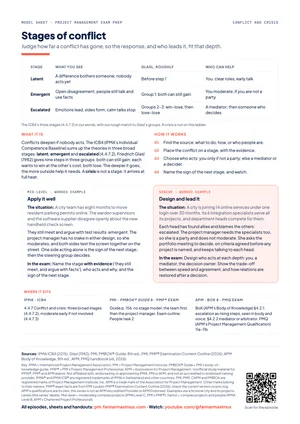
- Models and methods: stages of conflictWatch on YouTube
- Models and methods: five ways to handle conflictWatch on YouTube
- Mid-level and SeniorWatch on YouTube
- Exam drillWatch on YouTube
- RecapWatch on YouTube
Study materials
Open the original practice sheet · print or save as PDF
Anki package not yet available.
Key terms
The series’ own explanations. Official sources and edition pointers are below.
- Conflict
- A clash that matters to the people in it: over what to do, how to do it, or relationships. Handled with respect, it can improve decisions.
- Latent, emergent, escalated
- The ICB4's three broad stages of conflict: felt but not acted on; open, but still calm and factual; emotional, with sides taken.
- Five conflict modes
- Competing, collaborating, compromising, avoiding and accommodating (after Thomas and Kilmann). The PMBOK® Guide names five matching techniques, such as force/direct.
- Mediator and arbitrator
- A mediator helps the parties talk and find their own solution. An arbitrator hears both sides and decides for them.
- Positions and interests
- A position is what someone asks for; an interest is why they ask (after Fisher and Ury). Agreements built on interests last longer.
- Crisis
- A sudden event that threatens the project's goals at once, often with no conflict before it. Not a conflict stage: act, communicate, recover.
About the lesson’s level labels
Levels (this series' labels): Mid-level = moderately complex projects (IPMA Level C, PMI's PMP®); Senior = complex projects and people (IPMA Level B, APM's Chartered Project Professional).
These are the series’ teaching labels, not a declaration that the certifications are equivalent.
Read the transcript
Timed from the episode captions.
Open episode transcript
Sara: Welcome to Project Management Exam Prep.
This episode is about conflict and crisis.
Every project management exam tests it, because projects put people with different
interests under pressure.
Leo: You will learn how the three bodies frame it, how to judge and handle a conflict,
how to negotiate, and what to do in a crisis.
We finish with a drill, so keep a pen ready.
Sara: Let us start with the three lenses. What does IPMA® say?
Leo: IPMA®, the International Project Management Association, sets out its standard in
the Individual Competence Baseline, the ICB4.
Its element on conflict and crisis asks you to spot trouble early,
choose a response that fits, and help the team learn afterwards.
Negotiation has an element of its own.
Sara: And PMI®?
Leo: PMI®, the Project Management Institute, publishes the PMBOK® Guide,
its guide to the project management body of knowledge.
The eighth edition lists conflict management and negotiation among its tools.
The outline of PMI®'s Project Management Professional exam, the PMP®,
has a task called manage conflicts: find the sources, analyse the context,
and carry out an agreed resolution.
Sara: And APM?
Leo: APM, the Association for Project Management, publishes the APM Body of Knowledge.
Its section on conflict resolution includes negotiation.
The syllabus of APM's Project Management Qualification, the PMQ,
asks for the sources of conflict, its good and bad effects, and ways to handle it.
Sara: Where do the words differ?
Leo: In three places. First, the five ways of handling conflict.
APM uses the names from Thomas and Kilmann's model, such as competing.
PMI® uses pairs, such as force or direct.
PMI®'s smooth means giving way, not smoothing a schedule.
Sara: Second?
Leo: Stages. The ICB4 names three. PMI® has no stage model.
APM describes escalation as rising steps, with signs in body language and voice.
Sara: And third?
Leo: Crisis. The ICB4 pairs it with conflict.
PMI® mentions times of crisis and continuity plans.
APM has no crisis section; a crisis reaches the sponsor as an issue,
a problem beyond the project's limits.
Sara: What is the core, whichever exam you take?
Leo: Three ideas. One: conflict starts when people want different things,
and it matters to them. It can be about what to do, how to do it,
or the relationship, and it often starts with scarce people or clashing priorities.
Some conflict helps: a respectful disagreement finds better answers.
A team that never disagrees slides into groupthink, where nobody challenges a risky
plan.
Sara: Does that change in agile work?
Leo: The timing does. In a linear project, conflict often surfaces late,
at gates or in testing. In iterative work, the team writes ground rules early,
and each retrospective, the team's regular look back, brings friction out while
it is small.
Sara: Two?
Leo: When interests clash, negotiate. Roger Fisher and William Ury,
in Getting to Yes, give four rules. Keep the people apart from the problem.
Look behind each position, what someone asks for, to the interest,
why they ask. Invent options that serve both sides.
And judge them by a fair yardstick, such as a rule or a market price.
Sara: And three?
Leo: A crisis is not a conflict stage. It is sudden, often with no conflict before it.
So act, communicate, recover. Protect people first, speak early through one spokesperson,
then fix the cause and learn. The US Centers for Disease Control and Prevention,
in their Crisis and Emergency Risk Communication manual, name four phases:
preparation, before it; initial, the first hours; maintenance,
while it lasts; and resolution. So the work starts with a plan and a rehearsal.
Sara: How do I judge how far a conflict has gone?
The model sheets are free in the description.
Leo: The ICB4 sums up stage theories in three broad stages.
Latent: a difference bothers someone, but nobody acts yet.
Prevent it, with clear roles and early talks.
Emergent: it is in the open, but the parties still talk and use facts.
If you are not one of them, moderate. Escalated: emotions lead,
sides form, and calm talks stop. Now you need a mediator, who helps the parties
talk, or an arbitrator, who decides for them.
Friedrich Glasl gives a finer scale: nine steps in three groups.
First, win-win: both sides can still come out well.
Then win-lose: each wants to win at the other's cost.
Finally, lose-lose: harming the other matters more than their own losses.
In an answer, name the stage with your evidence, and the sign of the next one.
Sara: Once I know the stage, how do I respond?
Leo: Kenneth Thomas and Ralph Kilmann place five ways of handling conflict on two scales:
how hard you push for your own concern, and how much you help with the other side's.
The table on screen is our own. Competing: you push yours through.
It fits when safety or a legal duty is at stake, or there is no time.
Collaborating: you solve it together. It fits when both concerns matter and there
is time, but it takes the most work. Compromising: each side gives up part.
It fits when power is equal and time is short, but it may not last.
Avoiding: you step back for now. It fits a minor issue, or when tempers must cool.
Say when you will return. Accommodating: you give way, when it matters far more
to them.
Sara: So collaborating is always best?
Leo: No. The PMBOK® Guide says each technique has its place.
Stakes, time, power and the relationship decide.
So name the mode, and say why.
Sara: How does this change between Mid-level and Senior?
Leo: First, the two levels. They are this series' own labels.
Mid-level means leading moderately complex projects, the level of IPMA® Level C and
PMI®'s PMP® exam. Senior means leading complex projects and people,
the level of IPMA® Level B and of APM's chartered status, Chartered Project Professional.
At Mid-level, you handle your own project's conflicts.
Take Parking Permits Online, a city project that moves resident parking permits
online in eight months. The warden supervisors and the supplier disagree about the
screen wardens use to check permits, but still talk: emergent.
The project manager, Anna, has no stake in either design, so she moderates:
both sides test the screen on the street.
Sara: And at Senior level?
Leo: You design how disputes are settled, and sometimes you decide.
Take One City Account, a thirty-month city project that brings fourteen online services
under one login, led by Anna some years later.
Two suppliers blame each other for a failing link between their systems:
escalated. The contracts' dispute route takes three weeks: too slow.
So Anna rules within a week who fixes it, inside the limit the board delegated to
her. Then she reviews the cause with both, since she needs them for two more years.
Sara: Now the drill. A city has just moved resident parking permits online.
Two days after go-live, the wardens' handheld devices start showing valid permits
as expired. By ten o'clock, wardens have issued thirty fines by mistake,
and a journalist calls. The supplier blames the city's network;
the city's IT team blames the supplier.
You are the project manager. What do you do in the first hours?
Leo: Pause and write your answer. You have forty-five seconds.
Sara: Where do you start?
Leo: Name it: a crisis, not a conflict stage.
Act first: ask the sponsor, who runs parking services, to stop permit fines until
the devices are right. Then communicate, with one voice.
The sponsor and the steering group hear first; the city's communications team answers
the journalist. Each update says what we know, what we do not know yet,
what we are doing, and the time of the next update.
Sara: And the blame?
Leo: Set it aside, on purpose: that is avoiding, with a date to return to it.
On the fix, be directive: one named lead, both teams in one room.
Then recover: cancel the wrong fines, and write to the residents affected.
Later, collaborate: both teams review the root cause, not the blame.
Sara: What lifts that to Senior?
Leo: The system. Agree before go-live who may declare a crisis and stop fines.
Set a trigger in advance: if there is no fix by noon, permit checks stop for the
day. Weigh speed against complete facts.
And keep the review from becoming a fight over claims: the city needs the supplier
for years.
Sara: How do the exams ask this?
Leo: IPMA®'s written exam asks for open answers; at Level B it may be oral.
IPMA®'s certification also includes an interview, where assessors ask about your
own projects, so note one conflict you handled and why you chose your approach.
The PMP® exam uses scenarios, and questions built on a case study or a chart.
APM's PMQ asks for short written answers, such as two ways conflict can help a project.
Sara: Let us recap.
Leo: One. Conflict comes from what to do, how to do it, or the relationship.
Some conflict helps.
Sara: Two. When interests clash, look behind positions to interests.
Leo: Three. Judge the stage: latent, emergent or escalated.
Deeper means more outside help.
Sara: Four. Compete, collaborate, compromise, avoid or accommodate:
the situation decides, so say why.
Leo: And five. A crisis is not a conflict stage.
Act, communicate with one voice, then recover and learn.
Sara: The two model sheets and the study handout are linked in the description.
Next time: requirements and scope.
Sources & further reading
Consult the original publications and authoritative references below. For certification requirements, use the current official documents. Edition-specific page references are included only when verified.
- IPMA® (2015). Individual Competence Baseline for Project, Programme and Portfolio Management, Version 4.0 (ICB4). Zurich: International Project Management Association. ISBN 978-94-92338-00-6 (print), 978-94-92338-01-3 (pdf). Free PDF from IPMA®: https://ipma.world/ipma-standards-development-programme/icb4/
- Project Management Institute (2025). A Guide to the Project Management Body of Knowledge (PMBOK® Guide), Eighth Edition, and The Standard for Project Management. Newtown Square, PA: PMI®. ISBN 9781628258295.
- Project Management Institute (2026). Project Management Professional (PMP®)® Examination Content Outline – 2026 (July 2026 exam update). Newtown Square, PA: PMI®. PDF on pmi.org, accessed 26 September 2026.
- Association for Project Management (2025). APM Body of Knowledge, 8th edition. Princes Risborough: APM. ISBN 9781913305390.
- Association for Project Management (2024, version 6 of April 2026). APM Project Management Qualification: Handbook. https://www.apm.org.uk/media/3r4jbodr/apm-project-management-qualification-handbook.pdf, and the PMQ page https://www.apm.org.uk/qualifications-and-training/project-management-qualification/, accessed 26 September 2026.
- Thomas, K. W. (1976). Conflict and conflict management. In M. D. Dunnette (ed.), Handbook of Industrial and Organizational Psychology (pp. 889–935). Chicago: Rand McNally.
- Kilmann, R. H. & Thomas, K. W. (1977). Developing a forced-choice measure of conflict-handling behavior: the "MODE" instrument. Educational and Psychological Measurement, 37(2), 309–325. https://doi.org/10.1177/001316447703700204
- Thomas, K. W. (1977). Toward multi-dimensional values in teaching: the example of conflict behaviors. Academy of Management Review, 2(3), 484–490. https://doi.org/10.5465/amr.1977.4281851
- Glasl, F. (1982). The process of conflict escalation and roles of third parties. In G. B. J. Bomers & R. B. Peterson (eds.), Conflict Management and Industrial Relations (pp. 119–140). Boston: Kluwer-Nijhoff. https://doi.org/10.1007/978-94-017-1132-6_6
- Fisher, R., Ury, W. & Patton, B. (2011). Getting to Yes: Negotiating Agreement Without Giving In, 3rd ed. New York: Penguin. ISBN 9780143118756.
- Centers for Disease Control and Prevention (CDC). Crisis and Emergency Risk Communication (CERC) Manual, chapters "Introduction" (2018 update), "Messages and Audiences" (last updated 2018) and "Spokesperson" (last updated 2014). Available free of charge at cdc.gov/cerc, accessed 26 September 2026. Its use here does not imply endorsement by CDC, HHS or the U.S. Government.
- IPMA® (2025). IPMA® International Certification Regulations (Public), Version 4.4, for the Assessment of Individuals in Project, Program & Portfolio Management. Zurich: International Project Management Association. https://ipma.world/app/uploads/2025/11/IPMA®-ICR-2025_v_4.4_digital.pdf, via https://ipma.world/ipma-certification/ipma-international-certification-regulations/, accessed 26 September 2026.