8 minute read · Original practice exercise included
Before you start: Define the project outcome and decision owners.
Read the lesson Explore tools and references
Next: Schedule
Watch this lesson
Requirements and scope
Watch on YouTubeOpen the planning and control playlist
YouTube connects when you play a video or follow its links. Playback depends on the video’s availability on YouTube. Its own privacy and storage practices then apply. Voices are AI-generated.
Tools and references for this lesson
Use these resources to practise and extend the topic. Further applications may go beyond the lesson transcript; source pointers lead to the original author or publisher.
Calculators (5)
- Pareto counts and cumulative share
Rank recorded problem categories to focus investigation. · Calculator + guide
- Defect density and removal efficiency
Track observed defects on a consistent measurement boundary. · Calculator + guide
- Make-or-buy cost comparison
Compare an in-house fixed-plus-variable cost with an external unit price. · Calculator + guide
- Incentive contract cost threshold
Calculate when an illustrative incentive-price formula reaches its ceiling. · Calculator + guide
- Process capability: Cp and Cpk
Compare a stable process’s spread and centring with specification limits. · Calculator + guide
Conceptual models (2)
- Work breakdown structure
A work breakdown structure decomposes agreed scope into manageable elements with boundaries and accountable owners. It organises the work; it does not by itself show its sequence. · Guide
- MoSCoW prioritisation
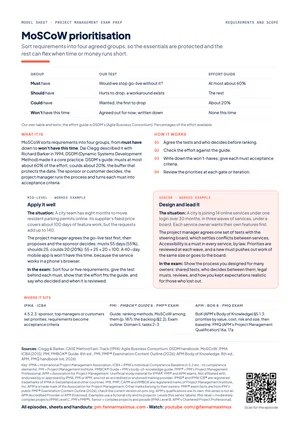
MoSCoW separates what a delivery increment must include from what is important, optional or explicitly outside this increment. It makes scope flexibility visible before time runs out. · Guide
Further applications (4)
- Quantifying a change request
Compare a proposed scope change with a clearly defined no-change baseline. · Guide
- Scope baseline changes
Distinguish approved scope change from unapproved expansion and incomplete delivery. · Guide
- Cost of quality
Compare the cost of preventing and detecting errors with the consequences of failures. · Guide
- Statistical process control
Distinguish routine process variation from signals that merit investigation. · Guide
Original framework and research sources (2)
- Plan–Do–Study–Act
Connect a small test with evidence and a deliberate learning decision. · Source pointer
- EFQM Model
Find an organisational assessment approach for improvement work. · Source pointer
Check your understanding
A requested feature sounds small. What should a change assessment check?
Show answer and reasoning
Check acceptance criteria, dependencies, effort, risk, benefits and the approved baseline. Compare the change with a no-change option and obtain the required decision before changing commitments.
Apply the same reasoning to your own example. State one assumption you would need to check.
Chapters
Jump to the corresponding passage in the transcript.
- OpeningWatch on YouTube
- One topic, three lensesWatch on YouTube
- The core in plain wordsWatch on YouTube
- Models and methods: MoSCoW prioritisationWatch on YouTube
- Models and methods: the work breakdown structureWatch on YouTube
- Mid-level and SeniorWatch on YouTube
- Exam drillWatch on YouTube
- RecapWatch on YouTube
Study materials
Open the original practice sheet · print or save as PDF
Anki package not yet available.
Key terms
The series’ own explanations. Official sources and edition pointers are below.
- Requirement
- What a result must have or do to meet a need. Needs often go unsaid, so they are drawn out, written down, traced to an objective and agreed.
- Acceptance criteria
- The checks a deliverable must pass before it is accepted, agreed before the work starts. In agile work, a definition of done adds checks shared by every item.
- MoSCoW
- Must have, should have, could have, won't have this time. Described by Dai Clegg and Richard Barker (1994); a core practice of the DSDM agile framework.
- Scope and exclusions
- What the project delivers and the work that produces it, plus a written list of what it does not include. The ICB4 and APM count outcomes and benefits in scope.
- Work breakdown structure (WBS)
- A tree that divides all of the project's work into smaller parts, down to work packages with clear boundaries and one owner each.
- Scope creep
- Scope that grows while time, cost and resources stay the same (after the PMBOK® Guide). A change that is logged, assessed and decided by the right person is not creep.
About the lesson’s level labels
Levels (this series' labels): Mid-level = moderately complex projects (IPMA Level C, PMI's PMP®); Senior = complex projects and people (IPMA Level B, APM's Chartered Project Professional).
These are the series’ teaching labels, not a declaration that the certifications are equivalent.
Read the transcript
Timed from the episode captions.
Open episode transcript
Sara: Welcome to Project Management Exam Prep.
This episode is about requirements and scope: what a project must deliver,
and where it stops. Every project management exam tests it, because every plan is
built on the scope.
Leo: You will learn how the three bodies frame it, how to rank requirements,
how to break the scope down, and how agile work changes it.
We finish with a drill, so keep a pen ready.
Sara: Let us start with the three lenses. What does IPMA® say?
Leo: IPMA®, the International Project Management Association, sets out its standard in
the Individual Competence Baseline, the ICB4.
It gives this topic two elements. Requirements and objectives is the why:
from the organisation's goals down to agreed requirements.
Scope is the what: the deliverables, how the work breaks down,
and keeping one agreed version.
Sara: And PMI®?
Leo: PMI®, the Project Management Institute, publishes the PMBOK® Guide,
its guide to the project management body of knowledge.
The eighth edition has a scope performance domain, from drawing out requirements
to the formal acceptance of each deliverable.
The outline of PMI®'s Project Management Professional exam, the PMP®,
asks you to define the scope, get stakeholders to agree it, and break it down.
Sara: And APM?
Leo: APM, the Association for Project Management, publishes the APM Body of Knowledge.
Its sections on requirements management and solutions development cover finding
the best solution, then defining its scope.
The syllabus of APM's Project Management Qualification, the PMQ,
has objectives with the same names, and adds the minimum viable product.
Sara: Where do the words differ?
Leo: In three places. First, what scope covers.
For the ICB4 and APM, it includes outcomes and benefits.
For PMI®, it is the products and the work.
Sara: Second?
Leo: The breakdown. The ICB4 and APM add a product breakdown structure to the work breakdown.
PMI®'s guide adds a value breakdown structure, which ties each deliverable to its
value.
Sara: And third?
Leo: One agreed version. The ICB4 says scope configuration, and APM configuration management.
PMI® speaks of the scope baseline, changed only through change control.
Sara: What is the core, whichever exam you take?
Leo: Three ideas. One: needs become requirements.
People rarely say all they need, because some needs seem too obvious to mention.
So you draw them out, in workshops, interviews and by watching the work.
Write each requirement down, and trace it to the objective it serves.
Test the objectives with SMART, after George Doran in nineteen eighty-one.
A common version reads specific, measurable, achievable, relevant and time-bound.
And give each requirement acceptance criteria: the checks a deliverable must pass
before it is accepted.
Sara: Two?
Leo: Scope sets the boundary: what the project delivers, the work that produces it,
and, in writing, what it does not include.
Every request is judged against that line.
Sara: Does that change in agile work?
Leo: Yes. In a linear project, you fix the scope early.
In iterative work, the scope lives in a backlog, an ordered list of possible work,
and each iteration takes the items at the top.
The first release is often a minimum viable product: the smallest version real users
can try. Time and cost are often fixed, so the scope flexes.
Sara: And three?
Leo: Change is normal; creep is not. Scope creep, as PMI® describes it,
is scope that grows while time, cost and resources stay the same,
often through small favours asked of one developer.
So log each request, assess it, and let the right person decide.
Change control has its own episode later in the series.
Sara: Now the models, both on free sheets in the description.
What if the requirements need more than the budget?
Leo: A common method is MoSCoW. Dai Clegg described it with Richard Barker in nineteen
ninety-four, and the agile framework DSDM, the Dynamic Systems Development Method,
made it a core practice. Must have: without it, the result is useless,
unsafe or illegal. Should have: it hurts to leave out, but a workaround exists.
Could have: wanted, and the first to go.
Won't have this time: agreed out for now, and written down.
Sara: How do I stop everything becoming a must?
Leo: Agree a test first. For example: if it were missing the day before go-live,
would we stop the launch? DSDM also gives a guide: musts at most about sixty percent
of the effort, and coulds about twenty, as the buffer that protects the date.
The sponsor or the customer decides. You run the process, and turn each must into
acceptance criteria.
Sara: Once the scope is agreed, how do you break it down?
Leo: With a work breakdown structure, or WBS: a tree that divides all of the project's
work into smaller parts. Level one is the project, level two the main deliverables
plus project management, and the lowest level the work packages.
The ICB4 describes two ways to divide: by the stages of the work,
or by the parts of the result. We prefer the parts, because a deliverable can be
checked and accepted.
Sara: How do I know nothing is missing?
Leo: Use the hundred percent rule, credited to Gregory Haugan and named in the PMBOK®
Guide. The parts under each element hold all of its work, no more and no less.
Each work package has clear boundaries and one owner, and a WBS dictionary describes
it. If its cost or duration is still unclear, the ICB4 calls it a planning package.
In iterative work, keep the WBS shallow: a user story plays the part of a work package.
Sara: How does this change between Mid-level and Senior?
Leo: First, the two levels. They are this series' own labels.
Mid-level means leading moderately complex projects, the level of IPMA® Level C and
PMI®'s PMP® exam. Senior means leading complex projects and people,
the level of IPMA® Level B and of APM's chartered status, Chartered Project Professional.
At Mid-level, you hold the scope of one project.
Take Parking Permits Online, a city project that moves resident parking permits
online in eight months. The project manager, Anna, runs workshops with residents,
service-desk staff and wardens. Her WBS fits on one page.
Beside it sit the exclusions, such as the parking fines process,
which stays as it is.
Sara: And at Senior level?
Leo: You design the scope system that others work in.
Take One City Account, a thirty-month city project that brings fourteen online services
under one login, led by Anna some years later.
Each service owner wants their features first.
So Anna agrees one set of MoSCoW tests with the steering board,
which settles conflicts between services.
Accessibility is a must everywhere, by law.
Services that come later stay planning packages until their turn.
Sara: So the Senior answer is about the system: who decides, and on what evidence.
Sara: Now the drill. A city team has eight months to move resident parking permits online,
before January, when most residents renew.
The supplier's fixed price covers one hundred and twenty days of feature work.
The workshops asked for one hundred and sixty.
The sponsor marks one hundred of those days as musts, including a forty-day mobile
app. How do you make the list fit?
Leo: Pause and write your answer. You have forty-five seconds.
Sara: First, the numbers.
Leo: The list is forty days too long, and the musts fill over eighty percent of the days
available. DSDM's guide says at most about sixty percent.
So multiply the days available by point six: at most seventy-two days of musts.
The musts must lose at least twenty-eight days.
Sara: And the moves?
Leo: Agree the test with the sponsor first. Would you stop the launch without the app?
No: residents can use the service in a phone's browser.
So the app is won't have this time. That removes forty days, and leaves sixty days
of musts, half of the days available. You propose; the sponsor decides.
Give each must an acceptance criterion, write the app into the exclusions,
and have the steering group sign off the baseline.
Sara: What lifts that to Senior?
Leo: The date has no tolerance, so agree in writing that the scope flexes.
Offer a real choice: the app after January, or now as a funded change,
with its risk to the date. Set a rule: a new must pushes out work of the same size,
or goes to the steering group. And tell service-desk staff and wardens early what
waits.
Sara: How do the exams ask this?
Leo: IPMA®'s written exam asks for open answers; at Level B it may be oral.
IPMA®'s certification also includes an interview, where assessors ask about your
own projects, so note one scope you defended.
The PMP® exam uses scenarios, and questions built on a case study or a chart.
APM's PMQ asks for short written answers, such as the steps of requirements management:
gather, analyse, justify and baseline.
Sara: Let us recap.
Leo: One. Draw needs out, write them as requirements, and give each one acceptance criteria.
Sara: Two. Rank a long list with MoSCoW. Agree the test first, and keep the musts to about
sixty percent.
Leo: Three. Scope includes its exclusions. In iterative work, the backlog holds it.
Sara: Four. A WBS breaks all the work into work packages, and the hundred percent rule
keeps it complete.
Leo: And five. Change is normal. Creep is change that nobody decided.
Sara: The model sheets and the study handout are linked in the description.
Next time: the schedule.
Sources & further reading
Consult the original publications and authoritative references below. For certification requirements, use the current official documents. Edition-specific page references are included only when verified.
- IPMA® (2015). Individual Competence Baseline for Project, Programme and Portfolio Management, Version 4.0 (ICB4). Zurich: International Project Management Association. ISBN 978-94-92338-00-6 (print), 978-94-92338-01-3 (pdf). Free PDF from IPMA®: https://ipma.world/ipma-standards-development-programme/icb4/
- Project Management Institute (2025). A Guide to the Project Management Body of Knowledge (PMBOK® Guide), Eighth Edition, and The Standard for Project Management. Newtown Square, PA: PMI®. ISBN 9781628258295.
- Project Management Institute (2026). Project Management Professional (PMP®)® Examination Content Outline – 2026 (July 2026 exam update). Newtown Square, PA: PMI®. PDF on pmi.org, accessed 26 September 2026.
- Association for Project Management (2025). APM Body of Knowledge, 8th edition. Princes Risborough: APM. ISBN 9781913305390.
- Association for Project Management (2024, version 6 of April 2026). APM Project Management Qualification: Handbook. https://www.apm.org.uk/media/3r4jbodr/apm-project-management-qualification-handbook.pdf, and the PMQ page https://www.apm.org.uk/qualifications-and-training/project-management-qualification/, accessed 26 September 2026.
- IPMA® (2025). IPMA® International Certification Regulations (Public), Version 4.4, for the Assessment of Individuals in Project, Program & Portfolio Management. Zurich: International Project Management Association. https://ipma.world/app/uploads/2025/11/IPMA®-ICR-2025_v_4.4_digital.pdf, via https://ipma.world/ipma-certification/ipma-international-certification-regulations/, accessed 26 September 2026.
- Doran, G. T. (1981). There's a S.M.A.R.T. way to write management's goals and objectives. Management Review, 70(11), 35–36.
- Clegg, D. & Barker, R. (1994). CASE Method Fast-Track: A RAD Approach. Wokingham: Addison-Wesley. ISBN 9780201624328.
- Agile Business Consortium. "MoSCoW Prioritisation". In DSDM Project Framework Handbook (online edition; the framework was first printed in 2014). https://www.agilebusiness.org/dsdm-project-framework/moscow-prioritisation.html, accessed 26 September 2026.
- Haugan, G. T. (2002). Effective Work Breakdown Structures. Project Management Essential Library. Vienna, VA: Management Concepts. ISBN 9781567261356.
Original and technical references for the related tools
- NIST: process capability
Standard process-capability indices. This implementation uses the published mathematical definitions without copying diagrams.
- NIST/SEMATECH: statistical methods
Standard mathematical statistics; the handbook is an authoritative technical reference, not a claim of sole origin.
- GAO: Cost Estimating and Assessment Guide
Standard estimating practice; the cited guide documents use rather than claiming invention.
- Federal Acquisition Regulation: incentive contracts
Standard incentive-contract arithmetic. The link gives one jurisdiction’s contractual context, not a universal rule.
- NIST: control charts
Walter A. Shewhart developed statistical control charts. NIST is a later technical reference, not their inventor.