8 minute read · Original practice exercise included
Before you start: Understand dependencies, durations and resource constraints.
Read the lesson Explore tools and references
Next: Estimation
Watch this lesson
Critical path and resource levelling
Watch on YouTubeOpen the methods playlist
YouTube connects when you play a video or follow its links. Playback depends on the video’s availability on YouTube. Its own privacy and storage practices then apply. Voices are AI-generated.
Tools and references for this lesson
Use these resources to practise and extend the topic. Further applications may go beyond the lesson transcript; source pointers lead to the original author or publisher.
Calculators (5)
- Capacity and utilisation
Compare required effort with genuinely available person-hours. · Calculator + guide
- Critical-path network calculator
Calculate earliest and latest dates and total float, then draw an activity-on-node (AON) diagram with critical paths highlighted. · Calculator + guide
- Schedule crashing cost slope
Compare additional activity cost per unit of possible duration reduction. · Calculator + guide
- Three-point fixed-path estimate
Combine weighted activity means and approximate variances on one defined path. · Calculator + guide
- Cumulative-average learning curve
Explore declining average effort for repeated comparable production. · Calculator + guide
Conceptual models (6)
- Milestone plan
A milestone marks a verifiable state or decision in delivery. It helps coordinate commitments without pretending to be the detailed schedule. · Guide
- Resource plan
A resource plan connects the work to the skills, capacity and availability required to perform it. · Guide
- Critical path method (CPM)
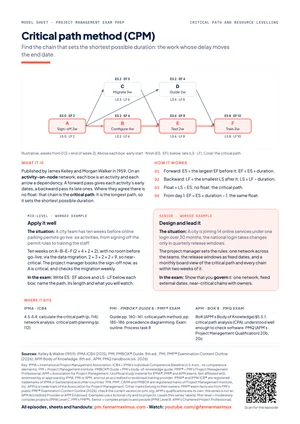
Find the chain that sets the shortest possible duration: the work whose delay moves the end date. · Study sheet
- Resource histogram and levelling
Set the people the plan needs per period against those available, and remove the overloads. · Study sheet
- Schedule compression
Schedule compression seeks an earlier finish by changing how critical work is performed, overlapped or resourced. · Guide
- Total float and free float
How long each activity can slip before the end date moves, or before the next activity must wait. · Study sheet
Step-by-step methods (2)
- Find what controls the finish
The critical path is the longest duration chain through a valid dependency network under the schedule’s assumptions. It can change as durations and logic change. · Guide
- Turn availability into a capacity plan
Work from usable time and the skills required. Separate effort from elapsed duration and allow for real operational commitments. · Guide
Further applications (5)
- Dependencies and lags
Represent the actual conditions that allow work to begin or finish. · Guide
- Resource loading over time
Translate scheduled activities into time-phased demand for particular people, skills or equipment. · Guide
- Milestone trend analysis
Track how successive forecasts of the same milestone change over time. · Guide
- Resource levelling and smoothing
Adjust work timing to make resource demand feasible or less uneven. · Guide
- Skill coverage and competence gaps
Compare the capabilities needed for the work with evidenced availability. · Guide
Original framework and research sources (1)
- Critical chain and constraints
Investigate resource constraints and schedule protection through the originating author’s work. · Source pointer
Check your understanding
A dependency-only schedule finishes in 12 days. Two parallel critical activities need the same unavailable specialist. Is 12 days still a reliable commitment?
Show answer and reasoning
No. The network calculation assumes sufficient resources. Apply the actual availability constraints and reassess the schedule; resource levelling may extend the finish date.
Apply the same reasoning to your own example. State one assumption you would need to check.
Chapters
Jump to the corresponding passage in the transcript.
- OpeningWatch on YouTube
- One topic, three lensesWatch on YouTube
- The core in plain wordsWatch on YouTube
- Models and methods: the forward and backward passWatch on YouTube
- Models and methods: float and levellingWatch on YouTube
- Mid-level and SeniorWatch on YouTube
- Exam drillWatch on YouTube
- RecapWatch on YouTube
Study materials
Open the original practice sheet · print or save as PDF
Anki package not yet available.
Key terms
The series’ own explanations. Official sources and edition pointers are below.
- Activity on node
- A network in which each activity is a box and each arrow a dependency. PMI® calls the drawing method precedence diagramming; APM speaks of a precedence network.
- Forward and backward pass
- Two sweeps through the network. Forward gives early starts and finishes, taking the largest finish where arrows meet. Backward gives late dates, taking the smallest start.
- Critical path
- The longest path through the network, so it sets the shortest possible duration. Its activities have no float: a delay on any of them moves the end date.
- Total float and free float
- Total float: how long an activity can slip before the end date moves (late start − early start). Free float: how long before the next activity must start later.
- Resource histogram
- Bars showing how many people the plan needs in each period, against a line for the people available. Bars above the line are overloads.
- Resource smoothing and levelling
- Smoothing holds the end date and shifts work only inside float (APM: it may also change the people). Levelling keeps the people limit and lets the date move. PMI® spells it leveling.
About the lesson’s level labels
Levels (this series' labels): Mid-level = moderately complex projects (IPMA Level C, PMI's PMP®); Senior = complex projects and people (IPMA Level B, APM's Chartered Project Professional).
These are the series’ teaching labels, not a declaration that the certifications are equivalent.
Read the transcript
Timed from the episode captions.
Open episode transcript
Sara: Welcome to Project Management Exam Prep.
This episode is about the critical path and resource levelling.
It asks which work sets the end date, and whether the people are there when needed.
Leo: You will learn to draw the network, find the critical path, read the float,
and fit the plan to your people. We finish with a calculation drill,
so keep a pen ready.
Sara: Let us start with the three lenses. What does IPMA® say?
Leo: IPMA®, the International Project Management Association, sets out its standard in
the Individual Competence Baseline, the ICB4.
Its element on time asks you to calculate the critical path and level the resources
of a given plan. Scarce people, it notes, can change that path.
Its element on resources links people to the schedule.
Sara: And PMI®?
Leo: PMI®, the Project Management Institute, publishes the PMBOK® Guide,
its guide to the project management body of knowledge.
Its eighth edition lists the critical path method, leveling and smoothing among
its tools. The outline of PMI®'s Project Management Professional exam,
the PMP®, covers them in two tasks: plan and manage the schedule,
and plan and manage resources.
Sara: And APM?
Leo: APM, the Association for Project Management, publishes the APM Body of Knowledge.
It calls the method critical path analysis: software does the calculation,
but you must be able to check it. The syllabus of APM's Project Management Qualification,
the PMQ, asks how smoothing differs from levelling.
Sara: Where do the words differ?
Leo: In two places. First, the name: the critical path method for PMI®,
critical path analysis for APM, and network analysis in the ICB4.
Second, smoothing. For PMI®, it moves work only within float.
APM also lets it add or remove people on an activity, so that the date holds.
Sara: What is the core, whichever exam you take?
Leo: Three ideas. One: draw the logic, with a box for each activity and an arrow for
each dependency. That is activity on node.
Most arrows are finish-to-start: one activity ends, then the next begins.
Other kinds let work overlap; this network needs none.
Sara: Two?
Leo: Every path must be finished, so the longest one sets the end date.
That is the critical path. Other activities have float, room to slip.
Sara: And three?
Leo: People are a limit too: a week that needs more people than you have cannot run as
drawn.
Sara: And in agile work?
Leo: A timebox fixes the time and the team, and the scope flexes, so there is little
to level inside it. But hybrid plans keep a network above the timeboxes,
for fixed dates, suppliers and hand-offs between teams.
Sara: Now the method, on a free model sheet in the description.
Leo: James Kelley and Morgan Walker published the critical path method in nineteen fifty-nine.
Take a city team's last ten weeks before go-live, with four people.
A, the sign-off of the rules, takes two weeks and two people.
B, C and D follow it. B, configure: four weeks, two people.
C, migrate the data: three weeks, two people.
D, the service-desk guide: two weeks, one person.
E, the test, follows B and C: two weeks, four people.
F, training, follows D and E: two weeks, three people.
Sara: Now the forward pass.
Leo: It gives each activity's early start and early finish.
Count from zero, so a start of two means the end of week two.
Add the duration to get the early finish.
An activity starts only when all its predecessors are done, so where arrows meet,
take the largest finish. A goes from zero to two.
B, C and D start at two. B ends at six, C at five, and D at four.
E waits for B and C: six to eight. F waits for D and E: eight to ten.
Ten weeks.
Sara: And the backward pass?
Leo: It works back from the end. Subtract the duration to get the late start.
An activity must end before its first successor must start, so where arrows split,
take the smallest start. F must start by eight, and E by six.
D must end by eight, for training, so it must start by six.
B and C must end by six, for the test. So B must start by two,
and C by three. A must end by two.
Sara: Where is the critical path?
Leo: First, total float: how long an activity can slip without moving the end date.
It is late start minus early start. A, B, E and F have none.
C has one week: three minus two. D has four: six minus two.
The chain with no float, A, B, E and F, is the critical path:
ten weeks. The path through C takes nine: it is near-critical,
so watch it too.
Sara: And free float?
Leo: How long an activity can slip before the next one must start later:
the next early start, minus its own early finish.
For C, six minus five: one week. Here both kinds are equal.
They differ when two activities with float follow each other.
If the first slips, the second starts later, but the end date holds.
Sara: Now the people.
Leo: Add up the people week by week in the early-start plan: that is the resource histogram.
In weeks three and four, B, C and D run together.
They need five people, one more than the team has.
Sara: What do I do?
Leo: First, ask for a fifth person for those two weeks.
If you cannot, try resource smoothing: the end date stays, and work moves only within
float. Here it fails. Between weeks three and eight, only one week has room.
D needs two weeks in a row, so some week always needs five.
Resource levelling keeps the limit of four, and lets the date move.
When people are short, the least float goes first.
So D waits for C's people until the end of week five.
At the end of week six, the test needs four, but D still holds one.
So the test waits a week, and go-live moves to the end of week eleven.
Sara: How does this change between Mid-level and Senior?
Leo: First, the two levels. They are this series' own labels.
Mid-level means leading moderately complex projects, the level of IPMA® Level C and
PMI®'s PMP® exam. Senior means leading complex projects and people,
the level of IPMA® Level B and of APM's chartered status, Chartered Project Professional.
At Mid-level, you calculate and act on your own plan.
Take Parking Permits Online, a city project that moves resident parking permits
online in eight months. The project manager, Anna, finds that levelling its last
ten weeks costs a week. So she asks her steering group: a fifth person for two weeks,
or go-live a week later, nearer January, when most residents renew?
Sara: And at Senior level?
Leo: You set the scheduling rules for others.
Take One City Account, a thirty-month city project that brings fourteen online services
under one login, led by Anna some years later.
Six integration specialists serve all the city's projects, so people,
not only logic, set Anna's dates. The steering board agrees her rule.
Work tied to the national login's quarterly releases keeps its date and buys extra
people. Other work is levelled to the city's allocation.
Sara: Now the drill. A city team has ten weeks and four people before a new online service
goes live. Its plan is the worked example's network, on screen again.
Now C's estimate drops from three weeks to two.
What is the critical path, and can you stay at four people without moving go-live?
Leo: Pause and write your answer. You have forty-five seconds.
Sara: First, the network.
Leo: C now ends at four. The test still starts at six, after B.
So C may start as late as four. Its total float is four minus two:
two weeks. The critical path is still A, B, E and F: ten weeks.
Sara: And the people?
Leo: Weeks three and four still need five: B, C and D.
But weeks five and six now need only B's two.
So smooth: move D two weeks later, into weeks five and six.
No week needs more than four, go-live holds, and D keeps two weeks of float.
Moving C also fits, but it leaves the migration no float.
Sara: What lifts that to Senior?
Leo: The date has almost no tolerance, so keep C's spare weeks as a visible buffer for
the migration. Agree D's new weeks with the guide writers' line manager.
And set a rule: who may spend float, and who must be told.
Sara: How do the exams ask this?
Leo: IPMA®'s exams ask for open answers. IPMA®'s certification also includes an interview,
where assessors ask about your own projects: note one plan you levelled.
The PMP® exam uses scenarios, and questions built on a case study or a chart:
practise reading a network. APM's PMQ asks for short written answers,
such as how smoothing differs from levelling.
Sara: Let us recap.
Leo: One. Draw the logic: boxes for activities, arrows for dependencies.
Sara: Two. Forward, take the largest finish. Backward, take the smallest start.
Leo: Three. Total float is late start minus early start.
None means critical.
Sara: Four. The histogram adds up the people per week.
Leo: And five. Ask for people first. Smoothing keeps the date; levelling keeps the limit.
Sara: The three model sheets and the study handout are free in the description.
Next time: estimation.
Sources & further reading
Consult the original publications and authoritative references below. For certification requirements, use the current official documents. Edition-specific page references are included only when verified.
- IPMA® (2015). Individual Competence Baseline for Project, Programme and Portfolio Management, Version 4.0 (ICB4). Zurich: International Project Management Association. ISBN 978-94-92338-00-6 (print), 978-94-92338-01-3 (pdf). Free PDF from IPMA®: https://ipma.world/ipma-standards-development-programme/icb4/
- Kelley, J. E. & Walker, M. R. (1959). Critical-path planning and scheduling. Proceedings of the Eastern Joint Computer Conference, 160–173.
- Project Management Institute (2025). A Guide to the Project Management Body of Knowledge (PMBOK® Guide), Eighth Edition, and The Standard for Project Management. Newtown Square, PA: PMI®. ISBN 9781628258295.
- Project Management Institute (2026). Project Management Professional (PMP®)® Examination Content Outline – 2026 (July 2026 exam update). Newtown Square, PA: PMI®. PDF on pmi.org, accessed 26 September 2026.
- Association for Project Management (2025). APM Body of Knowledge, 8th edition. Princes Risborough: APM. ISBN 9781913305390.
- Association for Project Management (2024, version 6 of April 2026). APM Project Management Qualification: Handbook. https://www.apm.org.uk/media/3r4jbodr/apm-project-management-qualification-handbook.pdf, and the PMQ page https://www.apm.org.uk/qualifications-and-training/project-management-qualification/, accessed 26 September 2026.
- IPMA® (2025). IPMA® International Certification Regulations (Public), Version 4.4, for the Assessment of Individuals in Project, Program & Portfolio Management. Zurich: International Project Management Association. https://ipma.world/app/uploads/2025/11/IPMA®-ICR-2025_v_4.4_digital.pdf, via https://ipma.world/ipma-certification/ipma-international-certification-regulations/, accessed 26 September 2026.
Original and technical references for the related tools
- Kelley & Walker (1959): Critical-Path Planning and Scheduling
James E. Kelley Jr. and Morgan R. Walker; originating critical-path publication.
- Wright (1936): Factors Affecting the Cost of Airplanes
T. P. Wright; original publication on the learning relationship.
- GAO: Schedule Assessment Guide
Common scheduling practice. The critical-path method is associated with James E. Kelley Jr. and Morgan R. Walker; their 1959 paper is the historical reference.
- Malcolm, Roseboom, Clark & Fazar (1959): PERT
D. G. Malcolm, J. H. Roseboom, C. E. Clark and W. Fazar, Application of a Technique for Research and Development Program Evaluation (1959). This calculator uses a simplified fixed-path approximation, not the entire original procedure.
- GAO: Cost Estimating and Assessment Guide
Standard estimating practice; the cited guide documents use rather than claiming invention.
- NASA: learning and cost-improvement curves
Theodore P. Wright is associated with the cumulative-average learning curve. It differs from a unit-time curve.