8 minute read · Original practice exercise included
Before you start: Read the business-case lesson; use consistent monetary units.
Read the lesson Explore tools and references
Next: Resources
Watch this lesson
Cost, budget and finance
Watch on YouTubeOpen the planning and control playlist
YouTube connects when you play a video or follow its links. Playback depends on the video’s availability on YouTube. Its own privacy and storage practices then apply. Voices are AI-generated.
See the calculation
An additional teaching example for the lecture’s distinction between budget and cash flow. Opening cash is 8,000 currency units; period flows are −6,000, −7,000, +5,000 and +9,000. These are not the transcript’s project-budget figures.
Scroll sideways to see the full chart. Exact values are available in the chart data below.
Read the chart data
| Period | Net flow | Balance before funding |
|---|---|---|
| 0 | Opening cash | 8,000 |
| 1 | -6,000 | 2,000 |
| 2 | -7,000 | -5,000 |
| 3 | 5,000 | 0 |
| 4 | 9,000 | 9,000 |
Tools and references for this lesson
Use these resources to practise and extend the topic. Further applications may go beyond the lesson transcript; source pointers lead to the original author or publisher.
Calculators (13)
- Benefit-cost ratio and net return
Compare present-value benefits and costs on one consistent boundary. · Calculator + guide
- Break-even volume
Find how much output is needed to cover fixed cost. · Calculator + guide
- Cash-flow funding gap
Find the worst cumulative shortfall in a time-phased cash plan. · Calculator + guide
- Present and future value
Put a single cash amount on a common time basis. · Calculator + guide
- Internal rate of return
Find the break-even discount rate for a conventional investment cash-flow sequence. · Calculator + guide
- Level-payment annuity
Value an equal payment at the end of each period. · Calculator + guide
- Make-or-buy cost comparison
Compare an in-house fixed-plus-variable cost with an external unit price. · Calculator + guide
- Nominal to real rate
Align a nominal rate with cash flows measured at constant prices. · Calculator + guide
- Simple and discounted payback
Estimate when positive receipts recover the initial outlay. · Calculator + guide
- Earned schedule
Translate earned value into equivalent baseline time. · Calculator + guide
- Incentive contract cost threshold
Calculate when an illustrative incentive-price formula reaches its ceiling. · Calculator + guide
- Straight-line depreciation
Separate a simple accounting charge from cash spending. · Calculator + guide
- Weighted average cost of capital
Combine equity and after-tax debt costs using financing weights. · Calculator + guide
Conceptual models (4)
- Cost aggregation
Cost aggregation rolls estimates into a coherent budget while preserving the ability to see what the totals contain. · Guide
- Reserves in the budget
A reserve is funding held for uncertainty under an explicit release rule. Showing reserves separately makes the remaining exposure and decision rights visible. · Guide
- Earned value forecasting
Earned-value forecasts estimate final cost under stated assumptions about the efficiency of remaining work. Several forecasts can be useful precisely because their assumptions differ. · Guide
- Earned value: progress and cost
Earned value compares the budgeted value of completed work with planned work and actual cost at the same status date. · Guide
Formulas (8)
- Cost performance index
Measure the budgeted value earned per unit of actual cost. · Guide
- Cost variance
Compare the budgeted value of completed work with what that work actually cost. · Guide
- Estimate at completion
Forecast final cost assuming the cost efficiency observed so far continues. · Guide
- Estimate to complete
Separate forecast spending still to come from money already spent. · Guide
- Schedule performance index
Measure the amount of budgeted work earned relative to what was planned by the status date. · Guide
- Schedule variance
Compare completed work with the work planned by a status date, expressed in budget units. · Guide
- Variance at completion
Show the difference between the work budget and the forecast final cost. · Guide
- To-complete performance index
Calculate the cost efficiency required on the remaining work to finish within the original work budget. · Guide
Step-by-step methods (1)
- Build and challenge an earned-value forecast
First validate the baseline and actual costs. Then choose the forecast assumption that fits the remaining work, rather than the number that best fits the budget. · Calculator + guide
Further applications (4)
- Life-cycle cost and total cost of ownership
Compare the cost of acquiring, operating, maintaining and eventually replacing or retiring an option. · Guide
- Measuring physical completion
Define observable evidence for crediting completed work. · Guide
- Currency exposure
Identify how cash flows in different currencies change a project’s funding needs. · Guide
- Variance thresholds and trends
Set explicit triggers for investigating a departure from an agreed baseline. · Guide
Check your understanding
An option has positive NPV but a large cash shortfall before receipts arrive. Is it affordable?
Show answer and reasoning
Positive NPV does not establish affordability. Inspect the cumulative cash plan and funding availability at each date, as well as the assumptions behind the discount rate and receipts.
Apply the same reasoning to your own example. State one assumption you would need to check.
Chapters
Jump to the corresponding passage in the transcript.
- OpeningWatch on YouTube
- One topic, three lensesWatch on YouTube
- The core in plain wordsWatch on YouTube
- Models and methods: cost aggregation and reservesWatch on YouTube
- Models and methods: cash flow and the forecastWatch on YouTube
- Mid-level and SeniorWatch on YouTube
- Exam drillWatch on YouTube
- RecapWatch on YouTube
Study materials
Open the original practice sheet · print or save as PDF
Anki package not yet available.
Key terms
The series’ own explanations. Official sources and edition pointers are below.
- Cost aggregation
- Adding cost estimates up from work packages to control accounts to the whole project, so the budget is built from the work. PMI®'s name for the step.
- Control account
- A group of work packages with one owner, where budget, schedule and actual costs are compared. A PMI® term, also used with earned value.
- Cost baseline
- PMI®'s term for the approved budget spread over time, without the management reserve; changed only through change control. APM treats the cash flow forecast as the first baseline.
- Committed cost
- A cost bound by an order or a contract but not yet paid. The ICB4 calls these liabilities; APM speaks of commitments.
- Funding and financing
- The ICB4 says funding for money from inside the organisation and financing for money from outside, such as a loan. PMI® and APM say funding for both.
- Forecast of the final cost
- Spent, plus committed, plus the estimate still to come. PMI® calls it the estimate at completion. Compare it with the whole budget.
About the lesson’s level labels
Levels (this series' labels): Mid-level = moderately complex projects (IPMA Level C, PMI's PMP®); Senior = complex projects and people (IPMA Level B, APM's Chartered Project Professional).
These are the series’ teaching labels, not a declaration that the certifications are equivalent.
Read the transcript
Timed from the episode captions.
Open episode transcript
Sara: Welcome to Project Management Exam Prep.
This episode is about cost, budget and finance.
Every project management exam tests it, because money shows whether a plan is real.
Leo: You will learn how the three bodies frame it, how to build a budget from the work,
and how to forecast the final cost. We finish with a drill, so keep a pen ready.
Sara: First, the three lenses. What does IPMA® say?
Leo: IPMA®, the International Project Management Association, sets out its standard in
the Individual Competence Baseline, the ICB4.
Its element on finance covers money going out and money coming in.
In our words, it asks you to build the budget, secure the funds,
and report so that cost breaches show early.
Sara: And PMI®?
Leo: PMI®, the Project Management Institute, publishes the PMBOK® Guide,
its guide to the project management body of knowledge.
The eighth edition has a finance performance domain.
The outline of PMI®'s Project Management Professional exam, the PMP®,
has a task to plan and manage finance, including contingency and the financial reserves.
Sara: And APM?
Leo: APM, the Association for Project Management, publishes the APM Body of Knowledge.
Its section on budgeting and cost control runs from cost planning to closing the
accounts. The syllabus of APM's Project Management Qualification,
the PMQ, has an objective with the same name.
It asks for the cost types in a budget, and how to close down the finances.
Sara: Where do the words differ?
Leo: In three places. First, money coming in.
The ICB4 says funding when it comes from inside the organisation,
and financing when it comes from outside, such as a loan.
PMI® and APM say funding for both.
Sara: Second?
Leo: The budget spread over time. PMI® calls it the cost baseline.
APM calls the spending profile a cash flow forecast, its first baseline for spending.
Sara: And third?
Leo: Costs you have ordered but not yet paid.
The ICB4 calls them liabilities. APM says commitments.
Sara: What is the core, whichever exam you take?
Leo: Three ideas. One: a budget is built from the work.
Estimate each work package with the people who will do it, and sort the costs by
type. Direct costs belong to the work, such as staff time.
Indirect costs are shared, such as office overheads.
Fixed costs stay the same whatever the volume, and variable costs grow with it.
Then challenge them, because first estimates are usually optimistic.
Sara: Two?
Leo: Money has a timeline. Spread the costs over the schedule, and set them against when
the funds arrive, often in steps at each gate.
Sara: And three?
Leo: Control means forecasting. Each month, compare the plan with the actual costs and
the signed orders. Forecast the final cost, and act while there is still time.
Sara: Does that change in agile work?
Leo: The shape changes. A stable team costs about the same in every iteration,
so most of the cost is fixed. The budget is often set for a quarter,
then reviewed. When money is short, the sponsor funds fewer iterations,
and the team delivers the most valuable items first.
Sara: How do you get from estimates to a budget?
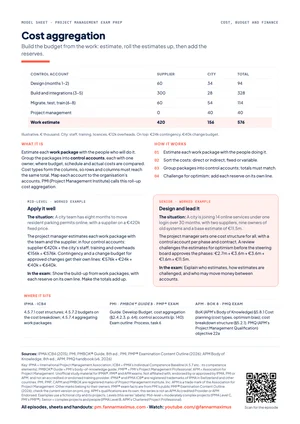
Leo: You add up in layers. The model sheets, free in the description,
have the full example. You group the work packages into control accounts.
Each control account has one owner, and it is where budget, schedule and actual
costs meet. Map each account to your finance team's own cost lines.
Sara: Can we have numbers?
Leo: Take an eight-month city project, in thousands of euros.
The supplier's fixed price is four hundred and twenty.
The city's own staff, training and overheads add one hundred and fifty-six.
So the work costs five hundred and seventy-six.
Sara: Is that the budget?
Leo: Not yet. Add twenty-four of contingency for the known risks.
That makes six hundred: PMI®'s cost baseline, if your organisation keeps contingency
inside it. Money held above you sits outside it.
Here, that is a change budget of forty, which the steering group releases for approved
changes only. So the budget is six hundred and forty.
Larger projects add a management reserve for risks nobody has found.
Keep each layer on its own line, and name who may release it.
Sara: And once the money starts to flow?
Leo: Each cost passes three moments. It is committed when you sign the order,
incurred when the work is done, and paid when the invoice is settled.
Finance often reports only what is paid, and that lags behind your orders.
Sara: So what do you report?
Leo: A forecast of the final cost: spent, plus committed, plus the estimate still to
come. PMI® calls it the estimate at completion.
Compare it with the whole budget. Earned value gives a second forecast,
from progress. It has its own episode.
Sara: And the cash flow?
Leo: Add the costs month by month, and set them against the funds released.
Say two hundred and fifty thousand euros come at the start, and the next funds at
a gate, a decision point, in month five.
If the plan spends three hundred thousand by month four, you are fifty thousand
short. So act early: move a payment or the work, or ask for an earlier release.
PMI® calls this check funding limit reconciliation: planned spending must never run
ahead of the money released.
Sara: How does this change between Mid-level and Senior?
Leo: First, the two levels. They are this series' own labels.
Mid-level means leading moderately complex projects, the level of IPMA® Level C and
PMI®'s PMP® exam. Senior means leading complex projects and people,
the level of IPMA® Level B and of APM's chartered status, Chartered Project Professional.
At Mid-level, you run one budget well. Take Parking Permits Online,
a city project that moves resident parking permits online in eight months.
The project manager, Anna, builds its budget of six hundred and forty thousand euros
from the work packages. Each month, she reports spent, committed and still to come.
Sara: And at Senior level?
Leo: You design the financial system that others work in.
Take One City Account, a thirty-month city project that brings fourteen online services
under one login, led by Anna some years later.
Its budget is thirteen and a half million euros.
Anna sets one cost structure for every service and supplier.
Funds are released at each phase gate, but the last release is decided after the
city council election in month twenty. So she shows the steering board early what
could wait if that money comes late.
Sara: Now the drill. A city is moving resident parking permits online in eight months.
At the end of month five, Finance reports three hundred thousand euros spent,
out of six hundred and forty thousand, reserves included.
The sponsor is pleased: less than half is gone.
But orders worth two hundred and twenty thousand are signed and not yet paid.
A trial data migration shows one hundred and thirty thousand of work still to come.
Is the project on budget, and what do you do?
Leo: Pause and write your answer. You have forty-five seconds.
Sara: First, the numbers.
Leo: Add all three: three hundred, two hundred and twenty, and one hundred and thirty.
The forecast is six hundred and fifty thousand, ten thousand over the whole budget.
A quicker check: spent and committed make five hundred and twenty.
That leaves one hundred and twenty of the budget, for one hundred and thirty of
work. The spent figure misled, because it left out the orders.
Sara: And the actions?
Leo: Check with Finance that every order is in.
Look for savings, such as cleaning some data at the source.
Then report now, not at go-live: the breach is beyond your authority.
Give the steering group the forecast, the cause, the options and your recommendation.
Sara: What lifts that to Senior?
Leo: Treat it as a trend: if one estimate was low, test the others,
and give a range. Weigh the trade-off: most residents renew in January,
and a late go-live would cost far more than ten thousand.
Propose a new reserve for the open risks.
Bring the team and the supplier into the fix, without blame.
Sara: How do the exams ask this?
Leo: IPMA®'s written exam asks for open answers; at Level B it may be oral.
IPMA®'s certification also includes an interview, where assessors ask about your
own projects, so note one cost breach you reported.
The PMP® exam uses scenarios, and PMI®'s outline adds questions built on a case study
or a chart: practise the forecast. APM's PMQ asks for short written answers,
for example how to close down the finances.
Sara: Let us recap.
Leo: One. Build the budget from the work, then add each reserve on its own line.
Sara: Two. Know the cost types: direct or indirect, fixed or variable.
Leo: Three. Set the spending against the funds, and close any gap before it opens.
Sara: Four. Forecast the final cost: spent, plus committed, plus still to come.
Report a breach early, with options.
Leo: And five. The bodies' words differ, but the moves are the same.
Sara: The model sheets and the study handout are linked in the description.
Next time: resources.
Sources & further reading
Consult the original publications and authoritative references below. For certification requirements, use the current official documents. Edition-specific page references are included only when verified.
- IPMA® (2015). Individual Competence Baseline for Project, Programme and Portfolio Management, Version 4.0 (ICB4). Zurich: International Project Management Association. ISBN 978-94-92338-00-6 (print), 978-94-92338-01-3 (pdf). Free PDF from IPMA®: https://ipma.world/ipma-standards-development-programme/icb4/
- Project Management Institute (2025). A Guide to the Project Management Body of Knowledge (PMBOK® Guide), Eighth Edition, and The Standard for Project Management. Newtown Square, PA: PMI®. ISBN 9781628258295.
- Project Management Institute (2026). Project Management Professional (PMP®)® Examination Content Outline – 2026 (July 2026 exam update). Newtown Square, PA: PMI®. PDF on pmi.org, accessed 26 September 2026.
- Association for Project Management (2025). APM Body of Knowledge, 8th edition. Princes Risborough: APM. ISBN 9781913305390.
- Association for Project Management (2024, version 6 of April 2026). APM Project Management Qualification: Handbook. https://www.apm.org.uk/media/3r4jbodr/apm-project-management-qualification-handbook.pdf, and the PMQ page https://www.apm.org.uk/qualifications-and-training/project-management-qualification/, accessed 26 September 2026.
- IPMA® (2025). IPMA® International Certification Regulations (Public), Version 4.4, for the Assessment of Individuals in Project, Program & Portfolio Management. Zurich: International Project Management Association. https://ipma.world/app/uploads/2025/11/IPMA®-ICR-2025_v_4.4_digital.pdf, via https://ipma.world/ipma-certification/ipma-international-certification-regulations/, accessed 26 September 2026.
Original and technical references for the related tools
- OpenStax: Principles of Finance, capital budgeting
Standard financial mathematics; no single inventor is asserted.
- OpenStax: calculating WACC
Standard corporate-finance calculation; no single inventor is asserted.
- GAO: Cost Estimating and Assessment Guide
Standard estimating practice; the cited guide documents use rather than claiming invention.
- Walt Lipke: original earned-schedule papers
Walt Lipke introduced earned schedule in “Schedule Is Different” (2003).
- Federal Acquisition Regulation: incentive contracts
Standard incentive-contract arithmetic. The link gives one jurisdiction’s contractual context, not a universal rule.