8 minute read · Original practice exercise included
Before you start: Understand scope, schedule and the difference between effort and duration.
Watch this lesson
Resources
Watch on YouTubeOpen the planning and control playlist
YouTube connects when you play a video or follow its links. Playback depends on the video’s availability on YouTube. Its own privacy and storage practices then apply. Voices are AI-generated.
Tools and references for this lesson
Use these resources to practise and extend the topic. Further applications may go beyond the lesson transcript; source pointers lead to the original author or publisher.
Calculators (5)
- Capacity and utilisation
Compare required effort with genuinely available person-hours. · Calculator + guide
- Descriptive statistics
Describe a numeric sample before choosing more advanced analysis. · Calculator + guide
- Correlation and simple regression
Describe a linear relationship between paired observations. · Calculator + guide
- Survey sample size for a proportion
Plan the number of completed responses for a simple random sample. · Calculator + guide
- Cumulative-average learning curve
Explore declining average effort for repeated comparable production. · Calculator + guide
Conceptual models (1)
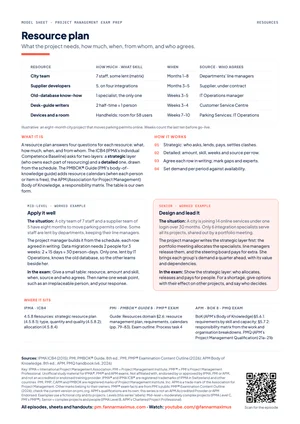
- Resource plan
A resource plan connects the work to the skills, capacity and availability required to perform it. · Guide
Formulas (1)
- Three-point estimation
Use optimistic, most likely and pessimistic estimates to make uncertainty explicit. · Guide
Step-by-step methods (2)
- Turn availability into a capacity plan
Work from usable time and the skills required. Separate effort from elapsed duration and allow for real operational commitments. · Guide
- Estimate with a range
Discuss distinct scenarios before calculating a weighted average. The explanation for the range is often more useful than the middle number. · Calculator + guide
Further applications (10)
- Analogous and parametric estimating
Use comparable historical work or a defensible quantity-rate relationship to estimate new work. · Guide
- Conditional probability and independence
Distinguish the chance of an event from its chance after learning that another event occurred. · Guide
- Resource loading over time
Translate scheduled activities into time-phased demand for particular people, skills or equipment. · Guide
- Units, periods and price bases
Check that a calculation combines quantities measured on compatible bases. · Guide
- Weighted averages and percentage changes
Combine measurements using weights that match the question and keep ratio denominators explicit. · Guide
- Estimate maturity and uncertainty
Explain how scope definition, evidence and estimation method affect the confidence in an estimate. · Guide
- Normal models and confidence intervals
Quantify sampling uncertainty when a distributional model and sampling design justify it. · Guide
- Resource levelling and smoothing
Adjust work timing to make resource demand feasible or less uneven. · Guide
- Skill coverage and competence gaps
Compare the capabilities needed for the work with evidenced availability. · Guide
- Software size and effort estimation
Keep product size, team-relative effort and elapsed duration distinct. · Guide
Original framework and research sources (1)
- Reference class forecasting
Challenge an estimate using outcomes from a defensibly comparable class of completed projects. · Source pointer
Check your understanding
Four people each offer five days at six usable hours per day. How much effort is available, and what might still constrain delivery?
Show answer and reasoning
4 × 5 × 6 = 120 person-hours. Skills, sequencing, shared resources and coordination may still constrain elapsed time. Total effort cannot substitute for a missing specialist.
Apply the same reasoning to your own example. State one assumption you would need to check.
Chapters
Jump to the corresponding passage in the transcript.
- OpeningWatch on YouTube
- One topic, three lensesWatch on YouTube
- The core in plain wordsWatch on YouTube
- Models and methods: the resource planWatch on YouTube
- Models and methods: effort, duration and capacityWatch on YouTube
- Mid-level and SeniorWatch on YouTube
- Exam drillWatch on YouTube
- RecapWatch on YouTube
Study materials
Open the original practice sheet · print or save as PDF
Key terms
The series’ own explanations. Official sources and edition pointers are below.
- Resource
- Anything the work needs that someone must provide: people and their skills, equipment, facilities, materials and tools. Money is one too, but budgets are managed as finance.
- Strategic resource plan
- The ICB4's top layer of the resource plan: who is responsible for each part of resourcing, such as who asks for people, who lends them and who settles a clash.
- Resource manager or line manager
- The person with authority over staff lent to a project. PMI® and APM say resource manager; the ICB4 speaks of line management in the permanent organisation.
- Effort and duration
- Effort is the amount of work, in person-days. Duration is the time from start to finish. Duration = effort ÷ the people, each counted by their share of time.
- Capacity
- The work a person or team can take on in a period, after meetings, leave and other duties. In iterative work, a stable team's capacity is fixed and the work is fitted to it.
- Resource calendar
- PMI®'s term for when each person or item is available to the project, including leave, part-time work and other commitments.
About the lesson’s level labels
Levels (this series' labels): Mid-level = moderately complex projects (IPMA Level C, PMI's PMP®); Senior = complex projects and people (IPMA Level B, APM's Chartered Project Professional).
These are the series’ teaching labels, not a declaration that the certifications are equivalent.
Read the transcript
Timed from the episode captions.
Open episode transcript
Sara: Welcome to Project Management Exam Prep.
This episode is about resources: the people, skills and things a project needs.
Every project management exam tests it, because a plan is only real if someone can
do the work.
Leo: You will learn how the three bodies frame it, how to plan resources and secure people,
and why effort is not duration. We finish with a drill, so keep a pen ready.
Sara: Let us start with the three lenses. What does IPMA® say?
Leo: IPMA®, the International Project Management Association, sets out its standard in
the Individual Competence Baseline, the ICB4.
Its element on resources asks you, in our words, to plan what the project needs
and who is responsible for it, to negotiate for people, and to settle conflicts.
Sara: And PMI®?
Leo: PMI®, the Project Management Institute, publishes the PMBOK® Guide,
its guide to the project management body of knowledge.
The eighth edition has a resources performance domain, from planning resources to
leading the team. The outline of PMI®'s Project Management Professional exam,
the PMP®, has a task to plan and manage resources, balancing needs against availability.
Sara: And APM?
Leo: APM, the Association for Project Management, publishes the APM Body of Knowledge.
It has two sections: resource capacity planning, which sets demand against capacity
across projects, and resource management, which allocates people to the work.
The syllabus of APM's Project Management Qualification, the PMQ,
asks how resources are allocated in linear and iterative schedules.
Sara: Where do the words differ?
Leo: In three places. First, what a resource is.
The ICB4 lists people, expertise and things.
PMI® splits the team from physical or virtual resources, such as licences.
APM says anything the project needs, but focuses on people.
Sara: Second?
Leo: The person who lends you staff. PMI® and APM say resource manager.
The ICB4 speaks of line management.
Sara: And third?
Leo: The plan's name. The ICB4 asks for a strategic resource plan:
who is responsible for what. PMI®'s resource management plan says how resources will
be managed. APM calls the view across projects resource capacity planning.
Sara: What is the core, whichever exam you take?
Leo: Three ideas. One: a resource is anything the work needs that someone must provide.
People and skills come first, then equipment, facilities, materials and tools.
Money counts too, but the budget has its own episode.
Look hardest for the scarce ones: the one specialist, the one test environment.
Sara: Two?
Leo: You rarely own your people. In a matrix organisation, staff lent to the project
keep their line manager, who decides their time.
So ask early, for named people and set weeks, in writing.
When two projects want one person, settle it by priority, through a route agreed
in advance.
Sara: And three?
Leo: Resourcing never stops, because people fall ill and estimates prove wrong.
So compare planned and real use, and correct early.
When a skill is missing, agree training with the person and whoever lends them.
Sara: Does that change in agile work?
Leo: Yes. In a linear project, you allocate people to activities, and design skills are
needed mostly early. In iterative work, you keep a stable team,
and design skills are needed throughout.
You fit the work to the team's capacity, not the team to the work.
Book shared specialists for each iteration, or build the skill inside the team.
Sara: Now the model, on a free sheet in the description.
Leo: A resource plan answers four questions for each resource: what,
how much, when, and from whom. The ICB4 builds it in two layers.
The strategic layer says who is responsible: who asks for people,
who lends them, who pays for extra, and who settles a clash.
The detailed layer comes from the schedule: each resource, with its amount,
skill and weeks.
Sara: For example?
Leo: Take an eight-month city project that moves parking permits online.
Seven city staff, some lent by departments.
Five supplier developers. One database specialist from IT Operations,
the only person who knows the old data.
And a training room for fifty-eight users.
Each row names who must agree.
Sara: And the skills?
Leo: A skills matrix sets the skills the work needs against each person.
It shows a skill nobody has, and a skill only one person has.
PMI® adds resource calendars: when each person is free.
APM adds a responsibility assignment matrix: who does each work package,
and in which role.
Sara: Next, a small calculation. What is the difference between effort and duration?
Leo: Effort is the amount of work, in person-days.
Duration is the time from start to finish.
Duration is effort divided by the people, each counted by their share of time.
So twenty person-days take one person twenty working days, and two people ten.
One person at half time needs forty. But more people do not always mean less time:
some work cannot be split, and newcomers must learn first.
Sara: And capacity?
Leo: Capacity is the work a person or team can take on in a period,
after meetings, leave and support. In iterative work, it is the planning unit.
Five people with ten working days each give at most fifty person-days per iteration,
before leave and other duties.
Sara: And if demand is higher than capacity?
Leo: Resource smoothing keeps the end date, and resource levelling lets it move.
Both are in the episode on critical path and resource levelling.
Sara: How does this change between Mid-level and Senior?
Leo: First, the two levels. They are this series' own labels.
Mid-level means leading moderately complex projects, the level of IPMA® Level C and
PMI®'s PMP® exam. Senior means leading complex projects and people,
the level of IPMA® Level B and of APM's chartered status, Chartered Project Professional.
At Mid-level, you resource your own project well.
Take Parking Permits Online, a city project that moves resident parking permits
online in eight months. The project manager, Anna, agrees each lent person's weeks
with their line manager, in writing. The data migration depends on one specialist
from IT Operations, so Anna books her early and pairs a colleague with her.
Sara: And at Senior level?
Leo: You design how people are shared across projects.
Take One City Account, a thirty-month city project that brings fourteen online services
under one login, led by Anna some years later.
The city's six integration specialists serve all its projects,
and its portfolio meeting shares them out.
Anna brings the demand for each wave, a group of services that goes live together,
a quarter ahead, with its value and dependencies.
And she develops people: customer-service staff move from counter work to digital
help, planned with the union that represents them.
Sara: Now the drill. A city project is moving resident parking permits online,
before most residents renew in January.
The end-to-end test is on the critical path, and needs four people for two weeks.
Two are service-desk staff, lent by the Customer Service Centre.
A week before the test, their line manager says the desk is short of staff,
so she can release them only half-time.
What is the gap, and what do you do?
Leo: Pause and write your answer. You have forty-five seconds.
Sara: First, the numbers.
Leo: The test needs forty person-days: four people for ten working days.
Two half-time people make one full-time person, so you have three people,
not four. You are ten person-days short: one person for two weeks.
The effort does not shrink, so the test would run longer, and go-live with it.
Sara: And the moves?
Leo: Talk to the line manager today, and ask what the desk needs.
Then offer options. The project pays for a temporary worker at the desk,
so the testers stay full-time. Or bring in a fourth tester, with time to learn.
Or test the riskiest paths first. If you cannot agree within two days,
take the options to the steering group.
Sara: What lifts that to Senior?
Leo: The date has almost no tolerance, so set a deadline for the decision.
Weigh both sides: the desk serves residents today, and a paid replacement protects
the desk and the date. Then fix the system: agree with each lending department its
notice period, and who settles a clash.
And protect the two testers: they should not have to choose between two bosses.
Sara: How do the exams ask this?
Leo: IPMA®'s written exam asks for open answers; at Level B it may be oral.
IPMA®'s certification also includes an interview, where assessors ask about your
own projects, so note one person you negotiated for.
The PMP® exam uses scenarios, and questions built on a case study or a chart.
APM's PMQ asks for short written answers, for example how the life cycle changes
the skills you need.
Sara: Let us recap.
Leo: One. A resource is anything the work needs that someone must provide.
Find the scarce ones early.
Sara: Two. A resource plan has two layers: who is responsible, then what,
how much, when and from whom.
Leo: Three. In a matrix, line managers decide your people's time: ask early,
and agree it in writing.
Sara: Four. Effort is work, and duration is time: effort divided by the people available.
Leo: And five. In iterative work, keep the team stable, and fit the work to its capacity.
Sara: The model sheet and the study handout are linked in the description.
Next time: procurement and contracts.
Sources & further reading
Consult the original publications and authoritative references below. For certification requirements, use the current official documents. Edition-specific page references are included only when verified.
- IPMA® (2015). Individual Competence Baseline for Project, Programme and Portfolio Management, Version 4.0 (ICB4). Zurich: International Project Management Association. ISBN 978-94-92338-00-6 (print), 978-94-92338-01-3 (pdf). Free PDF from IPMA®: https://ipma.world/ipma-standards-development-programme/icb4/
- Project Management Institute (2025). A Guide to the Project Management Body of Knowledge (PMBOK® Guide), Eighth Edition, and The Standard for Project Management. Newtown Square, PA: PMI®. ISBN 9781628258295.
- Project Management Institute (2026). Project Management Professional (PMP®)® Examination Content Outline – 2026 (July 2026 exam update). Newtown Square, PA: PMI®. PDF on pmi.org, accessed 26 September 2026.
- Association for Project Management (2025). APM Body of Knowledge, 8th edition. Princes Risborough: APM. ISBN 9781913305390.
- Association for Project Management (2024, version 6 of April 2026). APM Project Management Qualification: Handbook. https://www.apm.org.uk/media/3r4jbodr/apm-project-management-qualification-handbook.pdf, and the PMQ page https://www.apm.org.uk/qualifications-and-training/project-management-qualification/, accessed 26 September 2026.
- IPMA® (2025). IPMA® International Certification Regulations (Public), Version 4.4, for the Assessment of Individuals in Project, Program & Portfolio Management. Zurich: International Project Management Association. https://ipma.world/app/uploads/2025/11/IPMA®-ICR-2025_v_4.4_digital.pdf, via https://ipma.world/ipma-certification/ipma-international-certification-regulations/, accessed 26 September 2026.
Original and technical references for the related tools
- Wright (1936): Factors Affecting the Cost of Airplanes
T. P. Wright; original publication on the learning relationship.
- NIST/SEMATECH: statistical methods
Standard mathematical statistics; the handbook is an authoritative technical reference, not a claim of sole origin.
- GAO: Cost Estimating and Assessment Guide
Standard estimating practice; the cited guide documents use rather than claiming invention.
- NASA: learning and cost-improvement curves
Theodore P. Wright is associated with the cumulative-average learning curve. It differs from a unit-time curve.
- GAO: Schedule Assessment Guide
Common scheduling practice. The critical-path method is associated with James E. Kelley Jr. and Morgan R. Walker; their 1959 paper is the historical reference.