8 minute read · Original practice exercise included
Before you start: Know the requirement, constraints and decision authority.
Watch this lesson
Procurement and contracts
Watch on YouTubeOpen the planning and control playlist
YouTube connects when you play a video or follow its links. Playback depends on the video’s availability on YouTube. Its own privacy and storage practices then apply. Voices are AI-generated.
Tools and references for this lesson
Use these resources to practise and extend the topic. Further applications may go beyond the lesson transcript; source pointers lead to the original author or publisher.
Calculators (2)
- Make-or-buy cost comparison
Compare an in-house fixed-plus-variable cost with an external unit price. · Calculator + guide
- Incentive contract cost threshold
Calculate when an illustrative incentive-price formula reaches its ceiling. · Calculator + guide
Conceptual models (2)
- BATNA and ZOPA
Decide when to say yes and when to walk away, against your best alternative. · Study sheet
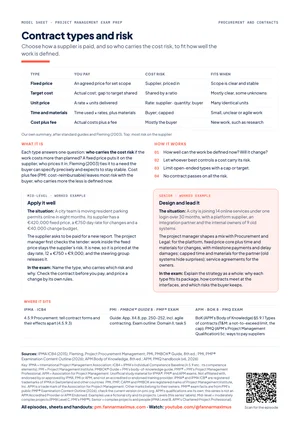
- Contract types and risk
Choose how a supplier is paid, and so who carries the cost risk, to fit how well the work is defined. · Study sheet
Check your understanding
The lowest-priced bid excludes support needed after handover. Is it necessarily the best offer?
Show answer and reasoning
No. Compare offers against the same scope, acceptance criteria, whole-life costs and risks. Apply agreed evaluation criteria and clarify exclusions before awarding a contract.
Apply the same reasoning to your own example. State one assumption you would need to check.
Chapters
Jump to the corresponding passage in the transcript.
- OpeningWatch on YouTube
- One topic, three lensesWatch on YouTube
- The core in plain wordsWatch on YouTube
- Models and methods: contract types and riskWatch on YouTube
- Models and methods: BATNA and the zone of agreementWatch on YouTube
- Mid-level and SeniorWatch on YouTube
- Exam drillWatch on YouTube
- RecapWatch on YouTube
Study materials
Open the original practice sheet · print or save as PDF
Anki package not yet available.
Key terms
The series’ own explanations. Official sources and edition pointers are below.
- Make or buy
- Deciding whether to do a piece of work in-house or buy it, on full costs, skills, capacity, control and risk. PMI® calls it make-or-buy analysis; APM sets make-or-buy criteria.
- Fixed price and cost plus
- Fixed price: an agreed price for a defined scope, so the supplier carries the cost risk. Cost plus fee (PMI®: cost-reimbursable): actual costs plus a fee, so the buyer carries most of it.
- Time and materials (T&M)
- The buyer pays for the time used at agreed rates, plus materials, and carries the risk of how long the work takes. A cap (APM: a not-to-exceed limit) limits it.
- Target cost
- A contract with an agreed target cost. Overruns and savings against the target are shared between buyer and supplier by an agreed ratio.
- BATNA and walk-away point
- BATNA: best alternative to a negotiated agreement (Fisher and Ury), what you do if talks fail. Its value sets your walk-away point (APM: bottom line; Raiffa: reservation price).
- Zone of possible agreement (ZOPA)
- The range between the two sides' walk-away points. A deal is possible only inside it; with no overlap, each side takes its BATNA.
About the lesson’s level labels
Levels (this series' labels): Mid-level = moderately complex projects (IPMA Level C, PMI's PMP®); Senior = complex projects and people (IPMA Level B, APM's Chartered Project Professional).
These are the series’ teaching labels, not a declaration that the certifications are equivalent.
Read the transcript
Timed from the episode captions.
Open episode transcript
Sara: Welcome to Project Management Exam Prep.
This episode is about procurement and contracts.
Every project management exam tests it, because suppliers often get much of a project's
money, and the contract decides who pays when things change.
Leo: You will learn how the three bodies frame it, when to buy, which contract to choose,
and how to negotiate and manage the deal.
We finish with a drill, so keep a pen ready.
Sara: Let us start with the three lenses. What does IPMA® say?
Leo: IPMA®, the International Project Management Association, sets out its standard in
the Individual Competence Baseline, the ICB4.
Its procurement element runs from agreeing what to buy to supervising the contract.
It often asks you to contribute, because specialists lead parts of it.
Negotiation has an element of its own.
Sara: And PMI®?
Leo: PMI®, the Project Management Institute, publishes the PMBOK® Guide,
its guide to the project management body of knowledge.
The eighth edition gives procurement no domain of its own.
A planning process sets the sourcing strategy, and an appendix covers contracts.
The outline of PMI®'s Project Management Professional exam, the PMP®,
has a task to plan and manage procurement, with contract types and a negotiation
strategy.
Sara: And APM?
Leo: APM, the Association for Project Management, publishes the APM Body of Knowledge.
It treats procurement strategy early, and contract management during delivery.
The syllabus of APM's Project Management Qualification, the PMQ,
asks for the procurement strategy, supplier selection with negotiation,
and ways to pay suppliers.
Sara: Where do the words differ?
Leo: In three places. First, the other party.
PMI® says seller or vendor, APM says supplier, and the ICB4 says suppliers and partners.
Sara: Second?
Leo: Paying for actual costs. PMI® calls it cost-reimbursable.
APM and the ICB4 say cost plus.
Sara: And third?
Leo: Where negotiation sits. The ICB4 makes it a people competence.
APM places it under conflict resolution.
PMI®'s exam outline puts it in the procurement task.
Sara: What is the core, whichever exam you take?
Leo: Three ideas. One: make or buy. Buy when you lack the skills or the people in time.
Make when the work is core, or you must keep the know-how.
Compare full costs: managing a supplier takes your time too.
Sara: Two?
Leo: Buying is a cycle. Plan the need, the contract type and how you will choose.
Select: ask the market for information, a proposal or a quote,
and judge bids on weighted criteria published in advance: best value,
not lowest price. Contract: negotiate with a clear mandate, and sign.
Manage delivery, changes and claims. Close: check every obligation is met,
and settle the money.
Sara: Does that change in agile work?
Leo: Yes. A linear project fixes the scope, then the price.
In iterative work the scope moves, so the contract fixes the team,
the rate and the timebox instead: for example, capped time and materials,
with working results every iteration. PMI® calls this agile contracting.
Sara: And three?
Leo: A contract is a relationship you manage.
Review the supplier on agreed indicators, and price changes by the contract's rules.
Record every instruction, because a claim is a demand for money or time.
When the supplier falls short, act in steps: talk, a formal notice,
renegotiation, and only then the lawyers.
Sara: Now the contract types. Both model sheets are free in the description.
Leo: Each type answers one question: who carries the cost risk if the work costs more?
Fixed price: a set price for a defined scope.
The supplier carries the risk, and prices it in.
Quentin Fleming, in his book Project Procurement Management, says it works when
the buyer knows exactly what it wants, can specify it precisely,
and expects no change.
Sara: And at the other end?
Leo: Cost plus fee: the buyer pays actual costs plus a fee, and carries most of the risk.
It fits work nobody can define yet. Three types sit in between.
Target cost shares overruns and savings against an agreed target,
by a ratio. Unit price pays a rate per unit delivered.
Time and materials pays for time used, so a cap limits the risk.
Sara: So which one is best?
Leo: None on its own. The less you can define, the more risk the buyer keeps.
APM warns that the buyer never passes on all of it: a supplier may walk away,
or go out of business.
Sara: Now the negotiation. How do I prepare?
Leo: As in any negotiation, look behind positions to interests.
Then add numbers. Roger Fisher and William Ury coined the term BATNA,
short for "best alternative to a negotiated agreement".
It is your real plan if the talks break down.
Its value, adjusted for quality and risk, is your walk-away point:
accept nothing worse. APM calls it your bottom line.
The negotiation scholar Howard Raiffa called it the reservation price.
Sara: And the other side?
Leo: Estimate theirs too, as an assumption: a supplier's floor is often near its cost.
Between the two walk-away points lies the zone of possible agreement,
the ZOPA. No overlap means no deal, and each side takes its BATNA.
Sara: And inside the zone?
Leo: Trade, not only on price: offer what is cheap for you and valuable to them.
Improve your BATNA first, and never bluff.
Agree who may commit how much: the PMBOK® Guide wants the lead negotiator to hold
the authority to sign. APM's four steps are prepare, open, bargain and close.
Then write the agreement down.
Sara: How does this change between Mid-level and Senior?
Leo: First, the two levels. They are this series' own labels.
Mid-level means leading moderately complex projects, the level of IPMA® Level C and
PMI®'s PMP® exam. Senior means leading complex projects and people,
the level of IPMA® Level B and of APM's chartered status, Chartered Project Professional.
At Mid-level, you run one contract well.
Take Parking Permits Online, a city project that moves resident parking permits
online in eight months. The supplier has a fixed price of four hundred and twenty
thousand euros. The project manager, Anna, checks each extra request against the
tender. Real changes are priced at the contract's day rate, and paid from a change
budget that only the steering group can release.
Sara: And at Senior level?
Leo: You design the contract strategy with the specialists.
Take One City Account, a thirty-month city project that brings fourteen online services
under one login, led by Anna some years later.
The platform supplier has a fixed price for the core, time and materials for changes,
and delay damages. The integration partner has capped time and materials,
because old systems hide surprises. And Anna sets each negotiator's mandate within
the limits the steering board delegated to her.
Sara: Now the drill. A city is moving resident parking permits online.
Its supplier has a fixed price, and the contract prices changes at seven hundred
and fifty euros a day. The city wants residents to change a permit's licence plate
online. The supplier quotes forty-eight days: thirty-six thousand euros.
The city's IT team could build it for twenty-four thousand, but the supplier would
charge six thousand to check it and keep its warranty.
How do you prepare the negotiation?
Leo: Pause and write your answer. You have forty-five seconds.
Sara: Where do you start?
Leo: Check the contract first: if the tender asked for plate changes,
the work is inside the fixed price. If it is new, your BATNA is the IT team.
Twenty-four thousand plus six thousand is thirty thousand, your walk-away point.
Thirty thousand divided by seven hundred and fifty is forty days,
so the quote is eight days above your limit.
Sara: And the supplier's side?
Leo: Estimate its floor near its cost: say twenty-six thousand.
So the zone runs from about twenty-six to thirty thousand.
Ask for a breakdown of the days, and trade: offer a later delivery,
after go-live, when its team is free. Get your mandate from the steering group first,
since only it releases the change budget.
Sara: What lifts that to Senior?
Leo: A Senior answer looks past this deal. In-house beats the quote,
but it splits the warranty and pulls the IT team from other work.
Say your alternative is real, without bluffing: the city needs this supplier after
go-live. And fix the system: agree prices for typical changes now.
Sara: How do the exams ask this?
Leo: IPMA®'s written exam asks for open answers; at Level B it may be oral.
IPMA®'s certification also includes an interview, where assessors ask about your
own projects, so note one contract you managed.
The PMP® exam uses scenarios, and questions built on a case study or a chart.
APM's PMQ asks for short written answers, such as when a fixed price fits.
Sara: Let us recap.
Leo: One. Make or buy first, on full costs.
Sara: Two. Buying is a cycle, from plan to close.
Choose on best value, not lowest price.
Leo: Three. The contract type sets who carries the cost risk.
In iterative work, let the scope flex.
Sara: Four. Your BATNA sets your walk-away point, and the zone of agreement lies between
the two limits.
Leo: And five. Manage the contract as a relationship, with changes by its rules and records
for claims.
Sara: The two model sheets and the study handout are linked in the description.
Next time: quality and continuous improvement.
Sources & further reading
Consult the original publications and authoritative references below. For certification requirements, use the current official documents. Edition-specific page references are included only when verified.
- IPMA® (2015). Individual Competence Baseline for Project, Programme and Portfolio Management, Version 4.0 (ICB4). Zurich: International Project Management Association. ISBN 978-94-92338-00-6 (print), 978-94-92338-01-3 (pdf). Free PDF from IPMA®: https://ipma.world/ipma-standards-development-programme/icb4/
- Project Management Institute (2025). A Guide to the Project Management Body of Knowledge (PMBOK® Guide), Eighth Edition, and The Standard for Project Management. Newtown Square, PA: PMI®. ISBN 9781628258295.
- Project Management Institute (2026). Project Management Professional (PMP®)® Examination Content Outline – 2026 (July 2026 exam update). Newtown Square, PA: PMI®. PDF on pmi.org, accessed 26 September 2026.
- Association for Project Management (2025). APM Body of Knowledge, 8th edition. Princes Risborough: APM. ISBN 9781913305390.
- Association for Project Management (2024, version 6 of April 2026). APM Project Management Qualification: Handbook. https://www.apm.org.uk/media/3r4jbodr/apm-project-management-qualification-handbook.pdf, and the PMQ page https://www.apm.org.uk/qualifications-and-training/project-management-qualification/, accessed 26 September 2026.
- Fleming, Q. W. (2003). Project Procurement Management: Contracting, Subcontracting, Teaming. Tustin, CA: FMC Press. ISBN 9780974391205 (print); page numbers cited from the edition with ISBN 9781628251739.
- Fisher, R., Ury, W. & Patton, B. (2011). Getting to Yes: Negotiating Agreement Without Giving In, 3rd ed. New York: Penguin. ISBN 9780143118756.
- Raiffa, H. (1982). The Art and Science of Negotiation. Cambridge, MA: Belknap Press of Harvard University Press. ISBN 9780674048126.
- IPMA® (2025). IPMA® International Certification Regulations (Public), Version 4.4, for the Assessment of Individuals in Project, Program & Portfolio Management. Zurich: International Project Management Association. https://ipma.world/app/uploads/2025/11/IPMA®-ICR-2025_v_4.4_digital.pdf, via https://ipma.world/ipma-certification/ipma-international-certification-regulations/, accessed 26 September 2026.
Original and technical references for the related tools
- GAO: Cost Estimating and Assessment Guide
Standard estimating practice; the cited guide documents use rather than claiming invention.
- Federal Acquisition Regulation: incentive contracts
Standard incentive-contract arithmetic. The link gives one jurisdiction’s contractual context, not a universal rule.