8 minute read · Original practice exercise included
Before you start: Distinguish agreed requirements from personal preferences.
Watch this lesson
Quality and continuous improvement
Watch on YouTubeOpen the planning and control playlist
YouTube connects when you play a video or follow its links. Playback depends on the video’s availability on YouTube. Its own privacy and storage practices then apply. Voices are AI-generated.
Tools and references for this lesson
Use these resources to practise and extend the topic. Further applications may go beyond the lesson transcript; source pointers lead to the original author or publisher.
Calculators (3)
- Pareto counts and cumulative share
Rank recorded problem categories to focus investigation. · Calculator + guide
- Defect density and removal efficiency
Track observed defects on a consistent measurement boundary. · Calculator + guide
- Process capability: Cp and Cpk
Compare a stable process’s spread and centring with specification limits. · Calculator + guide
Conceptual models (2)
- Plan–do–check–act (PDCA)
Improve a process or a deliverable in small, tested steps. · Study sheet
- Quality assurance vs quality control
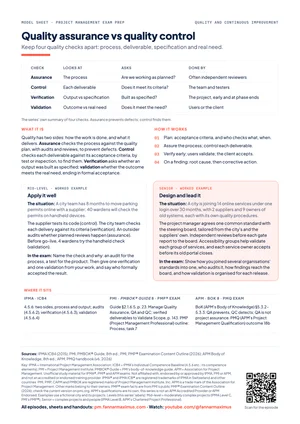
Keep four quality checks apart: process, deliverable, specification and real need. · Study sheet
Further applications (2)
- Cost of quality
Compare the cost of preventing and detecting errors with the consequences of failures. · Guide
- Statistical process control
Distinguish routine process variation from signals that merit investigation. · Guide
Original framework and research sources (2)
- Plan–Do–Study–Act
Connect a small test with evidence and a deliberate learning decision. · Source pointer
- EFQM Model
Find an organisational assessment approach for improvement work. · Source pointer
Check your understanding
A deliverable passes its specified checks, but users cannot complete the intended task. What distinction matters?
Show answer and reasoning
Verification asks whether specified requirements were met; validation asks whether the result meets the intended need. Review both the acceptance criteria and evidence from actual use.
Apply the same reasoning to your own example. State one assumption you would need to check.
Chapters
Jump to the corresponding passage in the transcript.
- OpeningWatch on YouTube
- One topic, three lensesWatch on YouTube
- The core in plain wordsWatch on YouTube
- Models and methods: assurance, control and the cost of qualityWatch on YouTube
- Models and methods: the PDCA cycleWatch on YouTube
- Mid-level and SeniorWatch on YouTube
- Exam drillWatch on YouTube
- RecapWatch on YouTube
Study materials
Open the original practice sheet · print or save as PDF
Anki package not yet available.
Key terms
The series’ own explanations. Official sources and edition pointers are below.
- Quality
- Fitness for purpose, and conformance to the agreed requirements. APM names both; the PMBOK® Guide measures it by acceptance criteria, the definition of done and fitness for use.
- Quality assurance and quality control
- Assurance checks the process, with audits and reviews, to prevent defects. Control checks each deliverable against its acceptance criteria, with tests and inspections, to find them.
- Verification and validation
- Verification: was it built as specified? The project checks it. Validation: does it meet the real need? Users or the client check it, ending in formal acceptance.
- Definition of done
- A checklist that every item must pass before it counts as finished (PMBOK® Guide glossary; the Scrum Guide). Acceptance criteria belong to one item; the definition of done applies to all.
- Cost of quality
- Prevention and appraisal (getting it right) against internal and external failure (getting it wrong), after Feigenbaum (1956). More prevention pays only up to an optimal point.
- Plan–do–check–act (PDCA)
- A loop for improving in small, tested steps. After Shewhart (1939) and Deming, who taught it in Japan from 1950 and later preferred ‘study’ to ‘check’.
About the lesson’s level labels
Levels (this series' labels): Mid-level = moderately complex projects (IPMA Level C, PMI's PMP®); Senior = complex projects and people (IPMA Level B, APM's Chartered Project Professional).
These are the series’ teaching labels, not a declaration that the certifications are equivalent.
Read the transcript
Timed from the episode captions.
Open episode transcript
Sara: Welcome to Project Management Exam Prep.
This episode is about quality and continuous improvement: delivering what people
need, and getting better as you go. Every project management exam tests it.
Leo: You will learn how the three bodies frame it, how to plan and check quality,
what it costs, and a loop for improving.
We finish with a drill, so keep a pen ready.
Sara: Let us start with the three lenses. What does IPMA® say?
Leo: IPMA®, the International Project Management Association, sets out its standard in
the Individual Competence Baseline, the ICB4.
Its element on quality covers two sides: how the project works,
and what it delivers. You plan quality, check it as you go, and get the result accepted.
Sara: And PMI®?
Leo: PMI®, the Project Management Institute, publishes the PMBOK® Guide,
its guide to the project management body of knowledge.
In the eighth edition, quality is a principle: build it into processes and deliverables.
The outline of PMI®'s Project Management Professional exam, the PMP®,
has one task on quality and one on continuous improvement.
Sara: And APM?
Leo: APM, the Association for Project Management, publishes the APM Body of Knowledge.
Its quality section covers planning, assurance, control and continuous improvement.
The syllabus of APM's Project Management Qualification, the PMQ,
asks how quality indicators relate to the business case.
Sara: Where do the words differ?
Leo: In three places. First, assurance. APM keeps quality assurance,
a project activity, apart from project assurance, which the organisation imposes
to give the board confidence.
Sara: Second?
Leo: Control. The PMBOK® Guide's eighth edition has no process called control quality.
Deliverables are checked under monitor and control scope.
APM keeps the name quality control, and the ICB4 speaks of verification.
Sara: And third?
Leo: Tolerance. In the PMBOK® Guide, it is how far a quality measure may vary.
For APM, it is the room delegated to the project manager.
Sara: What is the core, whichever exam you take?
Leo: Three ideas. One: quality means fit for purpose.
It meets the agreed requirements, and it works for the people who use it.
Two quality pioneers put it in different words: Philip Crosby stressed conformance
to requirements, and Joseph Juran fitness for use.
Aim for the quality this project needs, not the highest.
Sara: Two?
Leo: Plan quality before the work starts. Agree which standards apply.
Give each deliverable acceptance criteria: the checks it must pass to be accepted.
Then write the quality plan: which reviews and tests, who does them and when,
and who signs off. Tie each quality indicator to a benefit in the business case.
Sara: Does that change in agile work?
Leo: The rhythm changes. In linear work, the criteria are signed off early,
and the big checks come at phase ends. In iterative work, quality is checked in
every iteration, against a definition of done: a checklist every item must pass
to count as finished.
Sara: And three?
Leo: Keep improving: a lessons-learned review at each phase end, or a retrospective after
each iteration. A lesson counts only when someone owns an action.
Sara: Now the models, both on free sheets in the description.
How does assurance differ from control?
Leo: Assurance looks at the process: are we working the way the quality plan says?
It uses audits and reviews, and aims to prevent defects.
Control looks at the product: does this deliverable meet its acceptance criteria?
It uses tests and inspections, and finds defects.
Sara: And verification and validation?
Leo: Verification asks: was it built as specified?
The project checks it, starting early. Validation asks: does it meet the real need?
The users or the client check it, and it ends in formal acceptance.
Sara: How do you argue for the money?
Leo: With the cost of quality. Armand Feigenbaum described its groups in nineteen fifty-six.
Getting it right costs prevention and appraisal: training, reviews and tests.
Getting it wrong costs internal and external failure: rework before delivery,
and fixes and complaints after it.
Sara: An example?
Leo: Say a team spends ten thousand euros on getting it right, and fifty thousand on
getting it wrong. It adds ten thousand of prevention, so getting it right now costs
twenty thousand, and its failures fall to twenty thousand.
The total falls from sixty thousand to forty.
Sara: So more prevention always pays?
Leo: Only up to a point, which the PMBOK® Guide calls the optimal cost of quality.
The tools for finding causes, the cause-and-effect diagram, the Pareto chart and
the control chart, have their own episode.
Sara: And the loop for improving?
Leo: Plan, do, check, act, or PDCA. Walter Shewhart described the idea in nineteen thirty-nine.
W. Edwards Deming taught it in Japan from nineteen fifty, and later preferred study
to check. Plan: a target, and one change to test.
Do: try it on a small scale. Check: compare the result with the target.
Act: adopt it as the standard, or adjust it and go again.
Sara: An example?
Leo: Say service-desk staff ask many questions about one chapter of their guide.
The team rewrites it, aiming to halve the questions.
Two staff try it for a week, and the questions halve, so the rest is rewritten too.
A retrospective is also a small loop: one change, tried in the next iteration,
and checked at the next retrospective.
Sara: How does this change between Mid-level and Senior?
Leo: First, the two levels. They are this series' own labels.
Mid-level means leading moderately complex projects, the level of IPMA® Level C and
PMI®'s PMP® exam. Senior means leading complex projects and people,
the level of IPMA® Level B and of APM's chartered status, Chartered Project Professional.
At Mid-level, you run quality well on one project.
Take Parking Permits Online, a city project that moves resident parking permits
online in eight months. The project manager, Anna, agrees acceptance criteria with
the steering group. The city's team checks each supplier delivery against them.
Before go-live, the wardens' supervisors try the handheld check in the street.
Sara: And at Senior level?
Leo: You design quality for many parties. Take One City Account, a thirty-month city
project that brings fourteen online services under one login,
led by Anna some years later. Two suppliers and nine system owners each bring their
own procedures. Anna agrees one common standard with the steering board,
and independent reviews report to it before each gate.
After each group of services goes live, the lessons change the standard.
Sara: So the Senior answer is about the system.
Sara: Now the drill. A city is moving resident parking permits online.
A supplier builds the screens in two-week timeboxes.
In each of the last three timeboxes, the city's testers sent back four of the twelve
finished items. Most failed the same way: a screen reader, which reads a screen
aloud, could not read the forms. Each return takes two days to fix.
The supplier says its own tests pass. What do you do?
Leo: Pause and write your answer. You have forty-five seconds.
Sara: First, the numbers.
Leo: Four returns of two days make eight days of rework in every timebox.
The testers catch the faults, so control works.
But the same fault keeps coming back, so the process fails: a job for assurance.
Sara: And the moves?
Leo: Find the root cause with the supplier: its tests skip accessibility.
Add an accessibility check to the definition of done.
An automated check takes three days to set up, once.
If it cuts the returns from four to one, it saves six days in every timebox.
The shortcut: prevention pays when it costs less than the failure it removes.
Three days against six, so it pays in the first timebox.
Then check that it worked.
Sara: What lifts that to Senior?
Leo: Agree a tolerance with the steering group: more than one return in twelve,
two timeboxes in a row, goes to them. Weigh the trade-off openly:
one slower timebox now protects the date.
Treat it as a process problem, not anyone's fault.
And write the lesson into the city's standard.
Sara: How do the exams ask this?
Leo: IPMA®'s written exam asks for open answers; at Level B it may be oral.
IPMA®'s certification also includes an interview, where assessors ask about your
own projects, so note one corrective action and its root cause.
The PMP® exam uses scenarios, and questions built on a case study or a chart.
APM's PMQ asks for short written answers, such as how quality control tests outputs
against the acceptance criteria.
Sara: Let us recap.
Leo: One. Quality means fit for purpose: the agreed requirements, and real use.
Sara: Two. Plan it first: acceptance criteria, a quality plan and, in iterative work,
a definition of done.
Leo: Three. Assurance checks the process, to prevent defects.
Control checks the product, to find them.
Sara: Four. The cost of quality: spend on getting it right, until more no longer pays.
Leo: And five. Improve in small loops: plan, do, check, act.
Every retrospective ends in an action.
Sara: The model sheets and the study handout are linked in the description.
Next time: risk, opportunity and issues.
Sources & further reading
Consult the original publications and authoritative references below. For certification requirements, use the current official documents. Edition-specific page references are included only when verified.
- IPMA® (2015). Individual Competence Baseline for Project, Programme and Portfolio Management, Version 4.0 (ICB4). Zurich: International Project Management Association. ISBN 978-94-92338-00-6 (print), 978-94-92338-01-3 (pdf). Free PDF from IPMA®: https://ipma.world/ipma-standards-development-programme/icb4/
- Project Management Institute (2025). A Guide to the Project Management Body of Knowledge (PMBOK® Guide), Eighth Edition, and The Standard for Project Management. Newtown Square, PA: PMI®. ISBN 9781628258295.
- Project Management Institute (2026). Project Management Professional (PMP®)® Examination Content Outline – 2026 (July 2026 exam update). Newtown Square, PA: PMI®. PDF on pmi.org, accessed 26 September 2026.
- Association for Project Management (2025). APM Body of Knowledge, 8th edition. Princes Risborough: APM. ISBN 9781913305390.
- Association for Project Management (2024, version 6 of April 2026). APM Project Management Qualification: Handbook. https://www.apm.org.uk/media/3r4jbodr/apm-project-management-qualification-handbook.pdf, and the PMQ page https://www.apm.org.uk/qualifications-and-training/project-management-qualification/, accessed 26 September 2026.
- IPMA® (2025). IPMA® International Certification Regulations (Public), Version 4.4, for the Assessment of Individuals in Project, Program & Portfolio Management. Zurich: International Project Management Association. https://ipma.world/app/uploads/2025/11/IPMA®-ICR-2025_v_4.4_digital.pdf, via https://ipma.world/ipma-certification/ipma-international-certification-regulations/, accessed 26 September 2026.
- Kerzner, H. (2013). Project Management: A Systems Approach to Planning, Scheduling, and Controlling, 11th ed. Hoboken, NJ: Wiley. ISBN 9781118022276.
- Crosby, P. B. (1979). Quality Is Free: The Art of Making Quality Certain. New York: McGraw-Hill. ISBN 9780070145122.
- Feigenbaum, A. V. (1956). Total quality control. Harvard Business Review, 34(6), 93–101.
- Shewhart, W. A. (1939). Statistical Method from the Viewpoint of Quality Control. Washington, DC: The Graduate School, The Department of Agriculture. Dover reprint, 1986, ISBN 9780486652320.
- Deming, W. E. (1986). Out of the Crisis. Cambridge, MA: MIT Center for Advanced Engineering Study. ISBN 9780911379013.
- Moen, R. D. & Norman, C. L. (2010). Circling back: clearing up myths about the Deming cycle and seeing how it keeps evolving. Quality Progress, 43(11), 22–28.
- Schwaber, K. & Sutherland, J. (2020, November). The 2020 Scrum Guide™. https://scrumguides.org/scrum-guide.html, accessed 27 September 2026. © 2020 Ken Schwaber and Jeff Sutherland; offered under the Creative Commons Attribution Share-Alike licence (CC BY-SA 4.0). Explained here in our own words.
Original and technical references for the related tools
- NIST: process capability
Standard process-capability indices. This implementation uses the published mathematical definitions without copying diagrams.
- NIST/SEMATECH: statistical methods
Standard mathematical statistics; the handbook is an authoritative technical reference, not a claim of sole origin.
- GAO: Cost Estimating and Assessment Guide
Standard estimating practice; the cited guide documents use rather than claiming invention.
- NIST: control charts
Walter A. Shewhart developed statistical control charts. NIST is a later technical reference, not their inventor.