8 minute read · Original practice exercise included
Before you start: Start with the introduction.
Watch this lesson
Life cycles and delivery approaches
Watch on YouTubeOpen the foundations playlist
YouTube connects when you play a video or follow its links. Playback depends on the video’s availability on YouTube. Its own privacy and storage practices then apply. Voices are AI-generated.
Tools and references for this lesson
Use these resources to practise and extend the topic. Further applications may go beyond the lesson transcript; source pointers lead to the original author or publisher.
Calculators (3)
- Adoption rate and change
Separate delivery of a change from actual use by its intended population. · Calculator + guide
- Work in progress and cycle time
Relate average work in progress, throughput and time in a stable system. · Calculator + guide
- Completion-rate release estimate
Explore how observed delivery rates change a remaining-work estimate. · Calculator + guide
Conceptual models (2)
- Choosing the delivery approach
Choose how to organise delivery by examining uncertainty, the cost of change and the feedback available. Different components of the same project can need different approaches. · Guide
- Life cycles, phases and gates
A life cycle groups work into phases and defines when to reconsider the investment. A gate is a decision based on evidence, not simply a meeting on the calendar. · Guide
Further applications (2)
- Burndown, burnup and scope change
Track completed and remaining work while keeping changes in total scope visible. · Guide
- Cumulative flow and WIP limits
Observe how work accumulates in different workflow states and make overload visible. · Guide
Original framework and research sources (6)
- ADKAR®
Explore individual adoption alongside delivery of an organisational change. · Source pointer
- Bridges Transition Model
Explore the personal experience of transition when circumstances change. · Source pointer
- Kotter’s change approach
Consider the leadership and organisational work needed for a substantial change. · Source pointer
- Lean thinking
Explore improvement through customer value and the way work flows. · Source pointer
- Lewin’s group dynamics and change
Investigate the social forces and conditions that sustain or change behaviour. · Source pointer
- Scrum
Find the canonical definition before adapting a Scrum-based delivery approach. · Source pointer
Check your understanding
A team knows the desired outcome but expects the solution to change. What should you investigate before choosing a delivery approach?
Show answer and reasoning
Investigate how quickly feedback can be obtained, how costly changes are, and which constraints are fixed. Different components may justify different approaches; uncertainty alone does not select a named framework.
Apply the same reasoning to your own example. State one assumption you would need to check.
Chapters
Jump to the corresponding passage in the transcript.
Study materials
Open the original practice sheet · print or save as PDF
Anki package not yet available.
Key terms
The series’ own explanations. Official sources and edition pointers are below.
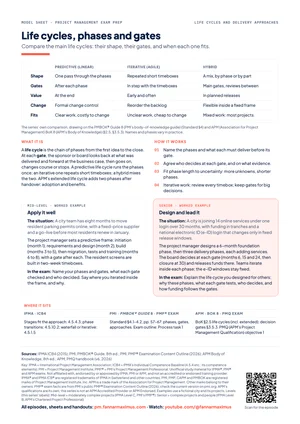
- Life cycle and phase
- The phases a project passes through from the first idea to the close. Each phase delivers something that is checked before the next one starts.
- Gate
- A decision point between phases: look back at what was delivered, look forward at the business case, then go on, change course or stop. PMI®: phase gate; APM: decision gate.
- Predictive (linear)
- Scope fixed early, planned in detail, one pass through the phases. PMI® says predictive, APM linear, the ICB4 waterfall.
- Iterative (agile)
- Short, fixed timeboxes that each end with a working result shown to users; the backlog is reordered as they learn. PMI® groups it under adaptive.
- Hybrid
- A mix: for example a predictive frame with fixed milestones and gates, and iterative teams inside it. Most projects end up here.
- Tailoring
- Fitting the approach, the governance and the processes to one project: add what it needs, drop what only costs effort, and review the fit.
About the lesson’s level labels
Levels (this series' labels): Mid-level = moderately complex projects (IPMA Level C, PMI's PMP®); Senior = complex projects and people (IPMA Level B, APM's Chartered Project Professional).
These are the series’ teaching labels, not a declaration that the certifications are equivalent.
Read the transcript
Timed from the episode captions.
Open episode transcript
Sara: Welcome to Project Management Exam Prep.
This episode is about life cycles and delivery approaches: how a project is split
into phases, and how much you plan up front or learn as you go.
Every project management exam tests it.
Leo: You will learn how the three bodies frame it, the main life cycles,
and how to choose and tailor an approach, with a strong focus on agile work.
We finish with a drill, so keep a pen ready.
Sara: Let us start with the three lenses. What does IPMA® say?
Leo: IPMA®, the International Project Management Association, sets out its standard in
the Individual Competence Baseline, the ICB4.
Its element on project design asks you to compare approaches,
pick the one most likely to succeed, and defend it, with waterfall or iterative
as an early choice. Phases sit in its elements on time and on plan and control.
Sara: And PMI®?
Leo: PMI®, the Project Management Institute, publishes the PMBOK® Guide,
its guide to the project management body of knowledge.
The eighth edition separates the life cycle, which is the phases,
from the development approach, which is how the result is built.
The outline of PMI®'s Project Management Professional exam, the PMP®,
asks you to assess a project's complexity and recommend an approach.
About sixty percent of its questions involve agile or hybrid work.
Sara: And APM?
Leo: APM, the Association for Project Management, publishes the APM Body of Knowledge.
It covers linear, iterative and hybrid life cycles, and an extended one that adds
adoption and benefits. The syllabus of APM's Project Management Qualification,
the PMQ, opens with life cycles: when each one fits, and its strengths and limits.
Sara: Where do the words differ?
Leo: In three places. Planning up front: PMI® says predictive, APM linear,
and the ICB4 waterfall. Learning as you deliver: PMI® says adaptive,
which includes agile, and the other two say iterative.
And the decision point between phases: PMI® says phase gate, APM decision gate,
and the ICB4 speaks of a phase transition.
In this series, we say predictive, iterative and gate.
Sara: What is the core, whichever exam you take?
Leo: Three ideas. One: a life cycle splits the project into phases,
from the first idea to the close. At each gate, the sponsor or the board looks back
at what the phase delivered, and forward at the business case.
Then they decide: go on, go on with changes, or stop.
The more uncertain the work, the shorter the phases.
Sara: Two?
Leo: A predictive project fixes the scope early and passes through its phases once.
It gives control, and suits work that is well defined or costly to change.
But users wait until the end for value.
Sara: And iterative work?
Leo: It starts with a vision and an ordered list of work, the backlog.
The team builds in fixed timeboxes, often one to four weeks.
Each one ends with a working result shown to users, and the list is reordered.
Time and cost are often fixed, so scope flexes.
Agile methods work this way. The first release is often a minimum viable product:
the smallest version users can really try.
Iterative work needs users who take part.
Sara: And three?
Leo: Most projects mix the two, by phase or by deliverable.
That is a hybrid.
Sara: Now the models. Both model sheets are free in the description.
Leo: The first compares the three life cycles.
Each row reads predictive, iterative, hybrid.
Shape: one pass through the phases, repeated timeboxes, or a mix.
Gates: after each phase, in step with the timeboxes, or main gates with reviews
between. Value: at the end, early and often, or in planned releases.
Change: through formal change control, by reordering the backlog,
or freely inside a fixed frame.
Sara: What does a hybrid look like?
Leo: Three patterns are common. Explore in short cycles, then build once.
Keep a predictive frame with fixed milestones, and agile teams inside it.
Or use different approaches for different deliverables, such as a building and the
software in it.
Sara: And how do I choose?
Leo: The second model is our own two-question matrix, drawn from factors that the PMBOK®
Guide and the APM Body of Knowledge both name.
Ask it of each part of the work. How clear are the requirements?
And how costly is a late change? Clear and costly points to predictive.
Unclear and cheap points to iterative. Unclear and costly: explore first,
then build once. Clear and cheap: a free choice, so deliver in useful parts.
Sara: Is that all?
Leo: No. Rank the success criteria first: if a date cannot move, fix time and let scope
flex. Check the users, the contract and the culture.
Then tailor. The PMBOK® Guide calls it tailoring when you fit the approach,
the governance and the processes to the project.
APM adds that a changed approach must still fit reporting and change control.
And the ICB4 asks you to review the approach, and to explain every change.
Sara: How does this change between Mid-level and Senior?
Leo: First, the two levels. They are this series' own labels.
Mid-level means leading moderately complex projects, the level of IPMA® Level C and
PMI®'s PMP® exam. Senior means leading complex projects and people,
the level of IPMA® Level B and of APM's chartered status, Chartered Project Professional.
At Mid-level, you choose and defend an approach for one project.
Take Parking Permits Online, a city project that moves resident parking permits
online in eight months. The project manager, Anna, must go live before January,
when most residents renew, and the supplier works to a fixed price.
So she sets a predictive frame with gates, and builds the resident screens in two-week
timeboxes.
Sara: And at Senior level?
Leo: You design the life cycle for others. Take One City Account, a thirty-month city
project that brings fourteen online services under one login,
led by Anna some years later. Anna sets a foundation phase, then three waves of
services. The steering board decides at each gate, and releases funding there.
Teams iterate inside each wave, while the national e-ID login's release dates stay
fixed.
Sara: So the Senior answer is about the system: who decides at each gate,
and on what evidence.
Sara: Now the drill. A city team must launch an online service in twenty weeks,
when a new law takes effect, on a fixed budget.
Its payment link has clear rules, but needs a security certification that is slow
and costly to repeat. Nobody knows yet which screens residents will find easy.
The feature list is one hundred and fifty story points, a relative size.
A similar team finishes about fifteen points per two-week timebox.
Which approach do you choose, and what may flex?
Leo: Pause and write your answer. You have forty-five seconds.
Sara: First, the approach.
Leo: Split the work. The payment link is clear and costly to change,
so plan it up front, and make certification a fixed milestone.
The screens are uncertain and cheap to change, so build them in timeboxes,
tested with residents. That is a hybrid: a predictive frame with a launch gate,
and iterative work inside.
Sara: And the numbers?
Leo: Keep the last four weeks for testing and launch.
That leaves sixteen weeks, or eight timeboxes.
Eight times fifteen is one hundred and twenty points.
So thirty of the one hundred and fifty points, one fifth, will not fit.
The shortcut: capacity is timeboxes times points per timebox.
So order the list by value, and agree a minimum viable product for launch day.
Sara: What lifts that to Senior?
Leo: Governance and people. Agree with the sponsor, up front, that scope flexes,
and who may trade features. Set measurable go or no-go criteria for the launch gate.
Make any supplier contract match the split.
And secure time from its users, because iterative work fails without them.
Sara: How do the exams ask this?
Leo: IPMA®'s written exam asks for open answers; at Level B it may be oral.
IPMA®'s certification also includes an interview, where assessors ask about your
own projects, so note one where you chose or changed the approach.
The PMP® exam uses scenarios, most of them agile or hybrid, and questions built on
a case study or a chart. APM's PMQ asks for short written answers,
such as two strengths and two limits of a linear life cycle.
Sara: Let us recap.
Leo: One. A life cycle is a chain of phases, with a gate after each:
go on, change course, or stop.
Sara: Two. Predictive work plans up front and delivers once.
Iterative work delivers in timeboxes and lets scope flex.
Leo: Three. Most projects are hybrids: a fixed frame where it matters,
and iterations where learning pays.
Sara: Four. Choose from the facts, part by part, then tailor and review.
Leo: And five. Predictive, linear and waterfall name one choice.
Learn the choice, then your exam's words.
Sara: The model sheets and the study handout are linked in the description.
See you in the next episode.
Sources & further reading
Consult the original publications and authoritative references below. For certification requirements, use the current official documents. Edition-specific page references are included only when verified.
- IPMA® (2015). Individual Competence Baseline for Project, Programme and Portfolio Management, Version 4.0 (ICB4). Zurich: International Project Management Association. ISBN 978-94-92338-00-6 (print), 978-94-92338-01-3 (pdf). Free PDF from IPMA®: https://ipma.world/ipma-standards-development-programme/icb4/
- Project Management Institute (2025). A Guide to the Project Management Body of Knowledge (PMBOK® Guide), Eighth Edition, and The Standard for Project Management. Newtown Square, PA: PMI®. ISBN 9781628258295.
- Project Management Institute (2026). Project Management Professional (PMP®)® Examination Content Outline – 2026 (July 2026 exam update). Newtown Square, PA: PMI®. PDF on pmi.org, accessed 26 September 2026.
- Association for Project Management (2025). APM Body of Knowledge, 8th edition. Princes Risborough: APM. ISBN 9781913305390.
- Association for Project Management (2024, version 6 of April 2026). APM Project Management Qualification: Handbook. https://www.apm.org.uk/media/3r4jbodr/apm-project-management-qualification-handbook.pdf, and the PMQ page https://www.apm.org.uk/qualifications-and-training/project-management-qualification/, accessed 26 September 2026.
- IPMA® (2025). IPMA® International Certification Regulations (Public), Version 4.4, for the Assessment of Individuals in Project, Program & Portfolio Management. Zurich: International Project Management Association. https://ipma.world/app/uploads/2025/11/IPMA®-ICR-2025_v_4.4_digital.pdf, via https://ipma.world/ipma-certification/ipma-international-certification-regulations/, accessed 26 September 2026.
Original and technical references for the related tools
- John D. C. Little (1961): original proof
John D. C. Little, A Proof for the Queuing Formula: L = λW (1961).
- GAO: Cost Estimating and Assessment Guide
Standard estimating practice; the cited guide documents use rather than claiming invention.