8 minute read · Original practice exercise included
Before you start: Understand discounting and the timing of cash flows.
Read the lesson Explore tools and references
Next: Quality tools
Watch this lesson
NPV, IRR and payback
Watch on YouTubeOpen the methods playlist
YouTube connects when you play a video or follow its links. Playback depends on the video’s availability on YouTube. Its own privacy and storage practices then apply. Voices are AI-generated.
Tools and references for this lesson
Use these resources to practise and extend the topic. Further applications may go beyond the lesson transcript; source pointers lead to the original author or publisher.
Calculators (10)
- Benefit-cost ratio and net return
Compare present-value benefits and costs on one consistent boundary. · Calculator + guide
- Break-even volume
Find how much output is needed to cover fixed cost. · Calculator + guide
- Cash-flow funding gap
Find the worst cumulative shortfall in a time-phased cash plan. · Calculator + guide
- Present and future value
Put a single cash amount on a common time basis. · Calculator + guide
- Internal rate of return
Find the break-even discount rate for a conventional investment cash-flow sequence. · Calculator + guide
- Level-payment annuity
Value an equal payment at the end of each period. · Calculator + guide
- Nominal to real rate
Align a nominal rate with cash flows measured at constant prices. · Calculator + guide
- Simple and discounted payback
Estimate when positive receipts recover the initial outlay. · Calculator + guide
- Straight-line depreciation
Separate a simple accounting charge from cash spending. · Calculator + guide
- Weighted average cost of capital
Combine equity and after-tax debt costs using financing weights. · Calculator + guide
Conceptual models (2)
- Net present value and IRR
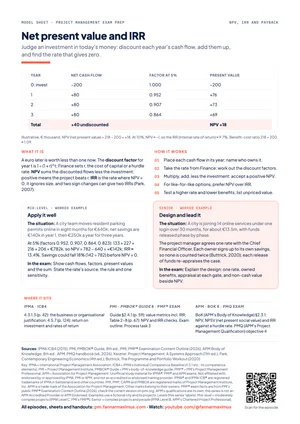
Judge an investment in today's money: discount each year's cash flow, add them up, and find the rate that gives zero. · Study sheet
- Payback period
Show how long the money is at risk: the time until the cash coming back equals the cash put in. · Study sheet
Further applications (2)
- Life-cycle cost and total cost of ownership
Compare the cost of acquiring, operating, maintaining and eventually replacing or retiring an option. · Guide
- Currency exposure
Identify how cash flows in different currencies change a project’s funding needs. · Guide
Check your understanding
An investment costs 100 now and returns 110 after one period. At a 10% discount rate, what is its NPV?
Show answer and reasoning
NPV = −100 + 110 ÷ 1.10 = 0. It meets that discount-rate threshold under the stated assumptions; this does not establish affordability or remove uncertainty.
Apply the same reasoning to your own example. State one assumption you would need to check.
Chapters
Jump to the corresponding passage in the transcript.
- OpeningWatch on YouTube
- One topic, three lensesWatch on YouTube
- The core in plain wordsWatch on YouTube
- Models and methods: payback and net present valueWatch on YouTube
- Models and methods: IRR and its trapsWatch on YouTube
- Mid-level and SeniorWatch on YouTube
- Exam drillWatch on YouTube
- RecapWatch on YouTube
Study materials
Open the original practice sheet · print or save as PDF
Anki package not yet available.
Key terms
The series’ own explanations. Official sources and edition pointers are below.
- Discount factor
- What one euro in year t is worth today at rate r: 1 ÷ (1 + r)^t. At 5%, it is 0.952 for year 1 and 0.907 for year 2.
- Net present value (NPV)
- Each year's net cash flow times its discount factor, added up, with the investment as a minus in year 0. Above zero, the project earns more than the rate.
- Internal rate of return (IRR)
- The discount rate at which the NPV is zero. Compare it with the hurdle rate. It ignores size, and cash flows that change sign twice can give two IRRs.
- Payback period
- The time until the cash coming back equals the cash put in. Discounted payback adds present values, so it comes later. Both ignore cash after payback.
- Cost of capital and hurdle rate
- The rate Finance sets for discounting: what the organisation's money costs (APM: WACC), or the lowest return it accepts. Public bodies often use a lower rate.
- Investment appraisal
- APM's term for judging an investment, with simple measures such as return on investment and discounted ones such as NPV, IRR and net present social value.
About the lesson’s level labels
Levels (this series' labels): Mid-level = moderately complex projects (IPMA Level C, PMI's PMP®); Senior = complex projects and people (IPMA Level B, APM's Chartered Project Professional).
These are the series’ teaching labels, not a declaration that the certifications are equivalent.
Read the transcript
Timed from the episode captions.
Open episode transcript
Sara: Welcome to Project Management Exam Prep.
This episode is about NPV, IRR and payback: the net present value,
the internal rate of return and the payback period.
Leo: They judge whether a project is worth its money, and every project management exam
can ask about them. You will learn to discount, what each measure tells you,
and where each one misleads. Keep a pen and a calculator ready for the drill.
Sara: Let us start with the three lenses. What does IPMA® say?
Leo: IPMA®, the International Project Management Association, sets out its standard in
the Individual Competence Baseline, the ICB4.
These methods have no element of their own.
Its strategy element asks you to build the project's justification,
sell it to the sponsors, and keep checking it.
Its finance element lists return on investment and rates of return as things to
know.
Sara: And PMI®?
Leo: PMI®, the Project Management Institute, publishes the PMBOK® Guide,
its guide to the project management body of knowledge.
In the eighth edition, the finance performance domain measures value with the IRR
and payback, and checks it with the NPV.
The outline of PMI®'s Project Management Professional exam, the PMP®,
asks you to check business value throughout the project.
Sara: And APM?
Leo: APM, the Association for Project Management, publishes the APM Body of Knowledge.
It calls this investment appraisal, and sets the NPV against the cost of capital
or a hurdle rate. The syllabus of APM's Project Management Qualification,
the PMQ, covers the business case but names no formula.
So PMQ candidates need the purpose more than the arithmetic.
Sara: Where do the words differ?
Leo: In two places. First, the document. PMI® and APM say business case;
the ICB4 says business or organisational justification.
Sara: Second?
Leo: Value beyond money. APM names net present social value, which also counts social
benefits. PMI® says value can be social or environmental.
Sara: What is the core, whichever exam you take?
Leo: Three ideas. One: a euro in hand now is worth more than one next year,
because it can earn interest meanwhile.
So you discount future cash to today's money.
Sara: At what rate?
Leo: The one Finance sets: the cost of capital, or a hurdle rate, the lowest return the
organisation accepts. Chan Park's engineering economics textbook notes that public
bodies often use a lower rate, near government borrowing.
State the rate, and show what a higher one does.
Sara: Two?
Leo: Each measure answers one question. Payback: how long is money at risk?
NPV: how much value is added? IRR: what return is earned?
Sara: And three?
Leo: Numbers inform a decision; they do not make it.
List the benefits you cannot price beside the NPV, and test what could change the
answer.
Sara: And in agile work?
Leo: Iterative delivery can bring benefits forward, and an earlier saving is worth more.
So teams order the backlog by value.
Sara: Now the methods. The two model sheets, free in the description,
work one example.
Leo: A project costs two hundred thousand euros now, and saves eighty thousand a year
for three years. When is the money back?
Add the cash flows until the running total reaches zero.
After two years, you are still forty thousand short.
Year three brings eighty, so you break even halfway through it.
The simple payback is two and a half years.
Sara: What does it miss?
Leo: Later euros count like today's, and nothing after payback counts at all.
So discount. To get a year's discount factor, raise one plus the rate to the number
of years, and divide one by the result.
At five percent, year one's factor is zero point nine five two.
Year two's is zero point nine zero seven.
Year three's is zero point eight six four.
Sara: And the net present value?
Leo: Multiply each saving by its factor. In thousands, that gives seventy-six,
seventy-three and sixty-nine. Together, two hundred and eighteen.
Minus the two hundred invested, the NPV is plus eighteen thousand euros.
Undiscounted, it looked like forty.
Sara: And the rule?
Leo: Accept a positive NPV: the project earns more than the rate.
Reject a negative one. Among options for the same job, take the highest.
Discounted payback runs the total on present values: about two point seven years,
always later.
Sara: Now the internal rate of return.
Leo: The IRR is the rate that turns the NPV to zero: the project's own return.
Find it by trial, or with a spreadsheet.
At five percent, our NPV is plus eighteen thousand.
At ten percent, it is minus one thousand.
So the IRR is just under ten: about nine point seven percent.
If it beats the hurdle rate, the project passes.
Sara: So a higher IRR is always better?
Leo: No. There are two traps. First, size. Invest twenty thousand,
and get thirty thousand back a year later.
That IRR is fifty percent, but the NPV is only about nine thousand,
half of ours. To choose between options, use the NPV.
Sara: Second?
Leo: Signs. The IRR expects money out, then money in.
A large cost later, such as replacing a system, changes the sign twice.
Park shows that there can then be two IRRs, and neither is a reliable guide.
Sara: What else does the sponsor need?
Leo: The sensitivity. The savings could fall by only about eight percent before the NPV
reaches zero. At ten percent, it is already negative.
Say both.
Sara: How does this change between Mid-level and Senior?
Leo: First, the two levels. They are this series' own labels.
Mid-level means leading moderately complex projects, the level of IPMA® Level C and
PMI®'s PMP® exam. Senior means leading complex projects and people,
the level of IPMA® Level B and of APM's chartered status, Chartered Project Professional.
At Mid-level, you run the numbers and explain them.
Take Parking Permits Online, a city project that moves resident parking permits
online in eight months. The project manager, Anna, sets its cost of six hundred
and forty thousand euros against four years of savings.
At five percent, the NPV is about one hundred and forty thousand.
She shows the steering group that it stays positive unless the savings fall by about
eighteen percent.
Sara: And at Senior level?
Leo: You design the appraisal others work in.
Take One City Account, a thirty-month city project that brings fourteen online services
under one login, led by Anna some years later.
The chief financial officer sets one rate for all.
Each service owner signs up to its own savings, since Robert Buttrick,
in his book The Project Workout, warns that projects can claim the same benefit
twice. The board checks the case before releasing each phase's funds.
Sara: Now the drill. A city has moved resident parking permits online,
and wardens check them by licence plate.
To speed up the checks, it will buy one of two tools.
A scan car that reads plates costs one hundred and twenty thousand euros,
and saves fifty thousand a year. An app for the wardens' handhelds costs fifteen
thousand, and saves ten thousand a year.
Both do the same job for four years. At five percent, the four discount factors
add up to three point five four six. The finance controller prefers the app:
it pays back sooner. What do you recommend?
Leo: Pause and write your answer. You have forty-five seconds.
Sara: First, payback.
Leo: The car: one hundred and twenty over fifty, two point four years.
The app: fifteen over ten, one and a half.
Sara: And the NPV?
Leo: Use a shortcut. The saving is the same each year, so fifty times each factor,
added up, is fifty times their sum. For the car, fifty times three point five four
six is about one hundred and seventy-seven.
Minus one hundred and twenty: plus fifty-seven thousand.
For the app, ten times the sum, minus fifteen: plus twenty and a half thousand.
Recommend the car: it adds about thirty-seven thousand more.
Payback ignores later years.
Sara: What lifts that to Senior?
Leo: Thirty-seven thousand, divided by three point five four six, is about ten thousand
a year. So the car stays ahead while its savings stay above about forty thousand,
a fall of a fifth. The head of parking services must own it.
The car also risks eight times as much money: agree the city's tolerance with the
sponsor. Weigh emissions too, and involve the wardens' supervisors.
Then the steering group decides.
Sara: How do the exams ask this?
Leo: IPMA®'s exams ask for open answers. IPMA®'s certification also includes an interview,
where assessors ask about your own projects: note one investment you helped justify.
The PMP® exam uses scenarios, and questions built on a case study or a chart.
APM's PMQ asks for short written answers, often on purpose: why are future benefits
discounted?
Sara: Let us recap.
Leo: One. A euro later is worth less than a euro now: discount at Finance's rate.
Sara: Two. NPV: present values minus the investment.
Accept it above zero; for one job, take the highest.
Leo: Three. The IRR turns the NPV to zero. It ignores size, and misleads when signs change
twice.
Sara: Four. Payback shows how long money is at risk, and ignores what follows.
Leo: Five. Show the value you cannot price, and test what would flip the answer.
Sara: The model sheet on NPV and IRR is free in the description.
Leo: So are the payback sheet and the study handout.
Next time: quality tools.
Sources & further reading
Consult the original publications and authoritative references below. For certification requirements, use the current official documents. Edition-specific page references are included only when verified.
- IPMA® (2015). Individual Competence Baseline for Project, Programme and Portfolio Management, Version 4.0 (ICB4). Zurich: International Project Management Association. ISBN 978-94-92338-00-6 (print), 978-94-92338-01-3 (pdf). Free PDF from IPMA®: https://ipma.world/ipma-standards-development-programme/icb4/
- Project Management Institute (2025). A Guide to the Project Management Body of Knowledge (PMBOK® Guide), Eighth Edition, and The Standard for Project Management. Newtown Square, PA: PMI®. ISBN 9781628258295.
- Project Management Institute (2026). Project Management Professional (PMP®)® Examination Content Outline – 2026 (July 2026 exam update). Newtown Square, PA: PMI®. PDF on pmi.org, accessed 26 September 2026.
- Association for Project Management (2025). APM Body of Knowledge, 8th edition. Princes Risborough: APM. ISBN 9781913305390.
- Association for Project Management (2024, version 6 of April 2026). APM Project Management Qualification: Handbook. https://www.apm.org.uk/media/3r4jbodr/apm-project-management-qualification-handbook.pdf, and the PMQ page https://www.apm.org.uk/qualifications-and-training/project-management-qualification/, accessed 26 September 2026.
- Kerzner, H. (2013). Project Management: A Systems Approach to Planning, Scheduling, and Controlling, 11th ed. Hoboken, NJ: Wiley. ISBN 9781118022276.
- Park, C. S. (2007). Contemporary Engineering Economics, 4th ed. Upper Saddle River, NJ: Pearson Prentice Hall. ISBN 9780131876286.
- Buttrick, R. (2020). The Programme and Portfolio Workout: Directing Business-Led Programmes and Portfolios. Abingdon: Routledge. ISBN 9781138721210 (paperback); 9780367502508 (hardback).
- IPMA® (2025). IPMA® International Certification Regulations (Public), Version 4.4, for the Assessment of Individuals in Project, Program & Portfolio Management. Zurich: International Project Management Association. https://ipma.world/app/uploads/2025/11/IPMA®-ICR-2025_v_4.4_digital.pdf, via https://ipma.world/ipma-certification/ipma-international-certification-regulations/, accessed 26 September 2026.
Original and technical references for the related tools
- OpenStax: Principles of Finance, capital budgeting
Standard financial mathematics; no single inventor is asserted.
- OpenStax: calculating WACC
Standard corporate-finance calculation; no single inventor is asserted.
- GAO: Cost Estimating and Assessment Guide
Standard estimating practice; the cited guide documents use rather than claiming invention.