8 minute read · Original practice exercise included
Before you start: Know the acceptance criteria and the future operational owner.
Watch this lesson
Closure, transition and handover
Watch on YouTubeOpen the planning and control playlist
YouTube connects when you play a video or follow its links. Playback depends on the video’s availability on YouTube. Its own privacy and storage practices then apply. Voices are AI-generated.
Tools and references for this lesson
Use these resources to practise and extend the topic. Further applications may go beyond the lesson transcript; source pointers lead to the original author or publisher.
Conceptual models (3)
- Choosing the delivery approach
Choose how to organise delivery by examining uncertainty, the cost of change and the feedback available. Different components of the same project can need different approaches. · Guide
- Life cycles, phases and gates
A life cycle groups work into phases and defines when to reconsider the investment. A gate is a decision based on evidence, not simply a meeting on the calendar. · Guide
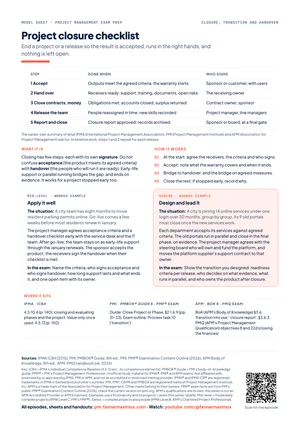
- Project closure checklist
End a project or a release so the result is accepted, runs in the right hands, and nothing is left open. · Study sheet
Original framework and research sources (2)
- Lean thinking
Explore improvement through customer value and the way work flows. · Source pointer
- Scrum
Find the canonical definition before adapting a Scrum-based delivery approach. · Source pointer
Check your understanding
A sponsor accepts the deliverable, but operations has no support owner or training. Is handover complete?
Show answer and reasoning
No. Acceptance and operational readiness are different checks. Agree ownership, training, support, remaining issues and the evidence required for transition before closing the handover.
Apply the same reasoning to your own example. State one assumption you would need to check.
Chapters
Jump to the corresponding passage in the transcript.
Study materials
Open the original practice sheet · print or save as PDF
Key terms
The series’ own explanations. Official sources and edition pointers are below.
- Acceptance
- Formal agreement that a deliverable meets its agreed acceptance criteria. The sponsor or customer signs, with the users. It often starts the warranty and releases the final payment.
- Transition and handover
- Moving the result into use by the people who will run it. The ICB4 says handover; PMI®, transition to operations; APM, transition into use, into business as usual.
- Early-life support
- A set period after go-live when the project team stays on to fix problems fast, before the permanent support team works alone. It ends on agreed measures, not a date.
- Parallel running
- Keeping the old way going beside the new one until the new one meets agreed criteria. It is safer, but costs double effort for a while.
- Warranty period
- A period after acceptance in which the supplier must fix defects at its own cost. After it, a fix is a paid change.
- Closure report
- The last report: the result against the plan, what was accepted, open matters with owners, and how benefits will be tracked. APM: project closure report; PMI®: final report.
About the lesson’s level labels
Levels (this series' labels): Mid-level = moderately complex projects (IPMA Level C, PMI's PMP®); Senior = complex projects and people (IPMA Level B, APM's Chartered Project Professional).
These are the series’ teaching labels, not a declaration that the certifications are equivalent.
Read the transcript
Timed from the episode captions.
Open episode transcript
Sara: Welcome to Project Management Exam Prep.
This episode is about closure, transition and handover: how a project ends well.
Every project management exam tests it, because a result nobody can run delivers
nothing.
Leo: You will learn how the three bodies frame it, why acceptance is not handover,
how to close contracts, money and the team, and what to do when a project stops
early. We finish with a drill, so keep a pen ready.
Sara: Let us start with the three lenses. What does IPMA® say?
Leo: IPMA®, the International Project Management Association, sets out its standard in
the Individual Competence Baseline, the ICB4.
Its element on plan and control asks you, in our words, to close and evaluate each
phase and the project, and hand the results to their users.
Its element on change and transformation gives the reason: a new capability adds
value only once people use it.
Sara: And PMI®?
Leo: PMI®, the Project Management Institute, publishes the PMBOK® Guide,
its guide to the project management body of knowledge.
The eighth edition has a process to close a project or phase,
including unsuccessful ones, releases and contracts.
The outline of PMI®'s Project Management Professional exam, the PMP®,
has a task to manage project closure: get approval of completion,
set the criteria for closing, and check that the next owner is ready.
Sara: And APM?
Leo: APM, the Association for Project Management, publishes the APM Body of Knowledge.
Its section on transition into use covers handing over outputs,
projects that end early, and administrative closure: the records,
accounts and archive. The syllabus of APM's Project Management Qualification,
the PMQ, has an objective on transition management: plan it from the start,
and agree it with stakeholders, including who takes over the risks.
Sara: Where do the words differ?
Leo: In three places. First, the move itself.
The ICB4 says handover, and PMI® transition to operations.
APM says transition into use, into business as usual: the organisation's normal
work.
Sara: Second?
Leo: The last document. The ICB4 asks for an evaluation report with lessons learned.
PMI® says final report, and APM project closure report.
Sara: And third?
Leo: Stopping early. The ICB4 speaks of a premature end, and PMI® of termination before
completion. APM calls it early closure: a sound decision, not a failure.
Sara: What is the core, whichever exam you take?
Leo: Three ideas. One: closure starts at the start.
Agree early who will receive the result, and what they need to run it:
support, training, documents and a budget.
Bring them into the planning, and set the acceptance criteria before the work starts.
Sara: Two?
Leo: Accepted is not handed over. There are two sign-offs.
Acceptance: the product meets its agreed criteria, and the sponsor or customer signs,
with the users. Handover: the people who will run it are ready:
support in place, staff trained, documents complete, and open risks and issues passed
to named owners. A bridge helps between the two.
Early-life support keeps the project team on for a set period after go-live,
to fix problems fast. Parallel running keeps the old way going until the new one
proves itself. End either one on evidence, not on the calendar.
Sara: Does that change in agile work?
Leo: The rhythm does. In a linear project, acceptance and handover come once,
near the end. In iterative work, each release is accepted, often against a definition
of done, the team's agreed checklist for finished work, and handed over.
The project ends, but the product lives on, with an owner and a team on normal budgets.
Sara: And three?
Leo: A project that stops early is closed properly too.
Hand over or store what is usable, close the contracts, release the people,
and record why it stopped, so others can learn from it.
Sara: Now the model, on a free sheet in the description.
Leo: The closure checklist has five steps, and each step has a signature.
One: accept. The outputs meet the agreed criteria, and the sponsor signs.
Acceptance often starts the supplier's warranty, the period in which it fixes defects
at its own cost, and releases the final payment.
Sara: Two?
Leo: Hand over. The receiving owner confirms they are ready, and signs.
Three: close the contracts and the money.
Check that each supplier met every obligation, settle any claims,
and agree the final accounts. Then charge every last cost, close the accounts,
and return what is left.
Sara: Four?
Leo: Release the team. Tell line managers early, record the skills people gained,
and thank them. People who fear the end leave early, and take knowledge with them.
Sara: And five?
Leo: Report and close. The closure report compares the result with the plan.
It says what was accepted, what is still open and who owns it,
and how the benefits will be tracked. The sponsor or the board approves it at a
final gate. Then archive the records.
Sara: And lessons learned?
Leo: They are collected throughout, and summarised in the report; the episode on communication
and knowledge transfer covers them. Most benefits arrive after closure,
so their owners keep measuring; the business case episode covers that.
Sara: How does this change between Mid-level and Senior?
Leo: First, the two levels. They are this series' own labels.
Mid-level means leading moderately complex projects, the level of IPMA® Level C and
PMI®'s PMP® exam. Senior means leading complex projects and people,
the level of IPMA® Level B and of APM's chartered status, Chartered Project Professional.
At Mid-level, you close one project cleanly.
Take Parking Permits Online, a city project that moves resident parking permits
online in eight months. The project manager, Anna, agrees a handover checklist early
with the city's IT team and service desk.
Go-live comes a few weeks before most residents renew in January,
so her team stays on as early-life support through the renewals.
Then the steering group approves the closure.
Sara: And at Senior level?
Leo: You design the transition for many receivers.
Take One City Account, a thirty-month city project that brings fourteen online services
under one login, led by Anna some years later.
Each group of services goes live in turn, and its department accepts it.
The nine old portals keep running alongside, and close in the final phase,
only on evidence. Anna agrees with the steering board who owns and funds the platform
after the project.
Sara: Now the drill. A city has moved resident parking permits online,
and the January renewals are over. On Friday, the project should hand over to the
service desk and close. The service passed all its acceptance tests.
But the service-desk manager will not sign the handover.
The agreed criterion was ninety percent of her eighteen staff trained,
and twelve are. Her team's guide also lacks the business permit cases.
The supplier wants its final payment, due at acceptance, and the sponsor wants to
close on time. What do you do?
Leo: Pause and write your answer. You have forty-five seconds.
Sara: First, the numbers.
Leo: Ninety percent of eighteen is sixteen point two.
So seventeen must be trained: five more than now.
A shortcut: ten percent of eighteen is one point eight.
So at most one person may be untrained.
Six are.
Sara: And the moves?
Leo: Split the two sign-offs. The product meets its criteria, so the sponsor accepts
it, and the supplier is paid as the contract says.
But do not hand over on Friday. Agree a plan with the service-desk manager:
train all six next week, and complete the guide.
Keep early-life support running until she signs.
Then close.
Sara: What lifts that to Senior?
Leo: A Senior answer treats her refusal as evidence, not resistance:
she runs the service after the project.
If a week's delay is within your agreed limits, decide and report;
if not, take options to the steering group.
Pass open defects and risks to named owners, in writing.
And fix the system: readiness criteria, signed by the receiver,
in every transition plan.
Sara: How do the exams ask this?
Leo: IPMA®'s written exam asks for open answers; at Level B it may be oral.
IPMA®'s certification also includes an interview, where assessors ask about your
own projects, so note one handover you led and who signed it.
The PMP® exam uses scenarios, and questions built on a case study or a chart.
APM's PMQ asks for short written answers, such as what a transition plan contains.
Sara: Let us recap.
Leo: One. Closure starts at the start: agree the receivers and the acceptance criteria
early.
Sara: Two. Accepted is not handed over. The sponsor accepts the product;
the receiving owner confirms readiness.
Leo: Three. Bridge the gap with early-life support or parallel running,
and end it on evidence.
Sara: Four. Close contracts, money and the team, then report and archive.
A project stopped early is closed the same way.
Leo: And five. In iterative work, each release is accepted and handed over.
The project ends; the product lives on.
Sara: The model sheet and the study handout are linked in the description.
Next time: organisational change and transformation.
Sources & further reading
Consult the original publications and authoritative references below. For certification requirements, use the current official documents. Edition-specific page references are included only when verified.
- IPMA® (2015). Individual Competence Baseline for Project, Programme and Portfolio Management, Version 4.0 (ICB4). Zurich: International Project Management Association. ISBN 978-94-92338-00-6 (print), 978-94-92338-01-3 (pdf). Free PDF from IPMA®: https://ipma.world/ipma-standards-development-programme/icb4/
- Project Management Institute (2025). A Guide to the Project Management Body of Knowledge (PMBOK® Guide), Eighth Edition, and The Standard for Project Management. Newtown Square, PA: PMI®. ISBN 9781628258295.
- Project Management Institute (2026). Project Management Professional (PMP®)® Examination Content Outline – 2026 (July 2026 exam update). Newtown Square, PA: PMI®. PDF on pmi.org, accessed 26 September 2026.
- Association for Project Management (2025). APM Body of Knowledge, 8th edition. Princes Risborough: APM. ISBN 9781913305390.
- Association for Project Management (2024, version 6 of April 2026). APM Project Management Qualification: Handbook. https://www.apm.org.uk/media/3r4jbodr/apm-project-management-qualification-handbook.pdf, and the PMQ page https://www.apm.org.uk/qualifications-and-training/project-management-qualification/, accessed 26 September 2026.
- IPMA® (2025). IPMA® International Certification Regulations (Public), Version 4.4, for the Assessment of Individuals in Project, Program & Portfolio Management. Zurich: International Project Management Association. https://ipma.world/app/uploads/2025/11/IPMA®-ICR-2025_v_4.4_digital.pdf, via https://ipma.world/ipma-certification/ipma-international-certification-regulations/, accessed 26 September 2026.