8 minute read · Original practice exercise included
Before you start: Distinguish delivery of an output from its adoption.
Watch this lesson
Organisational change and transformation
Watch on YouTubeOpen the change playlist
YouTube connects when you play a video or follow its links. Playback depends on the video’s availability on YouTube. Its own privacy and storage practices then apply. Voices are AI-generated.
Tools and references for this lesson
Use these resources to practise and extend the topic. Further applications may go beyond the lesson transcript; source pointers lead to the original author or publisher.
Calculators (1)
- Adoption rate and change
Separate delivery of a change from actual use by its intended population. · Calculator + guide
Conceptual models (2)
- Change curve
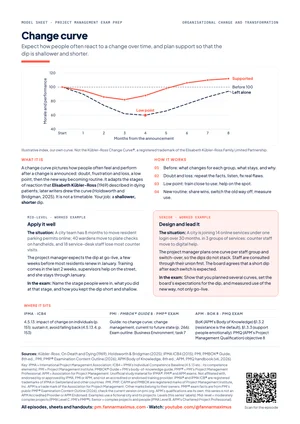
Expect how people often react to a change over time, and plan support so that the dip is shallower and shorter. · Study sheet
- Leading change in steps
Plan the people side of a change in an order that works: make the need felt, move with support, then make the new way last. · Study sheet
Original framework and research sources (4)
- ADKAR®
Explore individual adoption alongside delivery of an organisational change. · Source pointer
- Bridges Transition Model
Explore the personal experience of transition when circumstances change. · Source pointer
- Kotter’s change approach
Consider the leadership and organisational work needed for a substantial change. · Source pointer
- Lewin’s group dynamics and change
Investigate the social forces and conditions that sustain or change behaviour. · Source pointer
Check your understanding
A new process is launched but people keep using the old one. What should you investigate?
Show answer and reasoning
Investigate incentives, practical barriers, capability and local concerns. Define the behaviour needed for the benefit, involve affected people, provide support and measure sustained adoption.
Apply the same reasoning to your own example. State one assumption you would need to check.
Chapters
Jump to the corresponding passage in the transcript.
Study materials
Open the original practice sheet · print or save as PDF
Anki package not yet available.
Key terms
The series’ own explanations. Official sources and edition pointers are below.
- Change management
- Helping people and groups move from today's way of working to a new one, so that the benefits come. Not change control, which guards the approved baselines.
- Change and transformation
- Change improves how things are done today. Transformation is a deeper shift to something new, led by a vision (ICB4, APM). PMI®'s outline speaks of organizational change.
- Organisational culture
- The unwritten rules of how things are done in a group. Schein sees three levels: visible artefacts, stated values, and shared assumptions that nobody questions.
- Resistance
- Holding back from a change, often from fear of losing a skill, status, control or certainty. It can point to a real flaw, so treat it as information.
- Change curve
- A picture of how morale and performance often dip after a change is announced, then recover as people adopt the new way. Adapted from Kübler-Ross's stages of reaction.
- Adoption and benefits realisation
- Adoption is people using the outputs. Realisation turns that use into measured benefits, mostly after handover; APM makes the sponsor accountable for measuring it.
About the lesson’s level labels
Levels (this series' labels): Mid-level = moderately complex projects (IPMA Level C, PMI's PMP®); Senior = complex projects and people (IPMA Level B, APM's Chartered Project Professional).
These are the series’ teaching labels, not a declaration that the certifications are equivalent.
Read the transcript
Timed from the episode captions.
Open episode transcript
Sara: Welcome to Project Management Exam Prep.
This episode is about organisational change and transformation:
helping people use what a project delivers.
Every project management exam tests it, because the benefits depend on it.
Leo: You will learn how the three bodies frame it, why people resist,
how to read a culture, and how to lead a change that lasts.
We finish with a drill, so keep a pen ready.
Sara: Let us start with the three lenses. What does IPMA® say?
Leo: IPMA®, the International Project Management Association, sets out its standard in
the Individual Competence Baseline, the ICB4.
Its element on change and transformation asks you, in our words,
to judge how ready people are, build a change strategy with them,
and make the new behaviour last. A second element asks you to read the culture and
values around the project.
Sara: And PMI®?
Leo: PMI®, the Project Management Institute, publishes the PMBOK® Guide,
its guide to the project management body of knowledge.
The eighth edition says projects create value by moving an organisation to a future
state. The outline of PMI®'s Project Management Professional exam,
the PMP®, has a task to support organizational change.
You assess the culture, and judge how changes in the organisation affect the project.
Sara: And APM?
Leo: APM, the Association for Project Management, publishes the APM Body of Knowledge.
Its section on change covers culture, change management and transformation.
The syllabus of APM's Project Management Qualification, the PMQ,
covers transition management and benefits management.
Sara: Where do the words differ?
Leo: In three places. First, the word change.
In the PMBOK® Guide, a change modifies something under formal control,
such as a baseline, and the people side is change management.
The ICB4 and APM also use change for the organisation.
Sara: Second?
Leo: Transformation. For the ICB4 and APM, it is a deeper shift than change,
led by a vision. PMI®'s outline says only organizational change.
Sara: And third?
Leo: Culture. The ICB4 gives it an element of its own.
PMI® lists it among the enterprise environmental factors, the conditions the team
does not control. APM calls it the unwritten rules that shape behaviour.
Sara: What is the core, whichever exam you take?
Leo: Three ideas. One: a project delivers outputs, but benefits come only when people
work differently. A system nobody uses saves nothing.
So plan the people side from the start: who is affected, how much their work changes,
and how earlier changes went.
Sara: Two?
Leo: Resistance is information. As the ICB4 puts it, "People usually do not object to
change they object to being changed." Ask what people fear to lose:
a skill, status, control or certainty. Their objection may reveal a real flaw.
It often comes from the managers of those affected.
Sara: And three?
Leo: Culture: how things are really done here.
Edgar Schein, a psychologist, sees three levels.
Artefacts are what you can see, such as forms and reports.
Stated values are what people say matters.
Shared assumptions are beliefs that nobody questions.
To read them, watch what gets measured and praised, and how bad news travels.
A change that fights the assumptions stalls.
Sara: Does that change in agile work?
Leo: Yes. A linear project often changes people's work in one step near the end.
Iterative work changes it in small releases that users help shape,
so benefits start earlier. But pace it: too much change too fast causes change fatigue.
Sara: How do people react over time? The first model sheet, free in the description,
shows a change curve.
Leo: The idea goes back to Elisabeth Kübler-Ross, a psychiatrist.
In nineteen sixty-nine, she described stages of reaction in dying patients,
but drew no curve. Later writers turned her stages into curves for change at work.
Ours is our own design. After the announcement, many people doubt that the change
is real. Then come frustration and loss, because the old way was theirs.
Performance falls to a low point. Then people try the new way,
until it becomes routine.
Sara: Can you avoid the dip?
Leo: No, but support makes it shallower and shorter.
On our sheet, a group left alone falls by forty percent.
A supported group falls by less than twenty, and is back above its old level within
six months. Support means honest facts early, training close to use,
and help on the spot. And the stages are not a timetable: people skip them,
or slip back.
Sara: And how do you lead a change?
Leo: Two classic sources, summed up on the second sheet.
Kurt Lewin, a social psychologist, wrote in nineteen forty-seven about unfreezing
the old way, moving, and freezing the new one.
It is often taught as unfreeze, change, refreeze.
Sara: And the second?
Leo: John Kotter's book Leading Change, from nineteen ninety-six, sets out eight steps
in three groups. In our words, four steps loosen the old way.
Make the need felt with facts, form a leading group, give a clear picture of the
future, and tell it often. Three steps bring in the new way.
Remove what blocks people, plan early wins that people can see,
and use their credit to go further, without declaring victory too soon.
The last step makes the new way part of the culture.
Sara: How do you make it last?
Leo: Change what holds the old way in place: roles, procedures, measures and rewards.
Switch the old way off. And name who sustains it after the project:
the benefit owner, the manager who answers for the benefit, keeps measuring use,
and the sponsor holds benefit reviews. Neither model is a recipe,
so watch and adapt.
Sara: How does this change between Mid-level and Senior?
Leo: First, the two levels. They are this series' own labels.
Mid-level means leading moderately complex projects, the level of IPMA® Level C and
PMI®'s PMP® exam. Senior means leading complex projects and people,
the level of IPMA® Level B and of APM's chartered status, Chartered Project Professional.
At Mid-level, you lead the change for the groups your project touches.
Take Parking Permits Online, a city project that moves resident parking permits
online in eight months. The project manager, Anna, maps what changes for eighteen
service-desk staff and forty wardens, who will check licence plates on handheld
devices. The warden supervisors help design the new checks, and one parking zone
tries them first.
Sara: And at Senior level?
Leo: You design change across an organisation, and lead others through it.
Take One City Account, a thirty-month city project that brings fourteen online services
under one login, led by Anna some years later.
Customer-service roles move from counter tasks to digital help,
so the consultation with the staff's union is timed with each wave of services.
The Head of Customer Service co-leads the change with Anna.
And the steering board agrees that a short dip after each switch is expected,
not a failure.
Sara: Now the drill. A city has moved resident parking permits online,
and the project hands over next month. The business case expected seventy percent
of residents to renew online on their own.
After the January renewals, the share is fifty percent.
Service-desk staff kindly fill in the online form for anyone who walks in.
And the desk's monthly report still ranks staff by visitors served.
What do you do?
Leo: Pause and write your answer. You have forty-five seconds.
Sara: First, the gap.
Leo: Seventy minus fifty is twenty points. The city issues about twenty-six thousand
resident permits a year, and twenty percent of that is five thousand two hundred
counter visits, which the business case counted as saved.
Sara: And then?
Leo: Read the culture before you act. The staff are not against the change.
They value personal service, and the report rewards a busy counter.
That report shows an assumption: a good day is a busy day.
So, with the sponsor, ask the desk's manager to count residents helped to renew
on their own, not visitors served. Train the desk staff as digital helpers.
And share early wins.
Sara: What lifts that to Senior?
Leo: Tolerance, ownership and people. Agree a trigger with the sponsor:
for example, below sixty percent at the three-month review, the benefit owner acts.
Name that owner before the project closes.
Keep assisted service for residents who cannot go online, even at some cost to the
saving. Involve the staff; do not blame them.
And add measures and rewards to the city's readiness checks.
Sara: How do the exams ask this?
Leo: IPMA®'s written exam asks for open answers; at Level B it may be oral.
IPMA®'s certification also includes an interview, where assessors ask about your
own projects, so note one change you helped people adopt.
The PMP® exam uses scenarios, and questions built on a case study or a chart.
APM's PMQ asks for short written answers, for example how benefits are realised
after handover.
Sara: Let us recap.
Leo: One. Outputs bring benefits only when people work differently.
Sara: Two. Resistance is information: ask what people fear to lose.
Leo: Three. Read the culture at three levels: artefacts, stated values and shared assumptions.
Sara: Four. Support people through the dip, and lead in steps: loosen,
move with early wins, make it stick.
Leo: And five. Make it last: change measures and rewards, switch the old way off,
and name who measures the benefits.
Sara: The two model sheets and the study handout are linked in the description.
Next time: critical path and resource levelling.
Sources & further reading
Consult the original publications and authoritative references below. For certification requirements, use the current official documents. Edition-specific page references are included only when verified.
- IPMA® (2015). Individual Competence Baseline for Project, Programme and Portfolio Management, Version 4.0 (ICB4). Zurich: International Project Management Association. ISBN 978-94-92338-00-6 (print), 978-94-92338-01-3 (pdf). Free PDF from IPMA®: https://ipma.world/ipma-standards-development-programme/icb4/
- Project Management Institute (2025). A Guide to the Project Management Body of Knowledge (PMBOK® Guide), Eighth Edition, and The Standard for Project Management. Newtown Square, PA: PMI®. ISBN 9781628258295.
- Project Management Institute (2026). Project Management Professional (PMP®)® Examination Content Outline – 2026 (July 2026 exam update). Newtown Square, PA: PMI®. PDF on pmi.org, accessed 26 September 2026.
- Association for Project Management (2025). APM Body of Knowledge, 8th edition. Princes Risborough: APM. ISBN 9781913305390.
- Association for Project Management (2024, version 6 of April 2026). APM Project Management Qualification: Handbook. https://www.apm.org.uk/media/3r4jbodr/apm-project-management-qualification-handbook.pdf, and the PMQ page https://www.apm.org.uk/qualifications-and-training/project-management-qualification/, accessed 26 September 2026.
- Schein, E. H. (2004). Organizational Culture and Leadership, 3rd ed. San Francisco: Jossey-Bass. ISBN 9780787968458.
- Kübler-Ross, E. (1969). On Death and Dying. New York: Macmillan. The Kübler-Ross Change Curve® is a registered trademark of the Elisabeth Kübler-Ross Family Limited Partnership; the change curve in this series is its own design and is not that model.
- Holdsworth, L. & Bridgman, T. (2025). From coping with dying to coping with organizational change: the bricolage of the change curve's evolution. Journal of Organizational Change Management, 38(8), 254–269. https://doi.org/10.1108/JOCM-05-2025-0479
- Lewin, K. (1947). Frontiers in group dynamics: concept, method and reality in social science; social equilibria and social change. Human Relations, 1(1), 5–41. https://doi.org/10.1177/001872674700100103. Reprinted in Lewin, K. (1951), Field Theory in Social Science, ed. D. Cartwright. New York: Harper & Brothers.
- Cummings, S., Bridgman, T. & Brown, K. G. (2016). Unfreezing change as three steps: rethinking Kurt Lewin's legacy for change management. Human Relations, 69(1), 33–60. https://doi.org/10.1177/0018726715577707
- Kotter, J. P. (1996). Leading Change. Boston: Harvard Business School Press. ISBN 9780875847474.
- IPMA® (2025). IPMA® International Certification Regulations (Public), Version 4.4, for the Assessment of Individuals in Project, Program & Portfolio Management. Zurich: International Project Management Association. https://ipma.world/app/uploads/2025/11/IPMA®-ICR-2025_v_4.4_digital.pdf, via https://ipma.world/ipma-certification/ipma-international-certification-regulations/, accessed 26 September 2026.
Original and technical references for the related tools
- GAO: Cost Estimating and Assessment Guide
Standard estimating practice; the cited guide documents use rather than claiming invention.