8 minute read · Original practice exercise included
Before you start: Identify the approved baseline and who may authorise changes.
Watch this lesson
Change control
Watch on YouTubeOpen the planning and control playlist
YouTube connects when you play a video or follow its links. Playback depends on the video’s availability on YouTube. Its own privacy and storage practices then apply. Voices are AI-generated.
Tools and references for this lesson
Use these resources to practise and extend the topic. Further applications may go beyond the lesson transcript; source pointers lead to the original author or publisher.
Calculators (1)
- Adoption rate and change
Separate delivery of a change from actual use by its intended population. · Calculator + guide
Conceptual models (1)
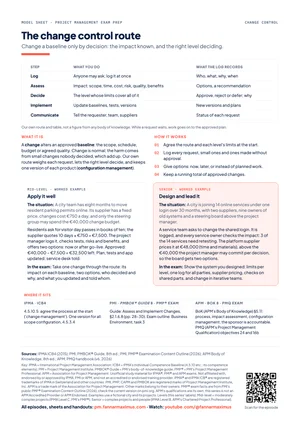
- The change control route
Change a baseline only by decision: the impact known, and the right level deciding. · Study sheet
Original framework and research sources (4)
- ADKAR®
Explore individual adoption alongside delivery of an organisational change. · Source pointer
- Bridges Transition Model
Explore the personal experience of transition when circumstances change. · Source pointer
- Kotter’s change approach
Consider the leadership and organisational work needed for a substantial change. · Source pointer
- Lewin’s group dynamics and change
Investigate the social forces and conditions that sustain or change behaviour. · Source pointer
Check your understanding
A stakeholder asks the team to implement a change before its impact is assessed. What should happen first?
Show answer and reasoning
Record the request, assess effects on scope, time, cost, risk and benefits, and obtain a decision through the agreed authority. Update the baseline only after approval.
Apply the same reasoning to your own example. State one assumption you would need to check.
Chapters
Jump to the corresponding passage in the transcript.
Study materials
Open the original practice sheet · print or save as PDF
Key terms
The series’ own explanations. Official sources and edition pointers are below.
- Change control
- The project process that logs, assesses and decides changes to a baseline. The ICB4 calls it change management; PMI® and APM keep that term for organisational change.
- Baseline
- The approved version of the scope, schedule or budget that progress and changes are measured against. It moves only by a decided change.
- Change log
- The record of every change request, proposed or approved: who asked, the impact, the decision and why, the owner and the status. APM also says change register.
- Change control board
- PMI®: a group that approves, defers or rejects changes and records why. APM makes the sponsor accountable for the decision. Often the steering group plays this role.
- Configuration management
- Keeping one agreed, traceable version of each product: items identified, changes controlled, status reported, audited. The ICB4 says scope configuration.
- Change freeze
- A set period when new change requests wait, for example around go-live or a busy season, so that no new risks are added (APM BoK).
About the lesson’s level labels
Levels (this series' labels): Mid-level = moderately complex projects (IPMA Level C, PMI's PMP®); Senior = complex projects and people (IPMA Level B, APM's Chartered Project Professional).
These are the series’ teaching labels, not a declaration that the certifications are equivalent.
Read the transcript
Timed from the episode captions.
Open episode transcript
Sara: Welcome to Project Management Exam Prep.
This episode is about change control. Every project management exam tests it,
because every project changes, and undecided change costs time and money and puts
benefits at risk.
Leo: You will learn how the three bodies frame it, the route from request to decision,
who decides at which size, how to keep one version of every product,
and how agile teams handle change. We finish with a drill, so keep a pen ready.
Sara: Let us start with the three lenses. What does IPMA® say?
Leo: IPMA®, the International Project Management Association, sets out its standard in
the Individual Competence Baseline, the ICB4.
Change control is part of its plan and control element.
It asks you to agree the change process with stakeholders at the start,
and prefers a process that expects change to one that only reacts.
Sara: And PMI®?
Leo: PMI®, the Project Management Institute, publishes the PMBOK® Guide,
its guide to the project management body of knowledge.
The eighth edition has a process called assess and implement changes.
The outline of PMI®'s Project Management Professional exam, the PMP®,
has a task to manage and control changes, which includes reporting on changes still
waiting for a decision.
Sara: And APM?
Leo: APM, the Association for Project Management, publishes the APM Body of Knowledge.
Its section on change control covers the process, impact assessment and configuration
management. The syllabus of APM's Project Management Qualification,
the PMQ, asks for the stages, what a change request records, and where linear and
iterative work differ.
Sara: Where do the words differ?
Leo: In three places. First, the name. The ICB4 calls this process change management.
PMI® and APM call it change control, and keep change management for organisational
change.
Sara: Second?
Leo: Who decides. PMI® names a designated person, or a change control board.
APM makes the sponsor accountable for the decision.
The ICB4 asks you to agree the decision process with stakeholders.
Sara: And third?
Leo: Keeping one version of the product. The ICB4 says scope configuration.
PMI® and APM say configuration management.
Sara: What is the core, whichever exam you take?
Leo: Three ideas. One: a change is measured against a baseline, the approved version
of the scope, the schedule and the budget.
Before the baselines are set, you are still planning.
Once they are set, every change needs a decision.
Sara: Why does it matter?
Leo: Because small changes add up. Each one looks harmless.
Together they move the date, use up the budget, add risks and tests,
and leave people working from different versions.
Change itself is normal. The aim is change that someone decided,
knowing what it costs.
Sara: Two?
Leo: Who decides depends on the size. Each level decides within the limits delegated
to it, and anything larger goes one level up, with options.
While a request waits, the team keeps working to the approved plan.
Sara: And three?
Leo: In iterative work, the backlog, the ordered list of work still to do,
absorbs most change. A new idea becomes a backlog item, and the product owner,
who orders the backlog, ranks it. PMI® notes that a low rank means deferred,
and leaving it out means rejected. The current timebox, a short fixed period of
work, keeps its goal, so new work usually waits for the next one.
Sara: So no formal control at all?
Leo: Not for the backlog. But the total budget, the contract and the release date sit
above the team, so changing them still needs formal control.
Sara: Now the model. The one-page model sheet, free in the description,
shows the route.
Leo: It is our own route, in five steps. One: log.
Anyone may ask for a change, and it goes into the change log at once:
who asked, what, and why. A change made without approval is logged too,
after the event.
Sara: Two?
Leo: Assess. Weigh the impact on six things: scope, time, cost, risk,
quality and benefits. Then give options with a recommendation:
now, later, or instead of planned work.
Sara: Three?
Leo: Decide, at the level whose limits cover all of it: approve, reject or defer.
The reason goes in the log.
Sara: And then?
Leo: Four: implement and update. Do the work, then update every baseline it touches,
the tests, and the contract if needed. Five: communicate.
Tell the person who asked, the team and the suppliers, and report the status of
every open request.
Sara: Where do versions come in?
Leo: Through configuration management. It keeps one agreed version of each product,
such as a design or a software release.
APM's syllabus names five activities: plan it, identify each item,
control its changes, report its status, and audit the finished item against the
approved version. So nobody builds from an old design.
Sara: And the change log?
Leo: It is the memory of the process: every request, with its impact,
decision, owner and status. Add up the approved changes, and you know how much of
the change budget, the money set aside for changes, is left.
Sara: How does this change between Mid-level and Senior?
Leo: First, the two levels. They are this series' own labels.
Mid-level means leading moderately complex projects, the level of IPMA® Level C and
PMI®'s PMP® exam. Senior means leading complex projects and people,
the level of IPMA® Level B and of APM's chartered status, Chartered Project Professional.
At Mid-level, you run the route well. Take Parking Permits Online,
a city project that moves resident parking permits online in eight months.
The project manager, Anna, keeps one change log for the city team and its supplier,
whose fixed price includes a day rate for changes.
The steering group acts as the change board, because only it can release the change
budget.
Sara: And at Senior level?
Leo: You design the change system for many parties.
Take One City Account, a thirty-month city project that brings fourteen online services
under one login, led by Anna some years later.
Two suppliers and nine owners of old systems share one change process.
Anna decides within the limits the steering board delegated to her.
Teams reorder their own backlogs freely, but a change to a shared part,
such as the login, is checked against every service that uses it.
Sara: Now the drill. A city is moving parking permits online before January,
when most residents renew. The supplier charges seven hundred and fifty euros a
day for changes. Only the steering group releases the change budget,
which has sixteen thousand euros left. The supplier's latest report shows five small
changes to the parking wardens' app, worth twenty-eight extra days.
Warden supervisors asked developers directly; nobody logged them.
Three are built, worth fourteen days. What do you do?
Leo: Pause and write your answer. You have forty-five seconds.
Sara: The numbers?
Leo: At seven hundred and fifty euros a day, every four days cost three thousand.
Twenty-eight days is seven times as much: twenty-one thousand euros.
That is five thousand more than is left.
Sara: Then?
Leo: Tell the supplier in writing that only logged, approved changes are paid.
Log all five, after the event, assess them, and take them to the steering group.
The three built ones are half the days: ten thousand five hundred,
leaving five thousand five hundred. The other two need another ten thousand five
hundred, more than is left, so propose that they wait until after January or replace
planned work. Then update the plan, tests and app version, and tell the supervisors.
Sara: What lifts that to Senior?
Leo: A Senior answer fixes the system. Each change looked too small to report;
together they broke the budget. Set one entry point: requests reach developers only
through the log. Ask the steering group for a small-change limit with a running
total, so they are decided in days. Freeze changes before go-live,
so new requests wait. Treat the requests as a signal that the app misses the wardens'
needs. Involve their supervisors, without blame.
Sara: How do the exams ask this?
Leo: IPMA®'s written exam asks for open answers; at Level B it may be oral.
IPMA®'s certification also includes an interview, where assessors ask about your
own projects, so note one change you controlled.
The PMP® exam uses scenarios, and questions built on a case study or a chart.
APM's PMQ asks for short written answers, such as what a change request records.
Sara: Let us recap.
Leo: One. A change is measured against the baseline.
Small changes add up, so each one needs a decision.
Sara: Two. The route: log, assess the impact, decide, implement and update,
then communicate.
Leo: Three. Each level decides within its delegated limits; larger changes go up.
Sara: Four. Configuration management keeps one version of every product;
the log keeps every request.
Leo: And five. In agile work, the backlog absorbs change.
The budget, the contract and the release date still need formal control.
Sara: The model sheet and the study handout are linked in the description.
Next time: closure, transition and handover.
Sources & further reading
Consult the original publications and authoritative references below. For certification requirements, use the current official documents. Edition-specific page references are included only when verified.
- IPMA® (2015). Individual Competence Baseline for Project, Programme and Portfolio Management, Version 4.0 (ICB4). Zurich: International Project Management Association. ISBN 978-94-92338-00-6 (print), 978-94-92338-01-3 (pdf). Free PDF from IPMA®: https://ipma.world/ipma-standards-development-programme/icb4/
- Project Management Institute (2025). A Guide to the Project Management Body of Knowledge (PMBOK® Guide), Eighth Edition, and The Standard for Project Management. Newtown Square, PA: PMI®. ISBN 9781628258295.
- Project Management Institute (2026). Project Management Professional (PMP®)® Examination Content Outline – 2026 (July 2026 exam update). Newtown Square, PA: PMI®. PDF on pmi.org, accessed 26 September 2026.
- Association for Project Management (2025). APM Body of Knowledge, 8th edition. Princes Risborough: APM. ISBN 9781913305390.
- Association for Project Management (2024, version 6 of April 2026). APM Project Management Qualification: Handbook. https://www.apm.org.uk/media/3r4jbodr/apm-project-management-qualification-handbook.pdf, and the PMQ page https://www.apm.org.uk/qualifications-and-training/project-management-qualification/, accessed 26 September 2026.
- IPMA® (2025). IPMA® International Certification Regulations (Public), Version 4.4, for the Assessment of Individuals in Project, Program & Portfolio Management. Zurich: International Project Management Association. https://ipma.world/app/uploads/2025/11/IPMA®-ICR-2025_v_4.4_digital.pdf, via https://ipma.world/ipma-certification/ipma-international-certification-regulations/, accessed 26 September 2026.
Original and technical references for the related tools
- GAO: Cost Estimating and Assessment Guide
Standard estimating practice; the cited guide documents use rather than claiming invention.